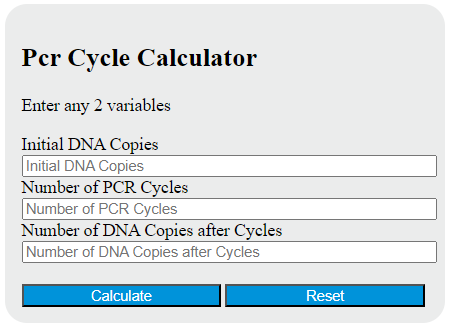
Calculate PCR final copies, starting copies, or required cycles with percent or fold efficiency, rounded-cycle planning, sensitivity, and optional amplicon mass.
Related Calculators
- Fold Change Calculator
- 10 Fold Dilution Calculator
- Transformation Efficiency Calculator
- Bacterial Concentration Calculator
- All Biology Calculators
PCR Cycle Formula
The PCR Cycle Calculator estimates the theoretical number of DNA copies produced after a selected number of amplification cycles. Under ideal conditions, the target sequence doubles during each cycle, so the total copy count grows exponentially rather than linearly.
- C: DNA copies after the selected number of cycles
- I: initial DNA copies
- n: number of PCR cycles
If you know the final copies and want to solve backward, the same relationship can be rearranged to estimate either the required cycle count or the starting template amount.
What a PCR Cycle Means
A PCR cycle is one complete round of:
- Denaturation – the DNA strands separate.
- Annealing – primers bind to the target sequence.
- Extension – polymerase synthesizes new DNA strands.
Repeating these steps drives rapid amplification, which is why even a modest increase in cycle count can create a very large change in copy number.
How to Calculate PCR Copy Number
- Determine the initial number of DNA copies.
- Determine the number of PCR cycles completed.
- Apply the amplification formula.
- Interpret the result as an ideal end-point copy count.
Because the model is exponential, every additional cycle has a larger absolute effect than the one before it.
Example Calculations
If a reaction starts with 25 copies and runs for 12 cycles, the ideal final copy count is:
If you want to estimate how many cycles are needed to increase 100 starting copies to 1,000,000 copies, solve for the cycle count:
Since PCR runs in whole cycles, you would need 14 full cycles to exceed one million copies in the ideal doubling model.
Common Cycle Counts and Ideal Amplification
| Cycles | Ideal Fold Increase | Copies from 1 Starting Template |
|---|---|---|
| 5 | 32× | 32 |
| 10 | 1,024× | 1,024 |
| 15 | 32,768× | 32,768 |
| 20 | 1,048,576× | 1,048,576 |
| 25 | 33,554,432× | 33,554,432 |
| 30 | 1,073,741,824× | 1,073,741,824 |
| 35 | 34,359,738,368× | 34,359,738,368 |
| 40 | 1,099,511,627,776× | 1,099,511,627,776 |
Efficiency Matters in Real PCR
The calculator uses the ideal assumption that amplification doubles every cycle. In practice, real reactions often amplify at less than perfect efficiency due to primer design, template quality, inhibitors, reagent depletion, polymerase performance, and plateau effects during later cycles.
- E represents per-cycle efficiency.
- An efficiency value of 1 corresponds to ideal doubling.
- Lower efficiency produces fewer copies than the simple doubling model predicts.
For quick planning, comparison, and teaching, the ideal model is useful. For experimental interpretation, actual amplification can be lower than the calculated value.
How to Interpret the Output
- The result is a copy number estimate, not DNA mass, concentration, or purity.
- High cycle counts can increase total product, but they can also increase nonspecific amplification and late-cycle plateau behavior.
- This calculator is best for estimating amplification trends, comparing cycle counts, and back-solving for targets.
- If you need concentration, dilution, or primer preparation values, use a dedicated concentration or dilution calculator alongside this one.
Frequently Asked Questions
- Does every PCR cycle exactly double DNA?
- No. Exact doubling is the idealized model. Real-world efficiency usually varies across the run.
- Why does one extra cycle change the result so much?
- PCR amplification is exponential, so each new cycle acts on all copies generated in the previous cycles.
- Can this calculator be used backward?
- Yes. If you know any two of the three variables, you can solve for the remaining one.
- Is this the same as qPCR quantification?
- No. End-point copy estimates are useful for theory and planning, while quantitative PCR relies on fluorescence thresholds and amplification behavior during the run.