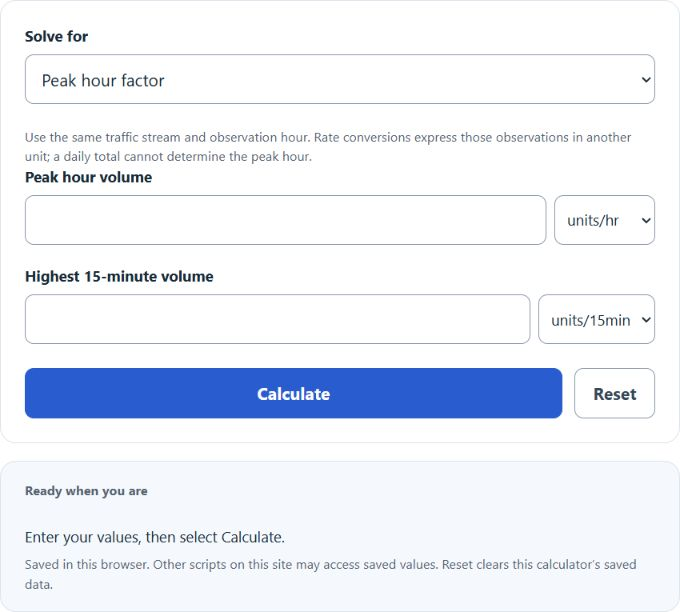
Calculate peak hour factor, peak hour volume, or peak 15-minute volume from any two inputs with unit conversions and selected units.
Related Calculators
- Stopping Sight Distance Calculator
- Compass Rule Adjustment Calculator
- Floor Space Ratio Calculator
- Channel Slope Calculator
- All Construction Calculators
Peak Hour Factor Guide
The peak hour factor (PHF) is a traffic engineering measure that shows how evenly traffic is distributed within the busiest hour of observation. It compares the total volume in the peak hour to the highest 15-minute volume inside that same hour. This matters because two locations can have the same hourly traffic total but perform very differently if one location receives vehicles in sharp bursts while the other receives them more uniformly.
A higher peak hour factor means traffic is spread more evenly across the hour. A lower peak hour factor means demand is concentrated into a shorter period, which usually creates more operational stress, longer queues, and a greater chance of temporary congestion.
Peak Hour Factor Formula
- PHF = peak hour factor
- PHV = peak hour volume in units per hour
- P15 = highest 15-minute volume within that hour in units per 15 minutes
The result is dimensionless, so the units cancel as long as the hourly volume and 15-minute volume come from the same traffic stream and the same observation period.
Rearranged Equations
If you know any two values, you can solve for the third. That is why this calculator can be used in more than one direction.
| Unknown Value | Equation |
|---|---|
| Peak Hour Factor | PHF = PHV / (4 × P15) |
| Peak Hour Volume | PHV = 4 × P15 × PHF |
| Peak 15-Minute Volume | P15 = PHV / (4 × PHF) |
How to Build the Inputs from 15-Minute Counts
If your field data is collected in four 15-minute intervals, first identify the peak hour and then compute the hourly total and the highest quarter-hour inside that same hour.
Here, V1 through V4 are the four consecutive 15-minute volumes that make up the peak hour. The key detail is that the peak 15-minute volume must come from the same hour as the hourly total.
Example Calculation
Suppose the four 15-minute volumes during the busiest hour are 280, 310, 340, and 270 vehicles.
A peak hour factor of 0.882 indicates that traffic is somewhat peaked, not perfectly uniform. The hour contains a noticeable surge, but demand is still distributed across the full 60 minutes rather than being concentrated almost entirely in one 15-minute interval.
How to Interpret the Result
| PHF Tendency | What It Means | Operational Insight |
|---|---|---|
| Closer to 1.00 | Traffic is distributed fairly evenly across the hour. | Average hourly volume is a good representation of actual demand conditions. |
| Mid-range values | Traffic has clear surges but still uses the full hour. | Short-term queues and turning conflicts may be more important than the hourly total alone suggests. |
| Closer to 0.25 | Traffic is highly concentrated into a brief period. | The location may need to be checked carefully for lane storage, signal timing, or access control because short bursts can overwhelm capacity. |
Why Peak Hour Factor Matters
- Capacity analysis: Lower PHF values indicate sharper demand spikes, which can cause congestion even when hourly totals appear manageable.
- Intersection and signal design: Traffic arriving in concentrated bursts affects queue lengths, green time needs, and turning movement performance.
- Access and site planning: Commercial driveways, schools, campuses, event venues, and parking facilities often experience strong peaking that PHF helps describe.
- Comparing locations: PHF provides more context than hourly volume alone, making it easier to compare how stable or bursty traffic flow is from one site to another.
- Multimodal counts: The same concept can be applied to vehicles, bicycles, pedestrians, or people movements as long as the counting periods are consistent.
How to Use This Calculator Correctly
- Determine the peak hour volume for the traffic stream you are studying.
- Find the highest 15-minute volume that occurs within that same peak hour.
- Choose the value to solve for and enter the two known values, or use four consecutive 15-minute counts.
- Calculate the missing value and interpret whether traffic is uniform or sharply peaked.
Common Mistakes to Avoid
- Using the highest 15-minute volume from a different hour than the one used for the hourly total.
- Entering mismatched units, such as comparing an hourly count to a daily count.
- Using the average 15-minute volume instead of the highest 15-minute volume.
- Mixing different traffic movements, directions, or count locations in the same calculation.
- Rounding too early, which can slightly distort the final PHF value.
Practical Notes
The peak hour factor is most helpful when you want to describe the intensity of short-term traffic surges inside a busy hour. A location with a lower PHF often needs more careful attention because peak demand is arriving less evenly, which can increase queue buildup and reduce operating efficiency. For planning, design, and traffic operations, PHF adds important context that a simple hourly total cannot provide by itself.