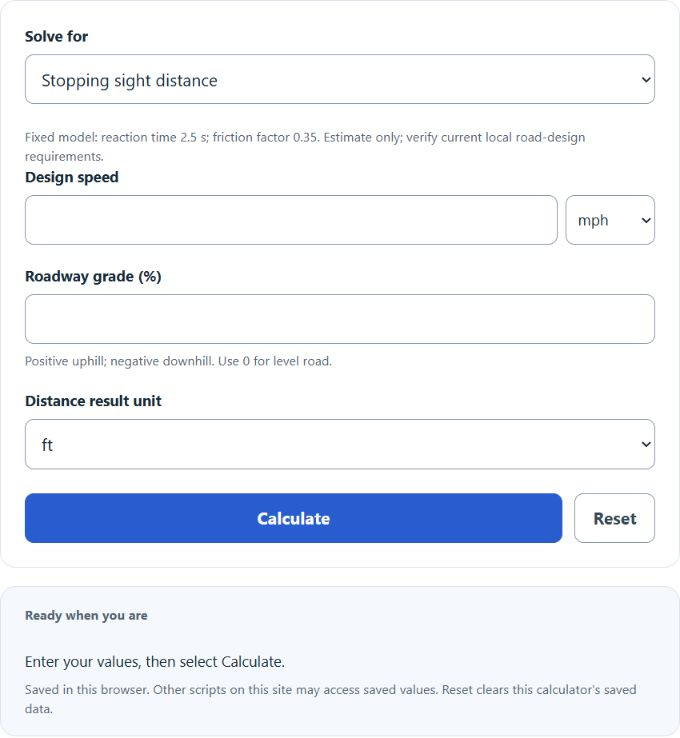
Choose stopping sight distance, design speed, or roadway grade, then enter the known values using mph or km/h and ft or m. This fixed-parameter estimate does not establish roadway design compliance.
- All Construction Calculators
- Stopping Distance Calculator
- Reaction Distance Calculator
- Line of Sight Calculator
- Velocity Calculator
- Deceleration Calculator
Stopping Sight Distance Formula
The stopping sight distance calculation uses design speed, roadway grade, driver reaction time, and braking friction. This calculator uses base units of miles per hour and feet, with a reaction time of 2.5 seconds and a friction factor of 0.35.
- SSD = stopping sight distance, in feet
- V = design speed, in miles per hour
- t = reaction time, in seconds. This calculator uses 2.5 seconds.
- f = friction factor. This calculator uses 0.35.
- G = roadway grade as a signed decimal, where +0.06 means a 6% upgrade and -0.06 means a 6% downgrade
To calculate stopping sight distance, the calculator adds reaction distance and braking distance. Reaction distance is the distance traveled before braking begins. Braking distance is the distance needed to stop after braking starts.
When roadway grade is selected, the calculator rearranges the stopping sight distance formula and returns grade as a signed percent.
When design speed is selected, the calculator solves the stopping sight distance equation as a quadratic equation. The positive speed solution is used.
Typical Stopping Sight Distance Values
The values below use level grade, 2.5 seconds of reaction time, and a friction factor of 0.35.
| Design Speed | Stopping Sight Distance | Stopping Sight Distance |
|---|---|---|
| 20 mph | 112 ft | 34.0 m |
| 30 mph | 196 ft | 59.7 m |
| 40 mph | 299 ft | 91.3 m |
| 50 mph | 422 ft | 128.6 m |
| 60 mph | 563 ft | 171.7 m |
| 70 mph | 724 ft | 220.6 m |
Grade changes the braking portion of stopping sight distance. Uphill grades reduce the required distance, while downhill grades increase it.
| Grade at 60 mph | Meaning | Calculated SSD |
|---|---|---|
| +6% | Upgrade | 513 ft |
| 0% | Level road | 563 ft |
| -6% | Downgrade | 634 ft |
| -10% | Steep downgrade | 701 ft |
Example Problems
Example 1: Calculate stopping sight distance
Find the stopping sight distance for a design speed of 55 mph on a -4% downgrade.
The stopping sight distance is 527.3938 ft.
Example 2: Calculate grade
Find the grade if the design speed is 60 mph and the stopping sight distance is 600 ft.
The grade is -3.3794%, which means a downgrade.
FAQ
What does a negative grade mean?
A negative grade means the vehicle is traveling downhill. For example, -5% means the road drops 5 feet vertically for every 100 feet horizontally. A downhill grade increases stopping sight distance because gravity works against braking.
Why must the stopping sight distance be greater than the reaction distance when solving for grade?
The total stopping sight distance includes reaction distance plus braking distance. If the entered stopping sight distance is less than or equal to the reaction distance, there is no remaining distance for braking. In that case, the grade calculation is not physically valid.
Why might this result differ from a roadway design table?
Design tables may use rounded values, speed-dependent friction factors, or agency-specific assumptions. This calculator uses a fixed reaction time of 2.5 seconds and a fixed friction factor of 0.35, so its results follow the formula shown above rather than a rounded design table. Current design methods may use a specified deceleration rate and local agency requirements; verify those requirements independently.