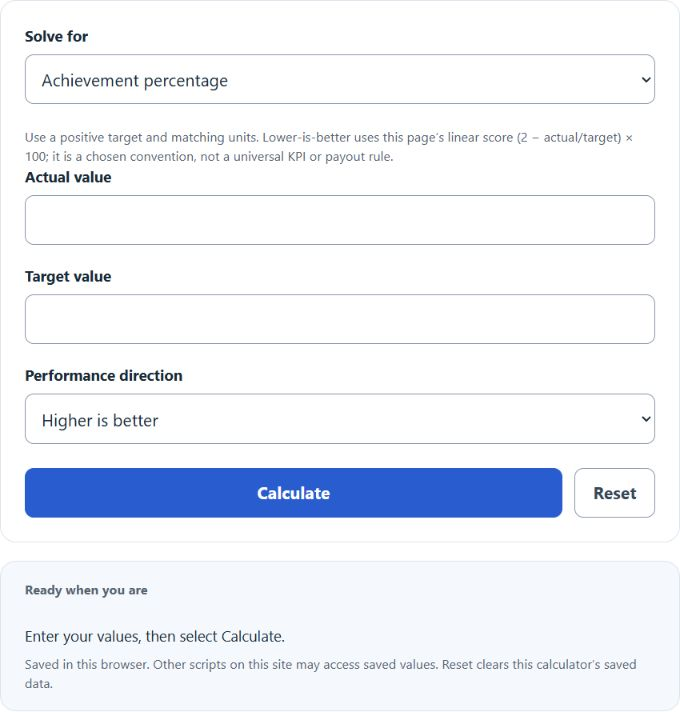
Calculate percentage achievement from actual and target values, or compare multiple goals with average, highest, and lowest results.
Related Calculators
- Percentage Calculator
- Completion Percentage Calculator
- Quota Attainment Calculator
- Attainment Percentage Calculator
- Progress Percentage Calculator
- Grade Point to Percentage Calculator
- All Math and Numbers Calculators
Watch the full explanation and transcript.
Percentage Achievement Formula
The following formula calculates the percentage of a target achieved.
- Percentage: the achievement rate (%)
- Actual: the measured or realized value
- Target: the goal or benchmark set in advance
This formula assumes higher actual values represent better performance (sales, output, revenue). For metrics where lower is better, such as cost, defects, or response time, see the adjusted formula below.
Achievement Rate Benchmarks
What counts as a good achievement rate depends on the target and the organization’s policy. The ranges below are illustrative display bands used by this page, not independently established industry standards. A higher-is-better result below 100% has not fully met the target.
| Achievement Rate | Classification | Typical Response |
|---|---|---|
| Below 50% | Critical underperformance | Immediate root cause review |
| 50% to below 70% | Below threshold | Corrective action plan |
| 70% to below 90% | Partial attainment | Coaching and gap analysis |
| 90% to 110% | On-target | Near target; full attainment begins at 100% |
| Above 110% | Exceeds target | Review applicable plan or stretch goal |
Quota attainment and commission thresholds vary by role, organization, period and compensation plan. Use the applicable plan’s actual thresholds; the illustrative bands above do not establish commission eligibility.
When Lower Is Better: Adjusted Formula
For metrics where lower actual values are preferred, such as costs or defects, actual/target remains a valid ratio but higher percentages do not indicate better performance. This page offers the following linear scoring convention; other organizations may use different definitions.
Example: cost target of $100,000, actual spend of $80,000. Actual/target is 80%, meaning spending is 20% below target. This page’s adjusted score is (2 − 0.80) × 100 = 120%. The score can be negative or exceed 200%; it is not the percentage of a reduction goal achieved without an initial baseline.
What is Percentage Achievement?
Percentage achievement quantifies how much of a defined target was completed within a specific period. It is used across sales quota tracking, project milestone reporting, manufacturing output measurement, academic grading, and budget variance analysis. The same ratio applies in every case: divide what was achieved by what was intended and express the result as a percentage. A result of 100% means the goal was exactly met. Below 100% is a shortfall; above 100% means the target was surpassed, which is generally positive but may also signal the target was set too conservatively.
How to Calculate Percentage Achievement
The following steps outline how to calculate percentage achievement.
- Identify the target value established before the measurement period begins.
- Measure the actual value achieved at the close of the period.
- Divide the actual value by the target value.
- Multiply by 100 to express the result as a percentage.
- Check your result with the calculator above.
Example Problem:
Target Value = 200 units
Actual Value = 150 units
Percentage Achievement = (150 / 200) x 100 = 75%
A result of 75% falls in this page’s illustrative partial attainment band. A plan that explicitly requires at least 80% attainment for a payout would place this result below that threshold; actual payout depends on the plan’s other terms.