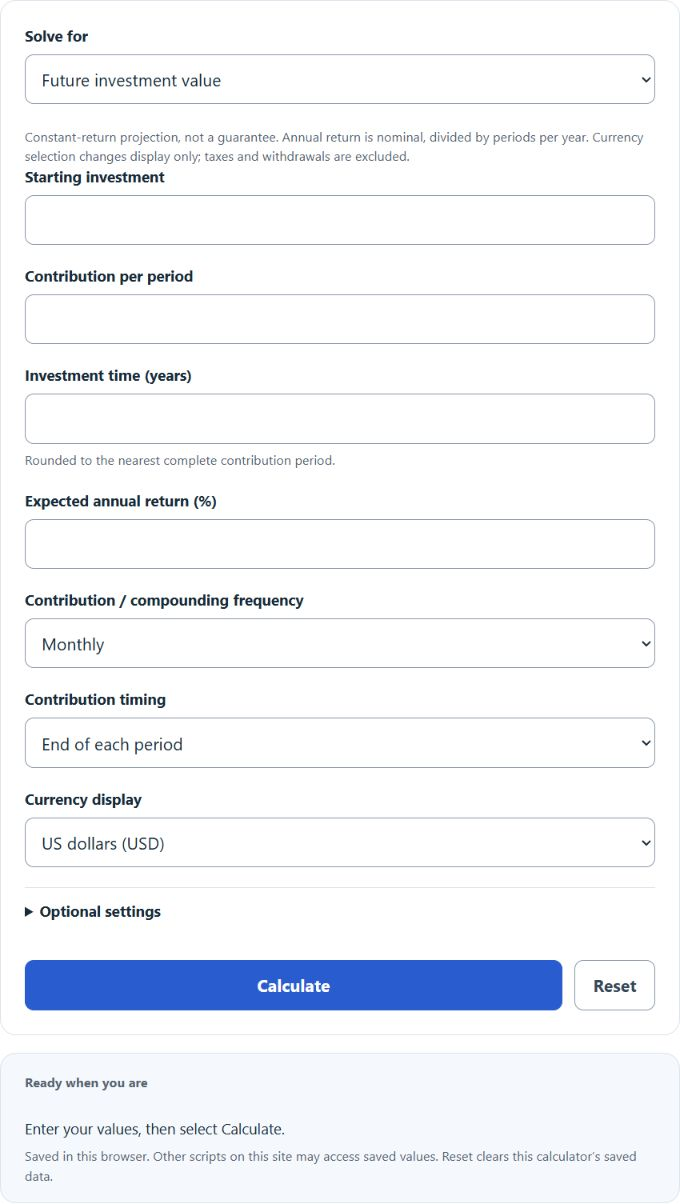
Project investment growth with recurring contributions, fees, inflation, and contribution timing, or solve the contribution or time needed to reach a target balance.
Investment Calculator Formula
For a fixed monthly contribution and a fixed periodic return, the future value of an investment can be estimated by adding the compounded value of the starting investment to the compounded value of recurring contributions:
- Where FV is the projected future value of the investment ($)
- P is the initial investment amount ($)
- PMT is the recurring contribution made at the end of each period ($)
- r is the estimated return per contribution period, expressed as a decimal
- n is the total number of contribution periods
When contributions are made at the beginning of each month, the compounded value of the contribution portion is multiplied by (1 + r). This calculator supports monthly, quarterly or annual fixed contributions, a simplified annual fee drag, and an inflation-adjusted purchasing-power view. It does not model annual contribution increases.
What is an Investment Calculator?
Definition:
An investment calculator is a planning tool used to estimate how a starting balance and ongoing contributions could grow over time under an assumed rate of return. It helps compare the impact of time, contributions, compounding, fees, and inflation on a long-term investment projection.
How to Calculate Investment Growth?
Example Problem:
Suppose an investor begins with $10,000, contributes $500 at the end of every month, invests for 30 years, and estimates a 7% annual return compounded monthly.
First, convert the estimated annual return to a monthly rate:
Next, determine the number of monthly investment periods:
Finally, insert the values into the future value equation:
Using these assumptions, the projected balance is approximately $691,150.47 after 30 years. The investor contributes $190,000 in total, and the remaining projected value comes from assumed compound growth. Actual investment returns can vary significantly and may be lower or higher than the estimate.
How Fees and Inflation Affect Investment Projections
Annual investment fees reduce the return left to compound over time. For example, a projected 7% annual return with a 0.25% annual fee is modeled as a 6.75% annual return after fees. Inflation does not reduce the account balance directly, but it can reduce purchasing power; the inflation-adjusted result estimates what the ending balance may be worth in today’s dollars.
FAQ
What return rate should I enter in an investment calculator?
Enter an estimated annual return that fits the type of projection you want to evaluate, then compare the displayed scenarios at two percentage points below and above the entered net annual rate. A projection is not a guarantee of future investment performance.
Does this investment calculator account for fees?
Yes. The optional annual fee field reduces the estimated annual return used in the calculation and shows the estimated difference between the projected ending balance with fees and the projected balance without that fee assumption.
Why does the calculator show an inflation-adjusted balance?
Inflation-adjusted value estimates future purchasing power in today’s dollars. Even when an account balance increases, rising prices can mean that the ending amount buys less than the same dollar amount would buy today.
Are contributions added at the beginning or end of each month?
You can select either option. Contributions invested at the beginning of each month are assumed to receive one additional month of growth compared with contributions made at the end of each month.
Can this calculator predict actual investment returns?
No. This calculator uses constant assumptions to create an educational projection. Actual results may vary due to market performance, asset allocation, taxes, trading costs, withdrawals, and changing contribution amounts.