Calculate battery discharge time or find Peukert's exponent from rated capacity, reference time, current draw, and observed runtime.
- All Physics Calculators
- Current Limiter Resistor Calculator
- Ah To Hours Calculator
- Discharge Calculator
Peukert’s Law Formula
Peukert’s Law estimates battery discharge time by adjusting for the fact that many batteries deliver less usable capacity as discharge current increases. This is especially useful when a battery is rated at a specific hour-rate, such as “100 Ah at the 20-hour rate,” and the real load is different from that rating condition.
| Symbol | Meaning |
|---|---|
| T | Estimated discharge time |
| Cr | Rated battery capacity at the stated reference discharge time |
| tr | Reference discharge time used for the published rating |
| I | Actual discharge current drawn by the load |
| k | Peukert exponent, which describes how strongly capacity falls as current rises |
How to Interpret the Equation
The rated capacity printed on a battery is not a fixed amount available at every current. It is tied to a test duration. A battery labeled at a long discharge rate usually delivers less total usable capacity when discharged faster. Peukert’s Law accounts for that nonlinearity.
If the exponent equals exactly 1, the battery behaves ideally and the estimate reduces to the familiar capacity-divided-by-current relationship:
When the exponent is greater than 1, heavier current draw causes runtime to shrink faster than the ideal estimate. The farther the exponent is above 1, the more sensitive the battery is to high-rate discharge.
Why the Reference Time Matters
The reference time is not optional. It defines the condition under which the published capacity was measured. The corresponding rating current is:
For example, a 100 Ah battery rated at 20 hours has a rating current of 5 A. If the real load is much higher than 5 A, the actual runtime will usually be lower than a simple ideal estimate suggests.
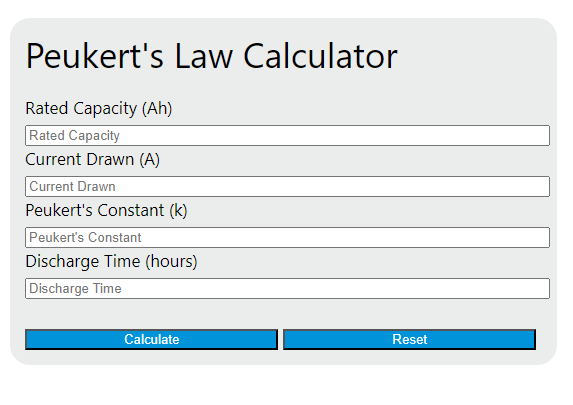
How to Use the Peukert’s Law Calculator
- Enter the battery’s rated capacity exactly as specified by the manufacturer.
- Enter the reference discharge time attached to that rating, such as 20 hours for a 20-hour rating.
- Enter the actual current draw from the load or system.
- Enter the Peukert exponent for the battery, preferably from the datasheet or measured test data.
- Read the calculated discharge time as the estimated runtime at that load.
The calculator supports convenient unit entry, but the underlying math still depends on consistent capacity, current, and time relationships.
Example
Assume a battery is rated at 100 Ah at the 20-hour rate, the load current is 10 A, and the Peukert exponent is 1.2.
The estimated discharge time is about 8 hours 43 minutes. An ideal battery would suggest 10 hours, so the Peukert adjustment shows the runtime penalty caused by the higher discharge rate.
Useful Derived Quantity
Once runtime is known, the effective delivered capacity at that load can be estimated as:
This helps compare the battery’s nameplate capacity with the capacity that is actually usable under the real current draw.
Practical Effects of Each Input
| Change | Effect on Runtime |
|---|---|
| Higher current draw | Runtime decreases, often faster than linearly when the exponent is above 1 |
| Larger rated capacity | Runtime increases |
| Exponent closer to 1 | Battery retains capacity better under heavier discharge |
| Exponent farther above 1 | Battery is more sensitive to high-current loads |
| Load near the rating current | Actual runtime tends to stay closer to the published capacity expectation |
When This Calculator Is Most Useful
- Estimating runtime for lead-acid battery systems under steady loads
- Comparing candidate batteries for backup power or off-grid storage
- Checking whether a load current is too aggressive for a given hour-rate rating
- Planning battery bank size when published capacity alone is too optimistic
Important Limitations
- Peukert’s Law is an approximation, not a full battery model.
- Temperature, battery age, state of charge, internal resistance, and cutoff voltage can all reduce real-world runtime.
- Very high pulse loads or rapidly changing loads may not match a constant-current estimate well.
- The method is most commonly applied to lead-acid batteries; some other chemistries may follow different discharge behavior.
- System-level limits such as inverter shutdown, low-voltage cutoffs, or battery management settings can end usable runtime before the theoretical discharge point.
Common Input Mistakes
- Using a capacity value without the matching reference hour-rate
- Entering the wrong discharge current, especially when startup or surge current differs from average current
- Using a guessed exponent when manufacturer data is available
- Assuming the label capacity applies equally at every discharge rate
- Interpreting calculated runtime as exact field performance instead of a planning estimate
Rearranged Forms
If you know the target runtime and need the required rated capacity, the equation can be rearranged to:
If you know the battery rating and want the average current that corresponds to a target runtime, use:
These forms are useful for battery sizing, runtime planning, and checking whether a proposed load is realistic for the battery’s published rating.