Calculate phase angle for ideal series RL, RC and RLC circuits from components or reactance magnitudes, or convert frequency and signed time delay to phase. Circuit modes also report impedance and displacement power factor.
- All Physics Calculators
- Transformer Calculator
- Phase Difference Calculator
- Reactive Power Calculator
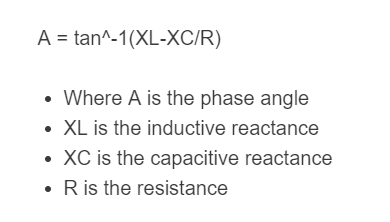
Phase Angle Formula
The following equation can be used to calculate the phase angle between voltage and current in a series RLC circuit (with series RL and RC circuits as special cases).
- Where φ is the voltage–current phase angle; positive means current lags voltage and negative means current leads
- XL is the nonnegative inductive reactance magnitude in ohms
- XC is the nonnegative capacitive reactance magnitude in ohms
- R is the nonnegative resistance in ohms
Use atan2(XL − XC, R). For R > 0, this equals atan((XL − XC)/R). At R = 0 and nonzero net reactance, the angle is +90° for inductive or −90° for capacitive reactance. When R and net reactance are both zero, impedance is zero and phase angle and power factor are undefined. The impedance magnitude is hypot(R, XL − XC), and displacement power factor is R/|Z|. See OpenStax’s series RLC model.
Phase Angle Definition
A phase angle is the amount by which one sinusoidal waveform (such as voltage) leads or lags another (such as current) in an AC circuit. This term is used widely in AC circuit analysis and signal processing.
In component mode, XL = 2πfL and XC = 1/(2πfC), using hertz, henries and farads. A blank or 0 component omits that element from the model; 0 capacitance is an omission control, not a physical 0 F series capacitor.
For same-frequency waveforms, unwrapped phase in degrees is 360fΔt. Positive Δt means current occurs later than reference voltage. The calculator displays the equivalent angle in [−180°, 180°) and retains unwrapped degrees, radians and cycle count; the wrapped sign can differ for delays longer than half a cycle. Delay is limited to ±1,000,000 cycles for numerical precision and does not determine impedance or power factor. See Tektronix’s time-to-phase relationship.
Phase Angle Example
How to calculate a phase angle?
The following example problem outlines the necessary steps in calculating the phase angle of an electrical circuit.
The first step is to determine the inductive reactance through measurement or calculation.
For this example, the inductive reactance is found to be 50 ohms.
Next, determine the capacitive reactance of the same circuit.
In this case, the capacitive reactance is found to be 25 ohms.
Next, determine the total resistance of the circuit.
For this problem, the total resistance is 10 ohms.
Finally, calculate the phase angle using the formula above:
φ = atan2(XL − XC, R)
φ = atan2(50 − 25, 10)
φ ≈ 68.20 degrees: current lags voltage.
FAQ
A phase angle is the phase difference between voltage and current (or between two waveforms) in an AC circuit, expressed in degrees or radians.