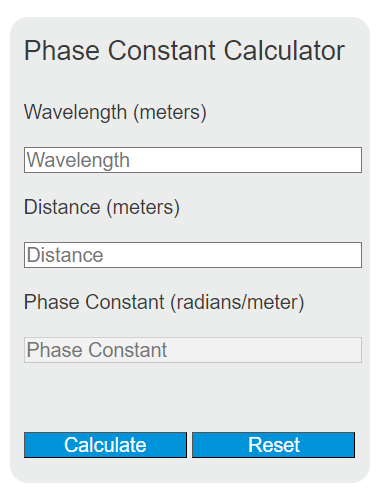
Calculate phase change, wavelength, or distance from any two values, and find phase constant β and wavelength from frequency and material.
- All Physics Calculators
- Phase Noise To Jitter Calculator
- Amps Per Phase Calculator
- Current Per Phase Calculator
Phase Change / Phase Constant Formulas
The following formulas are used for a sinusoidal wave:
Variables:
- β is the phase constant (wavenumber) (rad/m)
- Δφ is the phase change (phase shift) over distance d (radians)
- λ is the wavelength of the wave (meters)
- d is the distance traveled (meters)
To calculate the phase change over a distance, compute β = 2π/λ and then multiply by the distance traveled: Δφ = βd.
What is a Phase Constant?
The phase constant (often written as β or k) is the rate at which a wave’s phase changes with position. For a lossless, single-frequency wave, it is related to wavelength by β = 2π/λ and has units of rad/m. The total phase change (phase shift) after traveling a distance d is Δφ = βd in radians.
How to Calculate Phase Change (Phase Shift)?
The following steps outline how to calculate the phase change of a wave over a distance:
- First, determine the wavelength (λ) of the wave in meters.
- Next, determine the distance (d) the wave has traveled in meters.
- Use the formula Δφ = (2π / λ) · d to calculate the phase change (Δφ).
- Finally, report the phase change (Δφ) in radians (or convert to degrees if needed).
- After inserting the variables and calculating the result, check your answer with the calculator above.
Example Problem :
Use the following variables as an example problem to test your knowledge.
wavelength (λ) = 0.5 meters
distance (d) = 2 meters
Phase change: Δφ = (2π/0.5)·2 = 8π ≈ 25.133 radians (which is equivalent to 1440°).