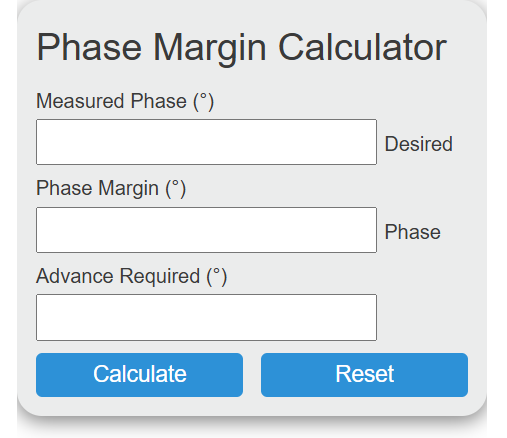
Calculate phase advance required, desired phase margin, or measured phase from two known values in degrees for control system analysis.
Related Calculators
- Delay Time Calculator
- Buck Converter Calculator
- Impedance to Voltage Calculator
- AC ↔ DC Voltage Calculator
- All Physics Calculators
Phase Margin Formula
The following equation is used to calculate the missing phase parameter.
- Where DPM is the Desired Phase Margin (°)
- MP is the Measured Phase (°)
- PA is the Phase Advance Required (°)
To calculate the missing value, rearrange the equation above so that the unknown variable is isolated.
What is Phase Margin?
Definition:
Phase margin is a measure of system stability in control systems. It represents the additional phase lag required to reach the critical -180° point, ensuring the system remains stable.
How to Calculate Phase Margin?
Example Problem:
The following example outlines the steps and information needed to calculate the phase advance required.
First, determine the measured phase. In this example, the measured phase is -200°.
Next, determine the desired phase margin. In this example, the desired phase margin is 20°.
Finally, calculate the phase advance required using the formula above:
DPM = MP + PA + 180
20 = (-200) + PA + 180
20 = -20 + PA
PA = 40°
FAQ
What is phase margin and why is it important?
Phase margin is a key indicator of system stability. It measures how much additional phase lag is required before a system reaches instability, helping engineers design safer and more reliable systems.
How can the phase margin of a system be improved?
Improving phase margin typically involves techniques such as adding compensators, adjusting gain, or redesigning filter networks. These strategies can help shift the phase response to ensure the system remains stable.
What are typical phase margin values for ensuring system stability?
Generally, a phase margin between 30° and 60° is considered acceptable for stability in most systems, though the optimal value may vary based on specific design requirements.