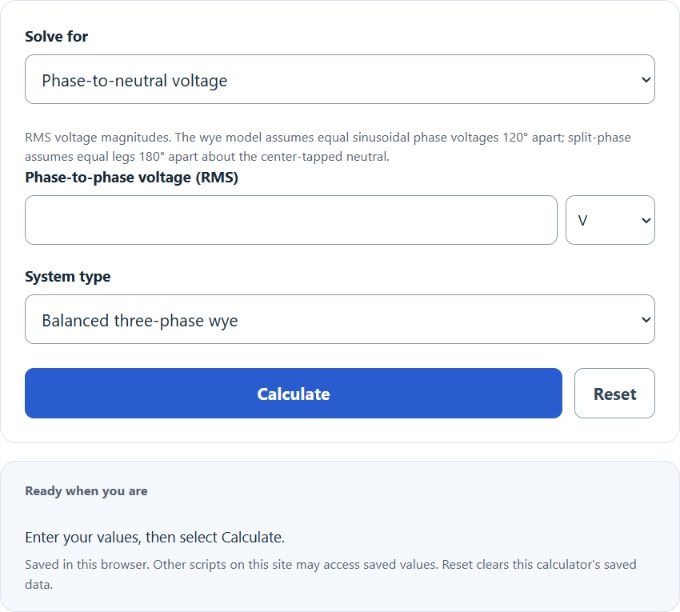
Convert phase-to-phase and phase-to-neutral voltage for balanced three-phase wye or split-phase systems, with V, kV, and mV units.
- All Physics Calculators
- Electricity, Magnetism, & Electronics Unit Converters
- Phase To Phase Voltage Calculator
- Phase to Ground Voltage Calculator
Phase to Neutral Voltage Formula
For equal sinusoidal phase voltages in a balanced three-phase wye system, the following RMS magnitude relationship applies. For equal center-tapped single-phase split-phase legs, use V_n = V_p / 2 instead.
Variables:
- V_n is the phase to neutral voltage
- V_p is the phase to phase voltage
- (sqrt{3}) is approximately 1.732
Select the system type and solve mode. For balanced three-phase wye, divide phase-to-phase voltage by the full square root of 3; multiply by √3 for the reverse conversion. For equal split-phase legs, divide or multiply by 2. This does not determine delta, unbalanced, floating-neutral or faulted voltages.
| Phase to Phase Voltage (Vpp) | Phase to Neutral Voltage (Vpn) |
|---|---|
| 208 V | 120.089 V |
| 220 V | 127.017 V |
| 230 V | 132.791 V |
| 240 V | 138.564 V |
| 380 V | 219.393 V |
| 400 V | 230.940 V |
| 415 V | 239.600 V |
| 440 V | 254.034 V |
| 460 V | 265.581 V |
| 480 V | 277.128 V |
| 575 V | 331.976 V |
| 600 V | 346.410 V |
| 690 V | 398.372 V |
| 3300 V | 1905.256 V |
| 4160 V | 2401.777 V |
| 6600 V | 3810.512 V |
| 11000 V | 6350.853 V |
| 12470 V | 7199.558 V |
| 13800 V | 7967.434 V |
| 33000 V | 19052.559 V |
| *Balanced three-phase wye: Vpn = Vpp ÷ √3. Values use the full √3 and are rounded to 0.001 V; split-phase is not represented by this table. | |
What is Phase to Neutral Voltage?
Phase to neutral voltage, also known as line to neutral voltage, is the voltage measured between any one of the phase conductors and the neutral conductor in a three-phase electrical system. This voltage is typically lower than the phase to phase voltage, which is the voltage measured between any two of the phase conductors. The phase to neutral voltage is important in the design and operation of electrical systems, as it determines the voltage levels for single-phase loads connected to the system. Understanding the relationship between phase to phase voltage and phase to neutral voltage is crucial for ensuring the proper functioning and safety of electrical equipment.
How to Calculate Phase to Neutral Voltage?
The following steps outline how to calculate the Phase to Neutral Voltage.
- First, determine the phase to phase voltage (V_p).
- Next, select the system: V_n = V_p / √3 for balanced three-phase wye or V_n = V_p / 2 for equal split-phase legs.
- Finally, calculate the phase to neutral voltage.
- After inserting the values and calculating the result, check your answer with the calculator above.
Example Problem :
Use the following variables as an example problem to test your knowledge.
Phase to phase voltage (V_p) = 400V
For the balanced three-phase wye example, V_n = 400 / √3 ≈ 230.940108 V. The factor √3 ≈ 1.732051 is displayed rounded and is used at full precision in the calculation.