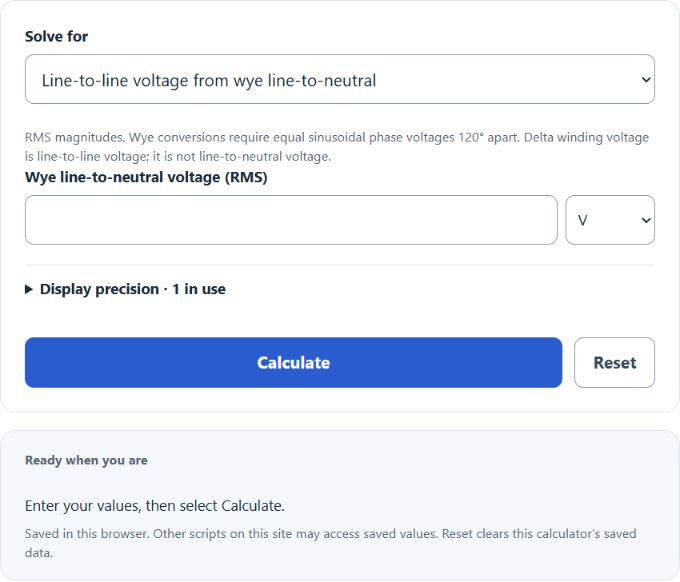
Convert RMS line-to-line and line-to-neutral voltage for balanced three-phase wye, or line-to-line and winding voltage for delta. V, kV and mV units convert the entered quantity. Delta winding voltage is not line-to-neutral voltage.
- All Physics Calculators
- Electricity, Magnetism, & Electronics Unit Converters
- Line To Ground Voltage Calculator
- Line to Phase Voltage Calculator
Phase To Phase Voltage Formula
The following RMS magnitude formula applies to equal sinusoidal phase voltages separated by 120° in a balanced three-phase wye system.
Variables:
- Vpp is the phase to phase voltage (volts)
- Vln is the line to neutral voltage (volts)
To calculate the phase to phase voltage, multiply the line to neutral voltage by the square root of 3 (approximately 1.732051).
| VLN (V) | VLL (V) |
|---|---|
| 12 | 20.785 |
| 24 | 41.569 |
| 36 | 62.354 |
| 48 | 83.138 |
| 60 | 103.923 |
| 100 | 173.205 |
| 110 | 190.526 |
| 115 | 199.186 |
| 120 | 207.846 |
| 127 | 219.911 |
| 190 | 329.090 |
| 200 | 346.410 |
| 220 | 381.051 |
| 230 | 398.372 |
| 240 | 415.692 |
| 254 | 439.941 |
| 277 | 479.778 |
| 346.410 | 600.000 |
| 347 | 601.022 |
| 400 | 692.820 |
| Balanced wye RMS magnitudes, rounded to 3 decimals. VLL = √3 × VLN using the full square root of 3. | |
What is Phase To Phase Voltage?
Phase to phase voltage, also called line to line voltage (VLL), is the electrical potential measured between any two of the three live conductors in a three-phase power system. In a balanced three-phase supply, three conductors each carry alternating current at the same frequency and amplitude, but offset by 120 degrees of phase angle from one another. For a balanced wye system, this 120-degree displacement is why line-to-line voltage is √3 times line-to-neutral voltage. Unbalanced or floating-neutral voltages cannot be determined from one scalar value.
The square root of 3 factor (1.732051) is not an arbitrary constant. It arises from vector addition of two phase voltages separated by 120 degrees. When you measure between two lines, you are measuring the vector difference of their respective phase voltages. Because the angle between any two phase vectors is 120 degrees, the magnitude of their difference works out to exactly the square root of 3 times the magnitude of either individual phase voltage. This is a direct result of the cosine rule applied to two equal-length vectors at 120 degrees.
Wye (Star) vs. Delta Voltage Relationships
How phase to phase voltage relates to individual winding voltages depends entirely on how the source or load is connected. The two standard three-phase configurations are wye (also called star or Y) and delta.
In a wye connection, one terminal of each winding connects to a shared neutral point. The voltage across each winding is the line to neutral voltage (VLN). The line to line voltage measured between any two outer terminals equals the square root of 3 times VLN. Line current equals the phase current through each winding. This configuration provides access to a neutral conductor, allowing both single-phase (line to neutral) and three-phase (line to line) loads to be served from the same system.
In a delta connection, each winding connects end to end in a closed triangle. The voltage across each winding equals the line to line voltage directly, with no multiplication factor. For balanced delta currents, line current is √3 times winding current. A plain delta has no common star-point neutral, but single-phase line-to-line loads are possible; a suitably center-tapped delta can also supply certain line-to-neutral loads. The calculator’s delta modes convert winding and line-to-line voltages only.
| Property | Wye (Star) | Delta |
|---|---|---|
| Line Voltage (VLL) | √3 × Wye Phase Voltage | = Phase Voltage |
| Line Current (IL) | = Phase Current | √3 × Balanced Phase Current |
| Neutral Available | Star point; conductor depends on wiring | No star point; center tap is a separate arrangement |
| Single-Phase Loads | Line to neutral when provided | Line to line; center-tap loads depend on design |
| Common Use | Distribution, mixed loads | Motors, industrial loads |
Standard Three-Phase Voltage Systems Worldwide
Three-phase voltage standards vary by region and application. The IEC 60038 standard harmonized nominal voltages internationally, replacing the older 220/380 V and 240/415 V standards with 230/400 V. In practice, legacy systems and regional variations still exist. Below are the most common three-phase voltage systems in use, expressed as line-to-neutral / line-to-line pairs.
| VLN (V) | VLL (V) | Frequency | Typical Region / Application |
|---|---|---|---|
| 120 | 208 | 60 Hz | North America, commercial buildings |
| 127 | 220 | 60 Hz | Brazil, Mexico (older systems) |
| 220 | 380 | 50 Hz | China, Southeast Asia, legacy European |
| 230 | 400 | 50 Hz | IEC standard, Europe, UK, Australia, Africa, Asia |
| 240 | 415 | 50 Hz | Australia (legacy), Southeast Asia |
| 277 | 480 | 60 Hz | North America, industrial distribution |
| 347 | 600 | 60 Hz | Canada, industrial power systems |
| 2,400 | 4,160 | 60 Hz | North America, medium-voltage distribution |
| 7,200 | 12,470 | 60 Hz | North America, utility primary distribution |
| 7,620 | 13,200 | 60 Hz | North America, utility primary distribution |
| Rounded nominal reference pairs, not exact inverse conversions. Applicable supply tolerances depend on the local standard, voltage level, service conditions and equipment. | |||
Voltage Imbalance in Three-Phase Systems
In real-world installations, the three phase to phase voltages are rarely perfectly equal. Voltage imbalance occurs when the magnitudes of the three line to line voltages differ. The NEMA MG1 standard defines voltage unbalance percentage as 100 times the maximum deviation of any line to line voltage from the average, divided by that average.
Even small voltage imbalances produce disproportionately large current imbalances in three-phase motors. The U.S. Department of Energy notes that current unbalance may be 6 to 10 times voltage unbalance, with the actual response depending on the motor. This excess current increases resistive losses, raises winding temperatures, and accelerates insulation degradation. General derating curves give only approximate capacity factors; use the motor manufacturer’s guidance for a specific installation. DOE recommends keeping terminal voltage unbalance at or below 1%; higher unbalance requires derating. This voltage-conversion calculator does not assess motor loading or safety.
| Voltage Unbalance (%) | Approx. Current Unbalance (%) | Derating Factor | Recommendation |
|---|---|---|---|
| 0 to 1% | 0 to 10% | 1.0 | Normal operation |
| 2% | 12 to 20% | ~0.95 | Monitor temperatures |
| 3% | 18 to 30% | ~0.90 | Derate load capacity |
| 4% | 24 to 40% | ~0.82 | Significant derating required |
| 5% | 30 to 50% | ~0.75 | Substantial derating; consult manufacturer |
| Approximate general guidance, not equipment-specific limits. Actual current response and derating depend on motor design, impedance and load. Consult the manufacturer; the conversion calculator does not compute these factors. | |||
Common causes of phase to phase voltage imbalance include unequal single-phase loading across the three phases, blown fuses on power factor correction capacitor banks, asymmetric transformer tap settings, and high-impedance connections from corrosion or loose terminals. Measuring all three line to line voltages and calculating the NEMA unbalance percentage is a standard first step in troubleshooting motor overheating or premature bearing failure.
Where Phase to Phase Voltage Applies
Phase to phase voltage is the operating voltage for most three-phase equipment. Three-phase induction motors are rated at line-to-line voltage (e.g., 480 V, 400 V). Variable frequency drives (VFDs) accept line to line input and reconstruct it at variable frequency to control motor speed. Three-phase welders, large HVAC compressors, and electric vehicle DC fast chargers also operate on phase to phase voltage.
In power distribution, a delta-wye transformer is one common three-phase transformer configuration. The primary side connects in delta (receiving line to line voltage directly across each winding) while the secondary side connects in wye, providing both a line to neutral voltage for single-phase loads (lighting, receptacles) and a line to line voltage for three-phase equipment. This is why a 480/277 V system in a North American commercial building provides 277 V for fluorescent lighting and 480 V for rooftop HVAC units from the same transformer.