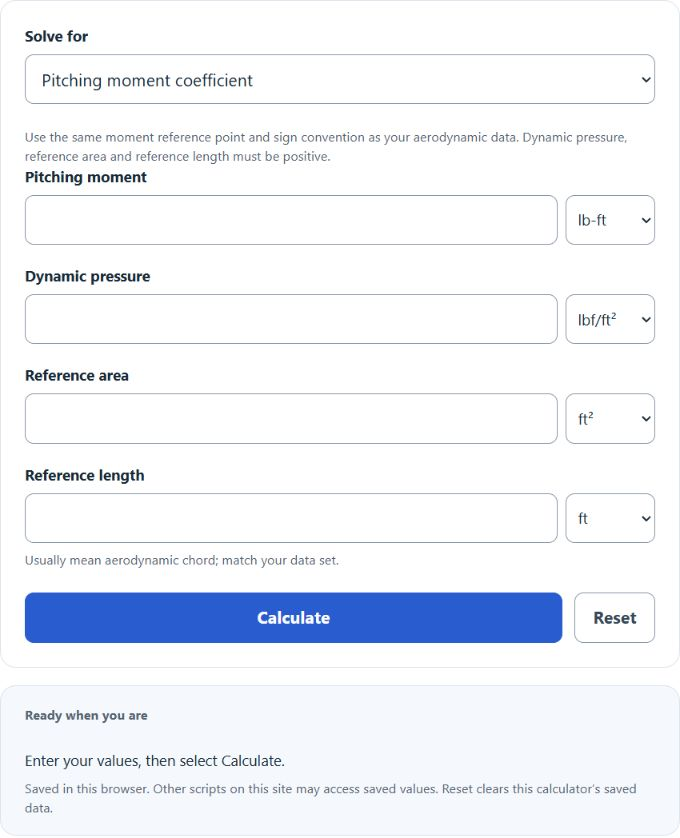
Calculate pitching moment coefficient, moment, dynamic pressure, reference area, or reference length from the Cm = M/(q × S × c) formula.
Pitching Moment Coefficient Formula
The pitching moment coefficient relates the pitching moment to dynamic pressure, reference area, and reference length. The coefficient is dimensionless, so all dimensional inputs must be in a consistent unit system before applying the formula.
The calculator can also rearrange the same equation to solve for any one missing value:
- Cm = pitching moment coefficient, dimensionless
- M = pitching moment, in N·m or lb-ft
- q = dynamic pressure, in Pa or lbf/ft²
- S = reference area, in m² or sq ft
- c = reference length, usually mean aerodynamic chord, in m or ft
To calculate Cm, enter the pitching moment, dynamic pressure, reference area, and reference length. To calculate M, enter the coefficient and the three reference quantities. To solve for q, S, or c, select it in Solve for and enter the four displayed values.
The calculator converts English units to SI internally, performs the calculation, then converts the result back to the selected result unit. The coefficient itself has no units.
Reference Units and Typical Inputs
| Quantity | Common SI unit | Common English unit | Calculator conversion |
|---|---|---|---|
| Pitching moment, M | N·m | lb-ft | 1 lb-ft ≈ 1.35582 N·m |
| Dynamic pressure, q | Pa | lbf/ft² | 1 lbf/ft² ≈ 47.8803 Pa |
| Reference area, S | m² | sq ft | 1 sq ft = 0.09290304 m² |
| Reference length, c | m | ft | 1 ft = 0.3048 m |
| Input | Typical note | Use in the formula |
|---|---|---|
| Dynamic pressure, q | Often comes from flight condition data or q = 0.5ρV². | Higher q gives a larger moment for the same Cm, S, and c. |
| Reference area, S | For aircraft, this is commonly wing planform area. | Larger area increases the reference moment scale. |
| Reference length, c | For wing pitching moment, this is commonly mean aerodynamic chord. | Larger length increases the reference moment scale. |
| Sign of M and Cm | Positive or negative depends on the sign convention used. | Use consistent signs for moment and coefficient. |
Example Calculations
Example 1: Calculate pitching moment coefficient
Suppose the pitching moment is 2,000 N·m, the dynamic pressure is 5,000 Pa, the reference area is 12 m², and the reference length is 1.5 m.
The pitching moment coefficient is approximately 0.0222.
Example 2: Calculate pitching moment
Suppose Cm = -0.05, q = 100 lbf/ft², S = 200 sq ft, and c = 5 ft. Using English units consistently:
The pitching moment is -5,000 lb-ft. The negative sign follows the sign convention used for Cm.
FAQ
Is the pitching moment coefficient dimensionless?
Yes. Cm is dimensionless because the denominator qSc has the same dimensions as moment. Dynamic pressure times area gives force, and multiplying by reference length gives moment.
What reference length should you use for c?
For many aircraft wing calculations, c is the mean aerodynamic chord. For another body or component, use the reference length defined for the aerodynamic data set you are working with. The important point is consistency: use the same reference length that was used to define or compare the coefficient.
Can Cm be negative?
Yes. A negative pitching moment coefficient usually means the pitching moment acts in the negative direction under the chosen sign convention. The formula allows positive or negative values, but dynamic pressure, reference area, and reference length should normally be positive physical quantities.