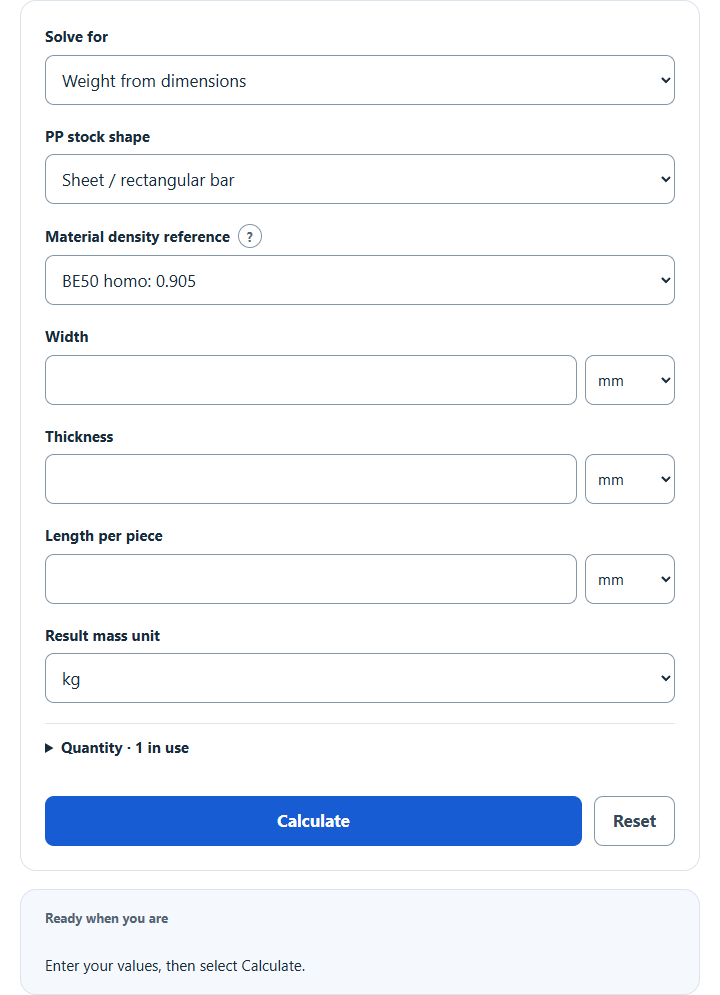
Calculate polypropylene sheet, rod or pipe weight from size and PP grade, or compare acrylic, HDPE, nylon, PEEK or PTFE, and find cut length.
- All Construction Calculators
- All Weight Calculators
- PVC Weight Calculator
- HDPE Weight Calculator
- Acrylic Weight Calculator
Polypropylene Weight Formulas
For uniform stock, material mass equals cross-sectional area × length × density. The calculator handles rectangular stock, round rods and hollow round pipes. The other section formulas below are manual extensions. Use consistent length units and a matching density unit; section dimensions below are overall dimensions with uniform wall thickness.
Polypropylene Flat Sheet Weight Formula = L * W * H * d
Polypropylene Round Bar Weight Formula = pi * D2/4 * L * d
Polypropylene Square Hollow Tube Weight Formula = [W2-(W-2*T)2] * L * d
Polypropylene Round Hollow Tube Weight Formula = pi * (R2-r2) * L * d
Polypropylene Square Angle Weight Formula = (2*W*T-T2) * L * d (equal legs, each of overall width W)
Polypropylene T bar Weight Formula = [W*T + (H-T)*T] * L * d
Polypropylene C Channel Weight Formula = [2*W*T1+(H-2*T1)*T2] * L * d (H is overall channel height)
Variables used in these equations:
- L is the length
- W is the width
- H is the height
- d is the density
- D is the outer diameter
- T is the thickness
- R is the outer radius
- r is the inner radius
- T1 is the channel thickness along the width
- T2 is the channel thickness along the height
Each dimension has an independent mm, cm, m, inch or foot unit control; changing a unit converts its entered value. Mass mode returns kg, g, lb or oz. Cut-length mode uses the total material mass for a whole-piece quantity and returns an equal length per piece. Quantity defaults to one. Pipe wall thickness must be less than half its outside diameter. The water comparison assumes fully submerged material in water of density 1,000 kg/m³. It excludes an open or flooded pipe bore, trapped air, fittings and ballast. Its kg-equivalent margin is displaced-water mass minus material mass; it is not a whole-part flotation prediction or a safe payload rating. Archimedes’ principle relates buoyancy to displaced fluid weight.
What is the density of Polypropylene?
Polypropylene density depends on the actual formulation. The calculator uses named typical examples: Borealis BE50 homopolymer and RE420MO random copolymer at 0.905 g/cm³, Fibremod GB364WG 30% glass-filled PP at 1.120 g/cm³, and INEOS L90G-00 impact copolymer at 0.910 g/cm³. These are not universal family densities. Use the supplier’s density for actual stock. References: Borealis grade comparison and INEOS L90G-00 technical data.