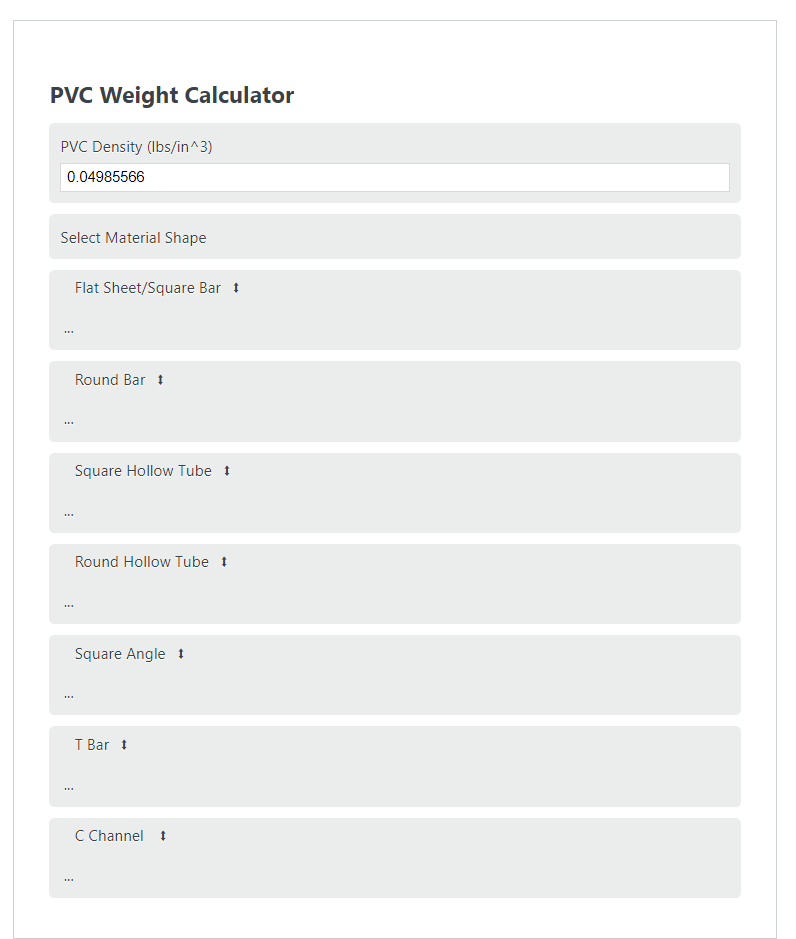
Calculate PVC or CPVC weight for sheets, rods, and pipes from dimensions, density, quantity, and units, or solve for the length needed for a target weight.
- All Construction Calculators
- All Weight Calculators
- HDPE Weight Calculator
- Acrylic Weight Calculator
- Carbon Fiber Weight Calculator
PVC Weight Formulas
Weight = cross-sectional area × length × density. The cross-section varies by shape:
| Shape | Cross-Section Area |
|---|---|
| Flat Sheet / Square Bar | L × W × T |
| Round Bar | π × (D/2)² |
| Square Hollow Tube | W² − (W − 2T)² |
| Round Hollow Tube | π × (R² − r²) |
| Square Angle (equal-leg) | 2 × W × T − T² |
| T Bar | W × Tf + (H − Tf) × Tw |
| C Channel | 2 × W × T1 + (H − 2T1) × T2 |
Variables: L = length, W = width, H = height, D = outer diameter, T = thickness, R = outer radius, r = inner radius, Tf = flange thickness (T bar), Tw = web thickness (T bar), T1 = flange thickness (C channel), T2 = web thickness (C channel), d = density. All length inputs convert to inches internally; density converts to lbs/in³. Mixed units are supported via the dropdowns.
PVC Density by Material Type
Density is the single most important variable in PVC weight calculations and varies significantly by formulation. ISO 4439 specifies 1.35–1.46 g/cm³ for unplasticized PVC-U pipe. Plasticizers lower density; fillers like calcium carbonate raise it. CPVC is inherently denser because each chlorination step replaces a hydrogen atom (1 amu) with chlorine (35.5 amu).
| PVC Type | Density (g/cm³) | Density (lbs/in³) | Max Temp | Typical Use |
|---|---|---|---|---|
| Rigid PVC / uPVC | 1.35–1.46 | 0.0488–0.0527 | 140°F (60°C) | Pipe, fittings, profiles |
| Flexible PVC (plasticized) | 1.10–1.35 | 0.0397–0.0488 | ~140°F | Cable insulation, hoses, film |
| CPVC | 1.50–1.58 | 0.0542–0.0571 | 200°F (93°C) | Hot water pipe, industrial |
| Filled PVC (CaCO₃ added) | 1.50–1.55 | 0.0542–0.0560 | 140°F | Low-cost siding, profiles |
| PVC Foam / Cellular | 0.45–0.80 | 0.0163–0.0289 | ~130°F | Sign boards, trim, cabinetry |
Biaxially oriented PVC (PVC-O) pipe is stretched during manufacturing, reducing wall thickness 30–40% while maintaining pressure ratings. This yields 15–25% less material by weight versus standard extruded Schedule 40 pipe at the same nominal size.
Schedule 40 and Schedule 80 PVC Pipe Reference Weights
Weights below are calculated from ASTM D1785 nominal dimensions at a density of 0.054 lbs/in³ (1.494 g/cm³), consistent with published manufacturer data. Schedule 80 adds 28–44% more wall material than Schedule 40 at the same nominal size.
| NPS | OD (in) | Sch 40 Wall (in) | Sch 40 (lbs/ft) | Sch 80 Wall (in) | Sch 80 (lbs/ft) |
|---|---|---|---|---|---|
| 1/2" | 0.840 | 0.109 | 0.164 | 0.147 | 0.213 |
| 3/4" | 1.050 | 0.113 | 0.218 | 0.154 | 0.282 |
| 1" | 1.315 | 0.133 | 0.324 | 0.179 | 0.414 |
| 1-1/4" | 1.660 | 0.140 | 0.434 | 0.191 | 0.581 |
| 1-1/2" | 1.900 | 0.145 | 0.537 | 0.200 | 0.721 |
| 2" | 2.375 | 0.154 | 0.705 | 0.218 | 0.966 |
| 3" | 3.500 | 0.216 | 1.478 | 0.300 | 1.988 |
| 4" | 4.500 | 0.237 | 2.118 | 0.337 | 2.938 |
| 6" | 6.625 | 0.280 | 3.661 | 0.432 | 5.455 |
ASTM D1785 wall thickness tolerance is ±5%, so actual pipe weight can vary from these values by the same margin. Use the Round Hollow Tube option above with measured OD and ID for the most accurate result on a specific piece of pipe.