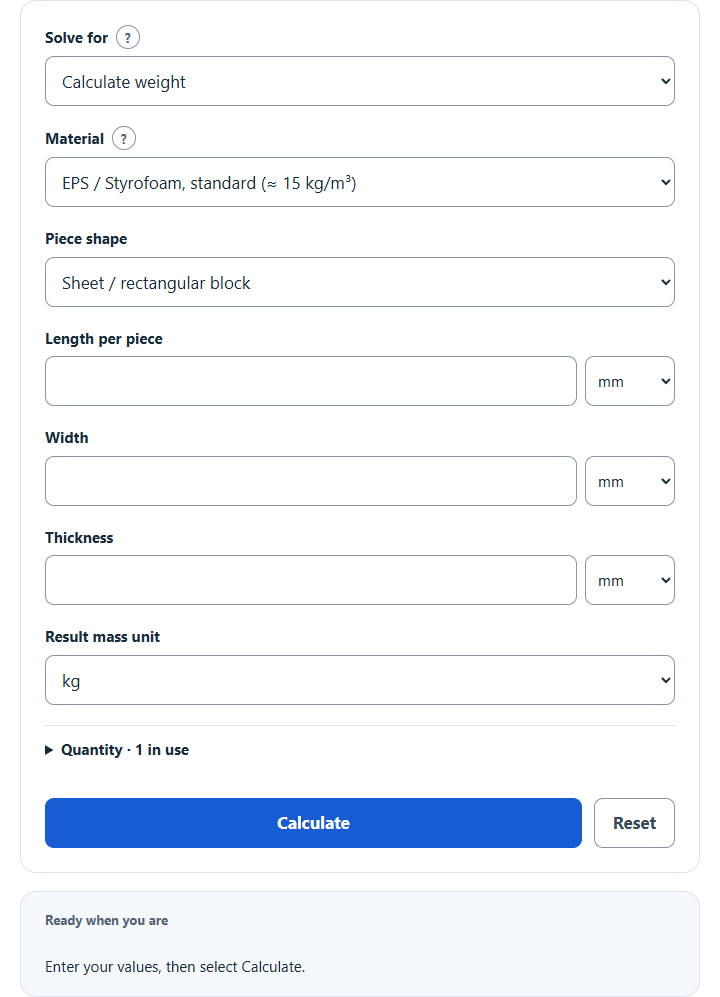
Calculate polystyrene or Styrofoam weight from sheet, cylinder or volume sizes using typical EPS, XPS or solid PS densities, or enter your own density.
- All Construction Calculators
- All Weight Calculators
- PET Weight Calculator
- LDPE Weight Calculator
- Polypropylene Weight Calculator
Polystyrene Weight Formulas
Material mass equals density × material volume. The calculator handles rectangular blocks, solid cylinders, known volume and inverse volume from a target mass. The other section formulas below are manual extensions for uniform material with consistent units.
Polystyrene Flat Sheet Weight Formula = L * W * T * d
Polystyrene Round Bar Weight Formula = (π/4) * D2 * L * d
Polystyrene Square Hollow Tube Weight Formula = [W2-(W-2T)2] * L * d
Polystyrene Round Hollow Tube Weight Formula = (π/4) * (Do2 – Di2) * L * d
Polystyrene Square Angle Weight Formula = (2*W*T – T2) * L * d
Polystyrene T Bar Weight Formula = (W*T1 + (H-T1)*T2) * L * d
Polystyrene C Channel Weight Formula = (2*W*T1 + (H-2*T1)*T2) * L * d
Variables used in these equations:
- L is the length
- W is the width (or outer width / leg length / flange width, depending on shape)
- H is the overall height/depth (for T bars and C channels)
- T is the thickness (sheet thickness, wall thickness, or angle thickness)
- d is the density
- D is the diameter (round bar)
- Do is the outer diameter (round hollow tube)
- Di is the inner diameter (round hollow tube)
- T1 is the flange thickness (for T bars and C channels)
- T2 is the web thickness (for T bars and C channels)
Each dimension has an independent mm, cm, m, inch or foot control. Density accepts kg/m³, g/cm³ or lb/ft³; known volume accepts m³, liters, cm³, ft³ or in³. Changing a unit converts its entered value. Mass mode reports kg, lb or g and multiplies volume per piece by a whole-piece quantity, default one. Inverse mode returns the total volume for the entered total target mass and an equivalent cube side. Foam volume includes its cells: use the finished foam’s apparent density, subtract cutouts and add facings, adhesive or absorbed water separately. Loose-bead bulk density and solid-resin density are not interchangeable with finished foam density.
What is the density of Polystyrene?
The named solid GPPS reference Styrolution PS 158 N/L has typical density 1,040 kg/m³ (1.04 g/cm³), as listed in the INEOS Styrolution grade comparison. Finished EPS foam is much less dense; BASF’s portfolio lists different processing/application density ranges. The calculator’s EPS 15 and 25 kg/m³ and XPS 35 kg/m³ presets are explicit illustrative assumptions, not universal densities or product specifications. Enter the actual supplier density for your finished material.