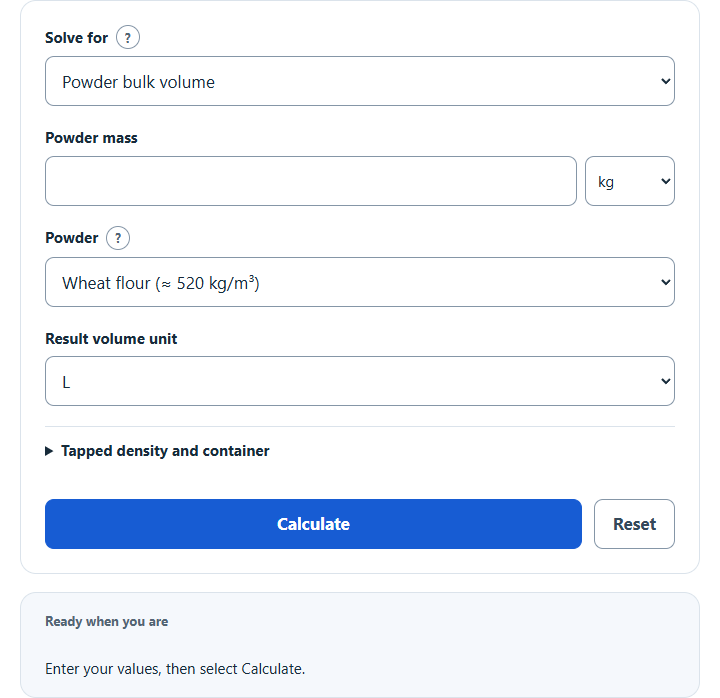
Calculate powder volume from mass using typical bulk densities for flour, sugar, salt and more, or enter your own bulk density to solve mass or density.
- All Chemistry Calculators
- All Volume Calculators
- Runoff Volume Calculator
- CC to Grams of Powder Calculator
- Powder Factor Calculator
Powder Volume Formula
The following formula calculates loose bulk volume. Use matching mass and density units; bulk density includes spaces between particles and depends on packing and handling. The calculator converts units internally, including g/m³ for the examples below.
- Where PV is the Powder Volume (m3)
- PM is the powder mass (g)
- BD is the bulk density (g/m3)
To calculate loose powder volume, divide mass by loose bulk density. Optional tapped density gives tapped volume and Carr index: 100 × (1 − loose density / tapped density), using the same powder and compatible measurements. Container working fill is a user-selected geometric planning allowance, not a safe handling or equipment rating.
How to Calculate Powder Volume?
The following example problems outline how to calculate Powder Volume.
Example Problem #1:
- First, determine the powder mass (g).
- The powder mass (g) is given as 40.
- Next, determine the bulk density (g/m3).
- The bulk density (g/m3) is provided as 300.
- Finally, calculate the Powder Volume using the equation above:
PV = PM / BD
The values given above are inserted into the equation below:
PV = 40 / 300 = .1333 (m3)
Example Problem #2:
The variables needed for this problem are provided below:
powder mass (g) = 60
bulk density (g/m3) = 700
Entering these values and solving gives:
PV = 60 g ÷ 700 g/m³ ≈ 0.085714 m³ (85.714 L). Choose grams, g/m³ and cubic meters to reproduce this illustrative example.