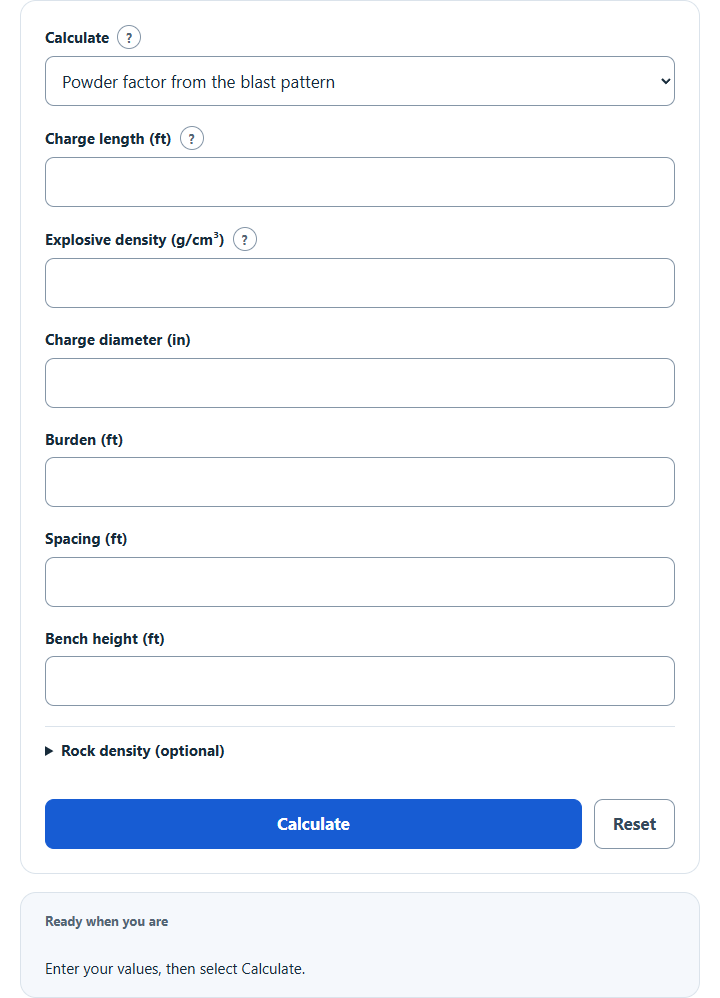
Calculate a blast’s powder factor in pounds of explosive per cubic yard from the charge, burden, spacing and bench height, or the charge a target needs.
- All Construction Calculators
- Net Explosive Weight Calculator
- Powder Volume Calculator
- Blast Yield Calculator
- Excavator Productivity Calculator
Calculator Functions
The calculator gives the powder factor of a blast, the amount of explosive used for each cubic yard of rock broken, and works the other way to find the charge a target powder factor needs. Select a function to open it in the calculator.
| Function | Use it when | You enter |
|---|---|---|
| Powder factor from the blast pattern | You know how each hole is loaded and the pattern | Charge length, explosive density, charge diameter, burden, spacing and bench height |
| Powder factor from totals | You know the total explosive and the rock it broke | Total explosive and the volume of rock |
| Charge for a target powder factor | You are planning a pattern for a chosen powder factor | The powder factor, the pattern, the hole diameter and the explosive density |
Add the rock’s specific gravity under the optional settings to see the powder factor per ton of rock as well.
Powder Factor Formulas
| P.F. | Powder factor, pounds of explosive per cubic yard of rock |
| W | Explosive in each hole, lb |
| V | Rock each hole breaks, cubic yards |
| L | Length of the explosive charge, ft |
| d | Density of the explosive, g/cm³ |
| D | Charge diameter, in |
| B, S, H | Burden, spacing and bench height, ft |
Powder factor is the ratio of the explosive loaded to the rock broken, usually in pounds per cubic yard or pounds per ton [1]. The term 0.3405 × d × D² is the loading density, the weight of explosive per foot of borehole, and B × S × H ÷ 27 is the cubic yards of rock each hole breaks. Where the excavated material has little value, as in coal stripping or construction, powder factor is given per cubic yard; for rock sold by the ton, such as limestone or metal ores, it is often given per ton [1]. One cubic yard of rock weighs about 0.8428 short tons times its specific gravity, and 1 lb/yd³ is 0.5933 kg/m³.
Typical powder factors
| Difficulty of rock breakage | Powder factor, lb/yd³ |
|---|---|
| Low | 0.25 to 0.40 |
| Medium | 0.40 to 0.75 |
| High | 0.75 to 1.25 |
| Very high | 1.25 to 2.50 |
Surface blasting powder factors run from 0.25 to 2.5 lb/yd³, with 0.5 to 1.0 lb/yd³ most typical [1]. Soft, light rock needs less explosive per yard than hard, dense rock, and massive rock with few cracks needs more than rock with many closely spaced flaws. Larger hole patterns need less explosive per yard because more of each hole is stemming, and the more free faces a blast has, the lower its powder factor [1].
Worked example
Each hole holds 20 ft of an explosive with a density of 0.85 g/cm³ in a 6 in hole, on a 15 ft by 18 ft pattern with a 30 ft bench. The loading density is 0.3405 × 0.85 × 6² = 10.42 lb/ft, so each hole holds 208.4 lb. Each hole breaks 15 × 18 × 30 ÷ 27 = 300 yd³ of rock, giving a powder factor of 208.4 ÷ 300 = 0.69 lb/yd³, or 0.41 kg/m³, in the medium range.
Limits of This Estimate
- Powder factor is a cost accounting figure more than a design tool. Blasts should be designed from their dimensions, such as burden, spacing, stemming and subdrilling, and the powder factor then checked [1].
- The pattern formula treats every hole as breaking a full burden by spacing block to the bench height. Edge holes, uneven faces and back break change the real volume.
- Explosives with more energy, such as those high in aluminum, can break more rock per pound, though most common products have similar energy and break rock about equally well [1].
- Blasts must be designed and fired by a licensed blaster under the rules that apply to the site.
Sources
- U.S. Bureau of Mines, Explosives and Blasting Procedures Manual, Information Circular 8925 (Dick, Fletcher and D’Andrea, 1983): the powder factor formula and definition, loading density, typical surface powder factors by difficulty of breakage, and what raises or lowers them