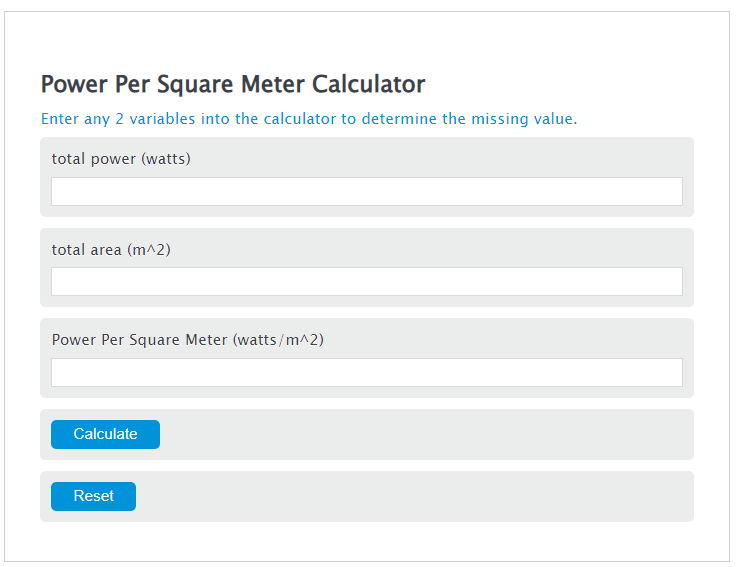
Calculate watts per square meter, total power, or required area with W, kW, MW, metric and imperial area units, converted density, and planning scenarios.
Related Calculators
- Field Strength To Power Density Calculator
- Energy To Power Conversion Calculator
- Lumens to Nits Calculator
- Par (Lumen Light) Calculator
- All Unit Converters
Power Per Square Meter Formula
Power per square meter measures average power density across a surface. It shows how much total power is distributed over each square meter of area, which makes it useful for comparing systems that have different sizes, footprints, or coverage areas.
In this relationship, PPSM is the power per square meter, P is total power, and A is total area. If power is entered in watts and area is entered in square meters, the result is expressed in W/m².
What the Formula Means
This calculator returns an average value. If power is spread evenly over the surface, the result describes the loading very well. If the power is unevenly distributed, the result still gives a useful average, but local spots may be higher or lower than the calculated value.
| Symbol | Description | Typical Units |
|---|---|---|
| PPSM | Average power per unit area | W/m², kW/m² |
| P | Total power delivered, emitted, or used across the surface | W, kW, MW |
| A | Total surface area over which the power is distributed | m², cm², ft², in² |
Rearranged Equations
If you know any two of the three values, you can solve for the third.
| Use Case | Equation |
|---|---|
| Find power per square meter | PPSM = (P) / (A) |
| Find total power | P = PPSM × A |
| Find area | A = (P) / (PPSM) |
How to Calculate Power Per Square Meter
- Determine the total power associated with the surface or system.
- Measure the total area over which that power is spread.
- Convert the inputs into a consistent unit system.
- Divide total power by total area.
- Interpret the result as the average power density over the chosen surface.
Common Unit Conversions
If you want the result in W/m², convert power to watts and area to square meters before dividing.
| Conversion | Why It Matters |
|---|---|
1 kW = 1000 W |
Convert kilowatts to watts for W/m² output. |
1 MW = 1000000 W |
Convert megawatts when working with large systems. |
1 m² = 10000 cm² |
Useful when area is measured in square centimeters. |
1 ft² = 0.092903 m² |
Convert square feet to square meters for SI-based results. |
1 in² = 0.00064516 m² |
Important when very small surfaces are measured in square inches. |
Examples
Example 1: A system delivers 780 watts across an area of 123 square meters.
Example 2: A surface receives 2400 watts over 12 square meters.
Example 3: A design target requires 150 W/m² across 20 square meters. The total power needed is:
How to Interpret the Result
- Higher W/m² means the same area carries more power.
- Lower W/m² means the power is spread over a larger area or the total power is smaller.
- If power increases while area stays fixed, power per square meter increases proportionally.
- If area increases while power stays fixed, power per square meter decreases.
- The value is an average surface loading, not necessarily the highest point value on the surface.
Typical Uses
- Comparing lighting loads across floor area.
- Estimating surface heating intensity.
- Evaluating beam or emitter power over a footprint.
- Comparing solar or radiant exposure across different panel sizes.
- Checking how concentrated equipment power is on a wall, roof, or platform.
Power Per Square Meter vs. Energy Per Square Meter
Power describes a rate, while energy includes time. If power density is constant over a known duration, you can convert it into energy per unit area by multiplying by time.
This distinction matters when you are comparing an instantaneous loading to a total exposure over minutes, hours, or days.
Common Input Mistakes
- Mixing watts and kilowatts without converting first.
- Using square feet or square inches when the desired output is W/m².
- Entering a gross surface area when only the active area should be used.
- Using a very small area, which can make the result appear extremely large.
- Assuming the average value represents every point on a non-uniform surface.
- Entering zero for area, which makes the calculation undefined.
FAQs
What does W/m² tell you?
It tells you how many watts are associated with each square meter of surface area.
Can I use units other than watts and square meters?
Yes. The formula still works as long as the units are consistent. Convert inputs first if you want the result reported specifically in W/m².
Why is my result so high?
A high value usually means the total power is large, the area is small, or the area units were not converted correctly.
Is this the same as total power?
No. Total power is the full amount of power, while power per square meter normalizes that power by area so different systems can be compared fairly.