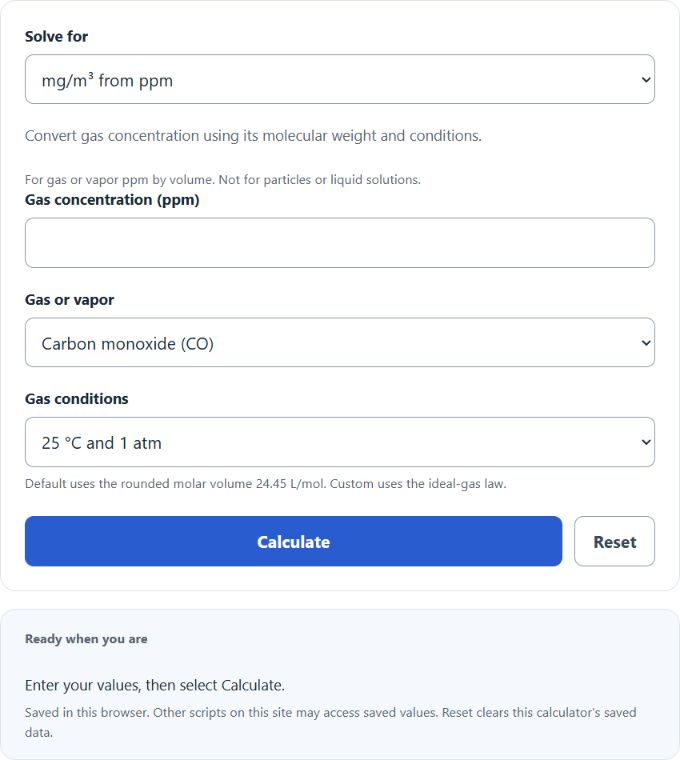
Convert ppm to mg/m³ for a gas or vapor by picking it or entering its molecular weight, or convert mg/m³ back to ppm at 25 °C, 0 °C or custom conditions.
- ug/kg to ppm Converter
- mg/mL To mM Calculator
- mg to ml Calculator
- cm³ To Grams Calculator
- All Unit Converters
ppm to mg/m³ Formula
The following formula is used to convert a gas concentration from parts per million (ppm) to milligrams per cubic meter (mg/m³) at 25°C and 1 atm.
For the reverse conversion, use ppm = mg/m³ × 24.45 ÷ MW.
Variables:
- mg/m³ is the concentration in milligrams per cubic meter
- ppm is the concentration in parts per million by volume
- MW is the molecular weight of the gas in g/mol
- 24.45 L/mol is a rounded approximation to the ideal-gas molar volume at 25°C and 1 atm
To calculate mg/m³ from gas ppm by volume at the default 25°C and 1 atm, multiply ppm by molecular weight and divide by the rounded molar volume 24.45 L/mol. For custom conditions, use molar volume = 8.31446261815324 × (temperature in °C + 273.15) ÷ absolute pressure in kPa. This ideal-gas conversion does not determine whether an exposure is safe.
What is ppm to mg/m³ Conversion?
ppm to mg/m³ conversion is used to translate a gas concentration from a volumetric basis to a mass-per-volume basis. ppm represents the number of gas molecules present relative to air, while mg/m³ expresses the actual mass of the contaminant in each cubic meter of air. Because different gases have different molecular weights, the conversion depends on the specific substance being measured.
This type of conversion is common in occupational hygiene, indoor air quality, environmental monitoring, and regulatory compliance. Exposure limits and air quality standards may be reported in either ppm or mg/m³, so converting between the two helps compare results correctly.
How to Convert ppm to mg/m³?
The following steps outline how to convert ppm to mg/m³.
- First, determine the gas concentration in ppm.
- Next, determine the molecular weight (MW) of the gas in g/mol.
- Then, apply the formula mg/m³ = ppm × MW ÷ 24.45.
- Finally, compare the result to the value shown by the calculator above.
Common Molecular Weights
- CO: 28.01 g/mol
- CO₂: 44.01 g/mol
- SO₂: 64.07 g/mol
- NO₂: 46.01 g/mol
- O₃: 48.00 g/mol
- NH₃: 17.03 g/mol
- Benzene: 78.11 g/mol
ppm to mg/m³ Conversion Table
The following table shows example conversions for a 10 ppm concentration of several common gases at 25°C and 1 atm.
| Gas | Molecular Weight (g/mol) | 10 ppm in mg/m³ |
|---|---|---|
| Carbon Monoxide (CO) | 28.01 | 11.46 mg/m³ |
| Carbon Dioxide (CO₂) | 44.01 | 18.00 mg/m³ |
| Sulfur Dioxide (SO₂) | 64.07 | 26.20 mg/m³ |
| Nitrogen Dioxide (NO₂) | 46.01 | 18.82 mg/m³ |
| Ozone (O₃) | 48.00 | 19.63 mg/m³ |
| Ammonia (NH₃) | 17.03 | 6.97 mg/m³ |
| Benzene (C₆H₆) | 78.11 | 31.95 mg/m³ |
Heavier gases produce higher mg/m³ values for the same ppm concentration, while lighter gases produce lower mg/m³ values. That is why selecting the correct gas is essential for an accurate conversion.
Example Problem:
Use the following variables as an example problem to test your knowledge.
ppm = 10
Gas = Carbon Monoxide (CO)
MW = 28.01 g/mol
mg/m³ = 10 × 28.01 ÷ 24.45 = 11.46 mg/m³