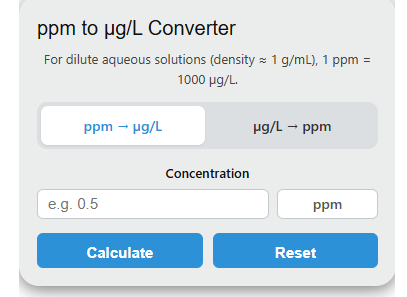
Calculate ug/L from ppm or ppm from ug/L using solution density, with mg/L, ppb, ng/L and molarity outputs plus an EPA drinking water limit check.
Quick overview: ppm to µg/L
For most environmental and water-quality calculations, 1 ppm in a dilute water-based solution is treated as 1 mg/L. Since 1 mg/L = 1000 µg/L, the conversion is:
µg/L = ppm × 1000
- 0.01 ppm = 10 µg/L
- 0.05 ppm = 50 µg/L
- 0.10 ppm = 100 µg/L
- 1.00 ppm = 1000 µg/L
This approximation is commonly used for drinking water, groundwater, river water, and wastewater calculations where the density is close to that of water.
- mg/dl to ng/ml Converter
- ng/ul to ug/ml Converter
- Parts Per Hundred Calculator
- Micromoles To Moles Calculator
- All Unit Converters
ppm to µg/L Formula
The following formula is used to convert parts per million (ppm) to micrograms per liter (µg/L) for dilute aqueous solutions.
Reverse formula:
Variables:
- ppm is the concentration in parts per million
- µg/L is the concentration in micrograms per liter
- 1000 is the conversion factor from milligrams to micrograms
To calculate micrograms per liter from ppm, multiply the ppm value by 1000. This is based on the standard approximation that 1 ppm in water-like solutions is equivalent to 1 mg/L.
What is ppm to µg/L Conversion?
Converting ppm to µg/L is a common step in water quality, environmental science, wastewater monitoring, and laboratory reporting. Parts per million expresses a very small concentration by mass, while micrograms per liter expresses the mass of a substance in a given liquid volume. In dilute water-based solutions, these units are directly related because 1 ppm is commonly treated as 1 mg/L, and 1 mg/L equals 1000 µg/L.
This means that a concentration of 0.02 ppm corresponds to 20 µg/L, 0.5 ppm corresponds to 500 µg/L, and 2.5 ppm corresponds to 2500 µg/L. The conversion is especially useful when comparing lab reports, instrument readings, or regulatory limits that may be listed in different units.
How to Convert ppm to µg/L?
The following steps outline how to convert ppm to micrograms per liter.
- First, determine the concentration in parts per million (ppm).
- Next, apply the conversion factor for dilute aqueous solutions: 1 ppm ≈ 1 mg/L.
- Then convert mg/L to µg/L by multiplying by 1000.
- Finally, use the formula µg/L = ppm × 1000 to calculate the result.
- After calculating, verify your answer using the converter above.
ppm to µg/L Conversion Table
The table below lists several example concentrations in ppm and their equivalents in µg/L using the relationship µg/L = ppm × 1000.
| Concentration | Relationship | Value in µg/L |
|---|---|---|
| 0.01 ppm | 0.01 × 1000 | 10 µg/L |
| 0.05 ppm | 0.05 × 1000 | 50 µg/L |
| 0.10 ppm | 0.10 × 1000 | 100 µg/L |
| 0.25 ppm | 0.25 × 1000 | 250 µg/L |
| 0.50 ppm | 0.50 × 1000 | 500 µg/L |
| 1.00 ppm | 1.00 × 1000 | 1000 µg/L |
| 2.50 ppm | 2.50 × 1000 | 2500 µg/L |
Laboratory and field measurements may be reported in ppm, mg/L, or µg/L depending on the method used and the reporting limits. Understanding that ppm in water is approximately the same as mg/L makes it easy to compare results across reports, standards, and calculations.
Example Problem :
Use the following variables as an example problem to test your knowledge.
Concentration (ppm) = 0.05
Conversion Factor = 1000
µg/L = 0.05 × 1000 = 50 µg/L