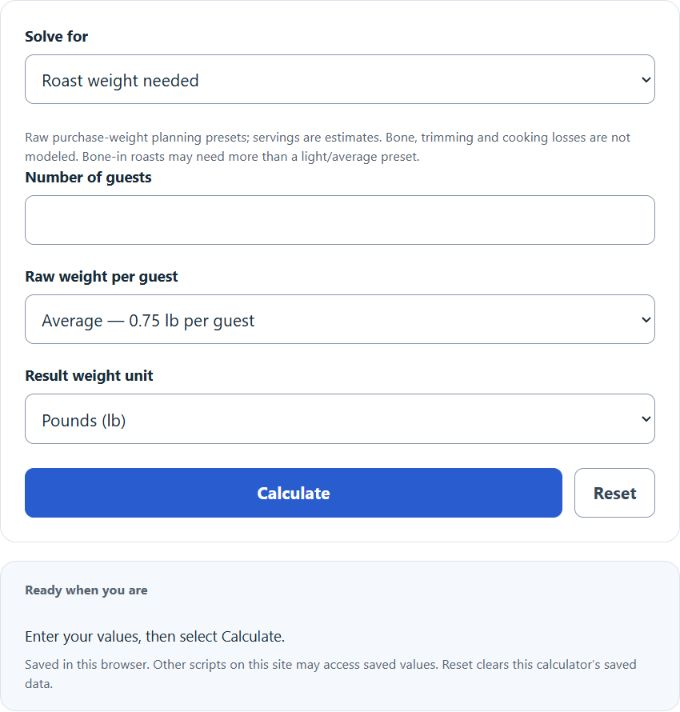
Estimate how much prime rib you need for your guest count by appetite level, or find how many guests a roast will serve with lb, oz, kg, or g units.
Related Calculators
- Meat Per Person Calculator
- Meat Shrinkage Calculator
- Potatoes Per Person Calculator
- 30 Minutes Per Pound Calculator
- All Food and Cooking Calculators
Prime Rib Per Person Formula
Use this calculator to estimate how much raw prime rib to buy for a dinner, holiday meal, buffet, or catered event. The calculation is simple: multiply the number of guests by the portion size you want to serve per guest. This works for prime rib, standing rib roast, and boneless rib roast planning.
Where:
| Variable | Meaning |
|---|---|
| PR | Total prime rib needed |
| G | Number of guests |
| A | Appetite level per guest |
If you already know the roast size and want to estimate how many people it can feed, reverse the formula:
Appetite Level Guide
The calculator uses three raw purchase-weight planning assumptions, not guaranteed edible servings. Bone-in roasts can need more weight than the light or average presets:
| Appetite Setting | Amount Per Guest | Best Use Case |
|---|---|---|
| Light Eater | 0.50 lb | Buffet service, many side dishes, mixed crowd, lighter portions |
| Average Eater | 0.75 lb | Standard dinner portion for most family meals and holiday gatherings |
| Heavy Eater | 1.00 lb | Large appetites, fewer sides, thick slices, or intentional leftovers |
These values are best treated as raw purchase weights. If you are between roast sizes, rounding up is usually the better choice.
Quick Prime Rib Reference Table
This table shows how much prime rib to buy for common guest counts using the calculator’s three appetite settings.
| Guests | Light Eaters | Average Eaters | Heavy Eaters |
|---|---|---|---|
| 4 | 2 lb | 3 lb | 4 lb |
| 6 | 3 lb | 4.5 lb | 6 lb |
| 8 | 4 lb | 6 lb | 8 lb |
| 10 | 5 lb | 7.5 lb | 10 lb |
| 12 | 6 lb | 9 lb | 12 lb |
| 16 | 8 lb | 12 lb | 16 lb |
| 20 | 10 lb | 15 lb | 20 lb |
How to Calculate Prime Rib Needed
- Count the total number of guests you expect to serve.
- Choose the appetite level that best matches your event.
- Multiply guests by the selected per-person amount.
- Round up to a practical roast size if the result lands between common weights.
- Use the converted weight output if you prefer ounces, kilograms, or grams.
Planning Notes for Better Accuracy
- Bone-in vs. boneless: bone-in roasts usually provide less edible meat per purchased pound, so rounding up is smart.
- Side dishes matter: if you are serving potatoes, vegetables, bread, salad, and appetizers, the light or average setting is often enough.
- Prime rib as the main attraction: if the roast is the centerpiece and portions will be generous, the heavy setting is safer.
- Small gatherings: underbuying is more noticeable with smaller groups, so round up instead of down.
- Leftovers: if you want extra slices for sandwiches, hash, or reheating, move up one appetite setting or buy the next larger roast.
- Mixed guest lists: when serving children, older guests, and hearty eaters together, the average setting is usually a solid starting point.
Unit Conversion Formulas
If you want to convert the result manually, use these formulas:
Prime Rib Per Person FAQ
- Is this calculator based on raw weight or cooked weight?
- It is most useful for estimating the raw weight you should buy before cooking.
- Which appetite setting should I choose for a normal dinner?
- The average eater setting is typically the best fit for a standard plated meal with a few side dishes.
- Should I round up or down?
- Round up. A slightly larger roast is usually easier to manage than running short at serving time.
- Can this be used for standing rib roast?
- Yes. Prime rib and standing rib roast are commonly planned the same way when you are estimating servings per guest.
- What if I am serving prime rib buffet-style?
- Choose the light eater setting when guests will also be filling their plates with several other foods.