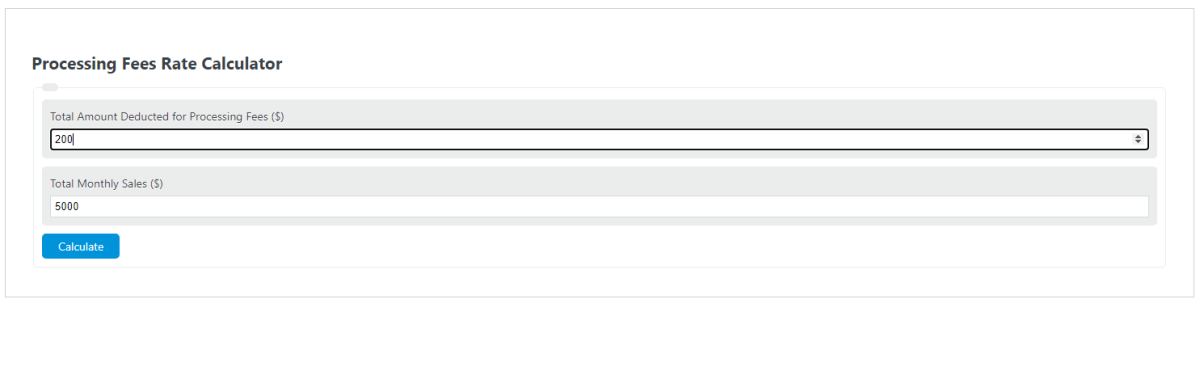
Calculate payment processing fees, net revenue, or the amount to charge for a target payout using a percentage rate, fixed fee, transaction count, and currency.
- All Business Calculators
- Credit Card Calculator
- Transaction Cost Calculator
- Average Transaction Value Calculator
Processing Fees Formula
The effective credit card processing rate expresses total fees as a percentage of gross sales:
- Where EFF is the effective credit card processing rate (%)
- PF is the total amount of processing fees per month ($)
- MS is the total amount of monthly sales ($)
This effective rate is the single most important metric for evaluating your payment processor. It captures every fee component (interchange, assessments, processor markup, monthly charges, and per-transaction fees) into one comparable number. An effective rate of 2.5% on $50,000 in monthly sales means you paid $1,250 in total processing costs that month.
The Three Layers of Processing Fees
Every card transaction carries three distinct cost layers, and understanding each one determines whether you are overpaying.
Interchange fees are set by the card networks (Visa, Mastercard, etc.) and paid to the bank that issued the customer’s card. These are non-negotiable and typically represent 70 to 80% of total processing costs. Visa interchange rates range from 1.15% + $0.05 to 2.40% + $0.10 per transaction, while Mastercard rates span 1.45% + $0.05 to 2.90% + $0.10. The exact rate depends on the card type (consumer debit, standard credit, rewards, corporate), the merchant category code (MCC), and whether the card was physically present at the point of sale.
Assessment fees (also called network fees or dues) go directly to the card brand. These are small but unavoidable: Visa charges approximately 0.14% of transaction volume, Mastercard roughly 0.13%, and both add per-transaction network access fees that range from $0.0155 to $0.0195. These fees are updated biannually, typically in April and October.
Processor markup is the only negotiable component. This is what your payment processor charges for routing the transaction, providing the terminal or gateway, handling settlement, and offering customer support. The markup varies enormously between providers and pricing models. On an interchange-plus plan, it might be as low as 0.15% + $0.05 for a high-volume merchant, or as high as 0.50% + $0.25 on a standard account.
Average Processing Fees by Card Network
Not all card brands cost the same to accept. The following ranges reflect typical interchange rates for standard consumer credit card transactions in 2025-2026:
| Card Network | Interchange Range | Per-Transaction Fee |
|---|---|---|
| Visa | 1.15% to 2.40% | $0.05 to $0.10 |
| Mastercard | 1.45% to 2.90% | $0.05 to $0.10 |
| American Express | 1.43% to 3.30% | $0.10 to $0.15 |
| Discover | 1.35% to 2.40% | $0.05 to $0.10 |
American Express has historically been the most expensive network to accept, which is why some small merchants do not accept it. However, Amex’s OptBlue program, introduced for businesses processing under $1 million annually in Amex volume, brought its effective rates closer to Visa and Mastercard for many small businesses. Discover tends to have the lowest interchange fees among the four major networks, though its smaller cardholder base means it represents a smaller share of most merchants’ transactions.
Processing Fees by Transaction Method
How a payment is captured significantly affects the rate charged. Card-present (in-person, chip, or tap) transactions carry lower fraud risk, so interchange rates are lower. Card-not-present (online, phone, or keyed-in) transactions carry higher risk and cost more.
| Transaction Method | Typical Effective Rate Range |
|---|---|
| In-person (chip/tap) | 1.70% to 2.60% |
| Online (e-commerce) | 2.25% to 3.50% |
| Keyed-in (MOTO) | 2.50% to 3.50% |
| Recurring / subscription | 2.30% to 3.10% |
The gap between in-person and online rates has widened slightly in recent years as card networks have increased fraud-related assessments on card-not-present transactions. Visa’s Digital Commerce Service Fee, which applies to all card-not-present authorizations at 0.0075%, is one example of network-level costs layered specifically onto e-commerce.
Pricing Models Compared
Payment processors use different pricing structures, and the model you are on determines whether your effective rate is competitive.
Interchange-plus passes through the actual interchange and assessment costs, then adds a fixed markup. This is the most transparent model and generally produces the lowest effective rate for businesses processing over $10,000 per month. A typical interchange-plus quote looks like IC + 0.30% + $0.08, meaning you pay actual interchange plus 0.30% of the transaction plus $0.08 per transaction.
Flat-rate pricing charges the same percentage on every transaction regardless of card type. Stripe (2.9% + $0.30 online), Square (2.6% + $0.10 in-person), and PayPal (3.49% + $0.49) use this model. It is simple but almost always more expensive than interchange-plus for businesses with average tickets above $15 and monthly volume above $5,000, because the processor keeps the difference between the flat rate and the actual interchange cost.
Tiered pricing groups transactions into qualified, mid-qualified, and non-qualified buckets at different rates. This model is common among traditional merchant account providers but is the least transparent, because the processor decides which bucket each transaction falls into. Qualified rates may look attractive (1.59% + $0.19), but most rewards cards and card-not-present transactions get routed to mid- or non-qualified tiers at rates of 2.50% or higher.
Effective Rate Benchmarks by Business Size
Your effective rate should decrease as transaction volume increases, because higher volume gives you leverage to negotiate lower processor markups and qualifies you for lower interchange categories.
| Monthly Card Volume | Expected Effective Rate (in-person) | Expected Effective Rate (online) |
|---|---|---|
| Under $10,000 | 2.80% to 3.50% | 3.10% to 3.80% |
| $10,000 to $50,000 | 2.30% to 2.90% | 2.70% to 3.30% |
| $50,000 to $250,000 | 2.00% to 2.50% | 2.40% to 2.90% |
| $250,000 to $1,000,000 | 1.80% to 2.20% | 2.20% to 2.60% |
| Over $1,000,000 | 1.50% to 2.00% | 2.00% to 2.40% |
If your effective rate exceeds the upper end of the range for your volume tier, you are likely overpaying. The most common causes are tiered pricing that downgrades most transactions, excessive monthly or annual fees that inflate the all-in cost, or a flat-rate provider that made sense when you were small but no longer fits your volume.
The Hidden Cost of Per-Transaction Fees
Per-transaction fees ($0.10 to $0.30 per transaction) have a disproportionate impact on businesses with low average tickets. A coffee shop selling a $5 latte at 2.6% + $0.10 pays an effective rate of 4.6% on that single transaction ($0.13 percentage fee + $0.10 flat fee = $0.23 on $5.00). The same rate structure on a $100 restaurant tab yields an effective rate of only 2.7%.
This is why businesses with average tickets below $10 should prioritize processors with low or zero per-transaction fees over those with the lowest percentage rate. A plan at 2.9% + $0.00 per transaction actually costs less than 2.3% + $0.30 on any transaction under roughly $12.
Industry Scale of Processing Fees
U.S. merchants paid an estimated $172 billion in total card processing fees in 2024, up from $148.5 billion the previous year. The average American household indirectly absorbed roughly $1,200 in swipe fees during 2024, passed through as higher retail prices. These figures make credit card processing fees the single largest non-labor, non-rent operating expense for many retail and restaurant businesses.
The Visa/Mastercard interchange settlement, with a decision expected in early 2026, proposes to reduce interchange rates by 0.10 percentage points over five years and cap standard card interchange at 1.25%. If approved, this would represent the first structural cap on U.S. interchange rates and could save merchants an estimated $30 billion over the settlement period. However, the proposed settlement has faced multiple objections, and the final terms may differ from the current proposal.
Processing Fees by Industry
Merchant category codes (MCCs) directly influence interchange rates, so effective processing costs vary significantly across industries:
| Industry | Typical Effective Rate | Key Factor |
|---|---|---|
| Grocery / Supermarket | 1.40% to 1.80% | High volume, low fraud, debit-heavy mix |
| Retail (in-person) | 1.70% to 2.40% | Card-present, moderate tickets |
| Restaurants | 1.80% to 2.50% | Tip adjustment adds complexity |
| Professional Services | 2.20% to 2.80% | Often keyed-in or invoiced |
| E-commerce (general) | 2.50% to 3.30% | Card-not-present, higher fraud rates |
| Travel / Hospitality | 2.30% to 3.00% | High tickets but rewards-card heavy |
| High-risk (CBD, nutraceuticals) | 3.50% to 5.00%+ | Elevated chargebacks, limited processor options |
Grocery and supermarket merchants consistently achieve the lowest rates because card networks offer preferential interchange categories for MCC 5411 (grocery stores), and their transaction mix skews heavily toward debit cards, which carry lower interchange than credit. High-risk industries face rates that can exceed 5% because fewer processors are willing to underwrite the chargeback exposure, reducing competitive pressure on pricing.
2026 Interchange Rate Changes
Several rate adjustments took effect or are scheduled for 2026 that may affect your processing costs. Visa’s Level 2 Commercial Enhanced Data Program (CEDP) interchange incentives sunset on April 17, 2026, meaning merchants who process corporate or purchasing cards will need verified CEDP status to access lower data rates. Visa’s Digital Commerce Service Fee is also expanding to four additional services.
Mastercard’s Excessive Authorization Integrity Fee increased to $0.50 as of January 2025 and remains in effect, penalizing merchants who generate a high ratio of authorization attempts to settled transactions. Mastercard also introduced its InControl program with a TPE (Transaction Processing Excellence) Fee set at 0.25% with a $0.04 minimum as of July 2025. The Capital One-Discover merger, completed in 2025, allows Capital One to route debit transactions through the Discover network, bypassing Durbin Amendment debit interchange caps and potentially increasing debit processing costs on those cards.