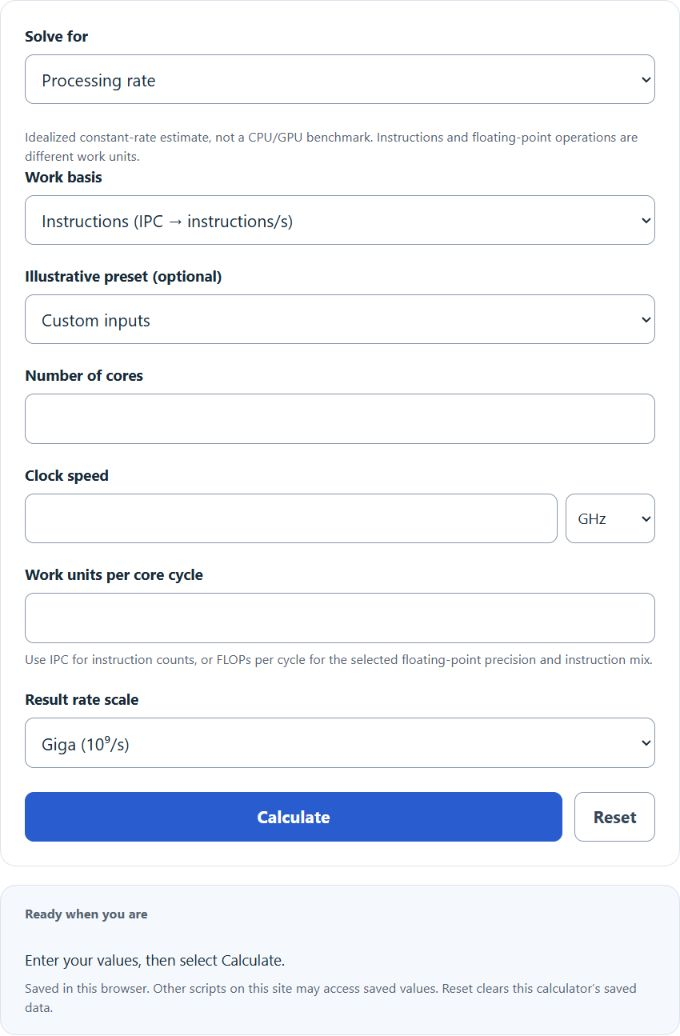
Estimate theoretical processing rate, task time, or system rate ratios from cores, clock speed, work per cycle, total work, and sustained throughput. Select instructions or floating-point operations consistently.
Processing Power Formula
The following formula is used to calculate the processing power for a given number of cores, clock speed, and instructions per cycle.
Variables:
- PP is the processing rate in GIPS when IPC means instructions per cycle; for GFLOPS, replace IPC with floating-point operations per core cycle
- N is the number of cores
- CS is the clock speed in GHz
- IPC is the average instructions per core cycle (not floating-point operations per cycle)
To calculate the processing power, multiply the number of cores by the clock speed and the instructions per cycle.
What is Processing Power?
GigaFLOPS measures billions of floating-point operations per second; GIPS measures billions of instructions per second. Multiplying cores by GHz and instructions per cycle estimates GIPS, not GFLOPS. Floating-point throughput also depends on precision, vector width and instruction mix. These idealized rates do not determine measured application speed or establish a CPU/GPU performance ranking.
How to Calculate Processing Power?
The following steps outline how to calculate the processing power.
- First, determine the number of cores (N).
- Next, determine the clock speed (CS) in GHz.
- Next, determine the instructions per cycle (IPC).
- Finally, calculate the processing power using the formula PP = N * CS * IPC.
- After inserting the values and calculating the result, check your answer with the calculator above.
Example Problem :
Use the following variables as an example problem to test your knowledge.
Number of cores (N) = 4
Clock speed (CS) = 3.5 GHz
Instructions per cycle (IPC) = 2; the theoretical instruction rate is 4 × 3.5 × 2 = 28 GIPS, not 28 GFLOPS.