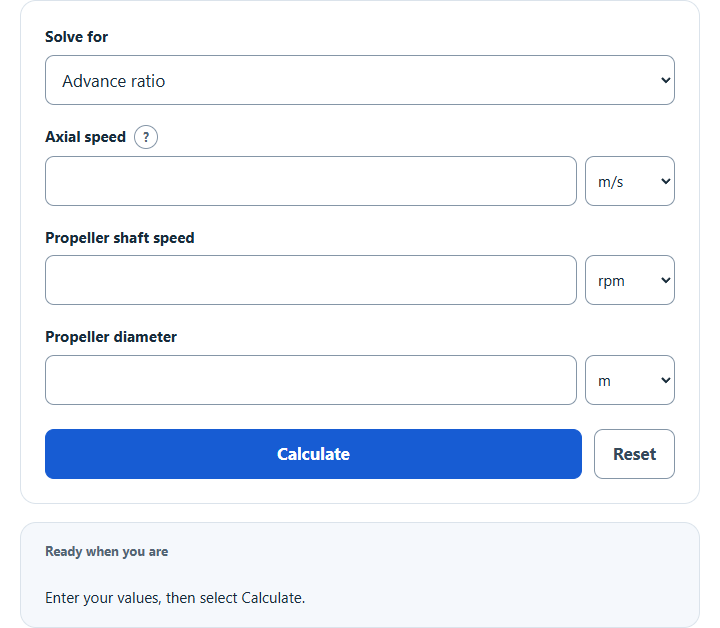
Calculate propeller advance ratio from aircraft velocity, rotational speed and diameter, plus thrust/power coefficients and efficiency.
Related Calculators
- Wing Loading Calculator
- Fan Efficiency Calculator
- Flywheel Power Calculator
- Maximum Torque Calculator
- All Physics Calculators
Calculator Functions
| Function | What it does | What it requires |
|---|---|---|
| Advance ratio | Finds the advance ratio J of a propeller | Requires the axial speed, the propeller shaft speed and the propeller diameter |
| Axial speed | Finds the forward speed that gives a chosen advance ratio | Requires the advance ratio, the propeller shaft speed and the propeller diameter |
| Rotational speed | Finds the shaft speed that gives a chosen advance ratio | Requires the axial speed, the advance ratio and the propeller diameter |
| Propeller diameter | Finds the diameter that gives a chosen advance ratio | Requires the axial speed, the advance ratio and the propeller shaft speed |
| Thrust/power coefficients and efficiency | Finds the advance ratio, thrust coefficient, power coefficient and propulsive efficiency of one operating point | Requires the axial thrust, the fluid density, the axial speed, the propeller shaft speed, the propeller diameter and the shaft power supplied |
Axial speed is entered in m/s, km/h or mph, shaft speed in rpm, rev/s or rad/s, and diameter in m, cm, mm, in or ft. Thrust is in N or lbf and shaft power in W, kW or hp. The fluid density starts at 1.225 kg/m³ for air at sea level, and fresh water is about 1,000 kg/m³.
Propeller Advance Ratio Formulas
| J | Advance ratio (no units) |
| V | Axial speed relative to the air or water (m/s) |
| n | Propeller shaft speed (rev/s) |
| D | Propeller diameter (m) |
V ÷ n is the distance the propeller moves forward in one revolution, and dividing by the diameter makes it a pure number [1]. The shaft speed must be in revolutions per second, so rpm is divided by 60 and rad/s by 2π. Speeds and lengths are converted with 0.44704 m/s per mph, 0.0254 m per inch and 0.3048 m per foot [2].
Advance ratio
This is the main formula. A 1.8 m propeller turning at 2,400 rpm, which is 40 rev/s, on an aircraft flying at 50 m/s has J = 50 ÷ (40 × 1.8) = 0.6944. At 120 mph with a 76 in propeller at 2,500 rpm, J is 0.6669.
Axial speed
An advance ratio of 0.7 at 2,400 rpm with a 1.8 m propeller means 0.7 × 40 × 1.8 = 50.4 m/s, also shown as 181.44 km/h and 112.74 mph.
Rotational speed
Holding J at 0.7 at 50 m/s with a 1.8 m propeller takes 50 ÷ (0.7 × 1.8) = 39.68 rev/s, which is 2,380.95 rpm. An advance ratio of zero is rejected here, because it cannot go with a speed above zero.
Propeller diameter
At 50 m/s and 2,400 rpm, an advance ratio of 0.7 needs a diameter of 50 ÷ (0.7 × 40) = 1.7857 m, or 70.30 in.
Thrust/power coefficients and efficiency
T is the thrust in N, P is the shaft power in W and ρ is the fluid density in kg/m³. The efficiency η is the useful power, thrust multiplied by speed, divided by the shaft power, and it equals J × CT ÷ CP [1]. A propeller giving 1,500 N at 50 m/s on 100 kW, with the 2,400 rpm and 1.8 m above in sea-level air, has CT = 0.0729, CP = 0.0675 and η = 1,500 × 50 ÷ 100,000 = 75%. Power in hp is converted at 745.6999 W per hp [2].
Limits of This Estimate
- The advance ratio is not an efficiency rating. Thrust and efficiency at a given J also depend on the propeller design, the Reynolds number and the tip Mach number [1].
- The coefficients describe the operating point that was entered. They do not predict thrust, pick a propeller or show that an installation is safe.
- The speed is the speed through the air or water, not ground speed. An efficiency above 100% means the entered thrust, speed and power do not belong together.
Sources
- Massachusetts Institute of Technology, Unified Engineering, Thermodynamics and Propulsion, Section 11.7 Performance of Propellers: advance ratio, thrust and power coefficients and efficiency
- NIST, Guide for the Use of the International System of Units (SP 811), Appendix B.8: unit factors for speed, length and horsepower