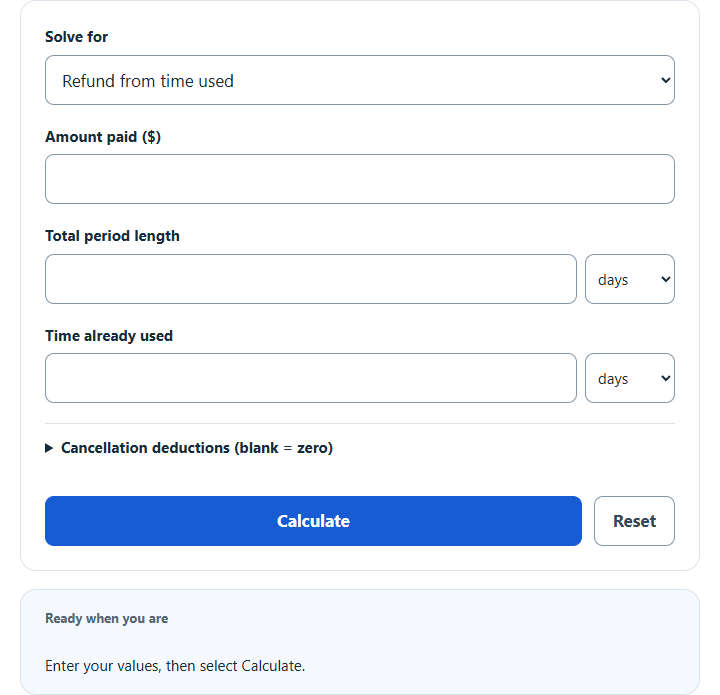
Calculate a prorated refund from the amount paid and the days, months or dates used, with optional cancellation penalty or fee for insurance or subscriptions.
Prorated Refund Formula
Where R is the pro-rata (prorated) refund, P is the amount paid, Dr is the days (or time) remaining, and Dt is the total length of the period. The fraction Dr / Dt is the share of the term you did not use, so multiplying it by what you paid returns the unused value.
When you cancel early and a short-rate penalty applies, the net refund is reduced:
Where N is the net refund, p is the penalty percentage applied to the pro-rata refund, and f is any flat cancellation fee. A pure pro-rata cancellation sets p and f to zero, while a short-rate cancellation keeps part of the premium as a penalty for ending the term early.
Typical Refund Fractions and Methods
The table below shows the fraction of time remaining and the pro-rata refund for a few common one-year scenarios on a $1,200 amount paid.
| Days Used (of 365) | Fraction Remaining | Pro-Rata Refund |
|---|---|---|
| 30 | 0.9178 | $1,101.37 |
| 91 | 0.7507 | $900.82 |
| 183 | 0.4986 | $598.36 |
| 274 | 0.2493 | $299.18 |
The next table compares the two common cancellation methods so you know which result to read.
| Method | How It Is Figured | When It Usually Applies |
|---|---|---|
| Pro-Rata | Refund equals the unused share of the amount paid, with no penalty. | When the provider cancels, or a refund is owed in full proportion. |
| Short-Rate | In this simplified model, pro-rata refund minus the entered percentage or flat fee. Actual schedules vary. | When you cancel early and the provider keeps part of the premium. |
Example Problems
Example 1. You paid $1,200 for a 365-day policy and cancel after 183 days. The time remaining is 365 minus 183, or 182 days, so the fraction remaining is 182 / 365 = 0.4986. Using the unrounded fraction, the pro-rata estimate is 1200 times (182 / 365), which is $598.36. With no penalty, that is also your net refund.
Example 2. You paid $600 for a 12-month subscription and cancel with 4 months left, and the provider applies a 10 percent short-rate penalty. The fraction remaining is 4 / 12 = 0.3333, so using the unrounded fraction, the pro-rata estimate is 600 times (4 / 12), or $200.00. The penalty is 200 times 0.10, which is $20.00, leaving a net refund of $180.00.
FAQ
What is a prorated refund? A prorated refund returns the portion of money that covers time or usage you did not consume. It is found by multiplying the amount you paid by the share of the term still remaining.
What is the difference between pro-rata and short-rate? A pro-rata refund returns the full unused share with no deduction. A short-rate refund takes that same pro-rata amount and subtracts a penalty or fee, so you receive less when you cancel early voluntarily.
How do I find the fraction of time remaining? Divide the days (or months) left in the term by the total length of the term. You can enter days directly, enter dates, or type a decimal fraction from 0 to 1. Date mode includes coverage start, excludes coverage end, and treats cancellation as the first unused day. Cancellations outside coverage give a full or zero unused share.