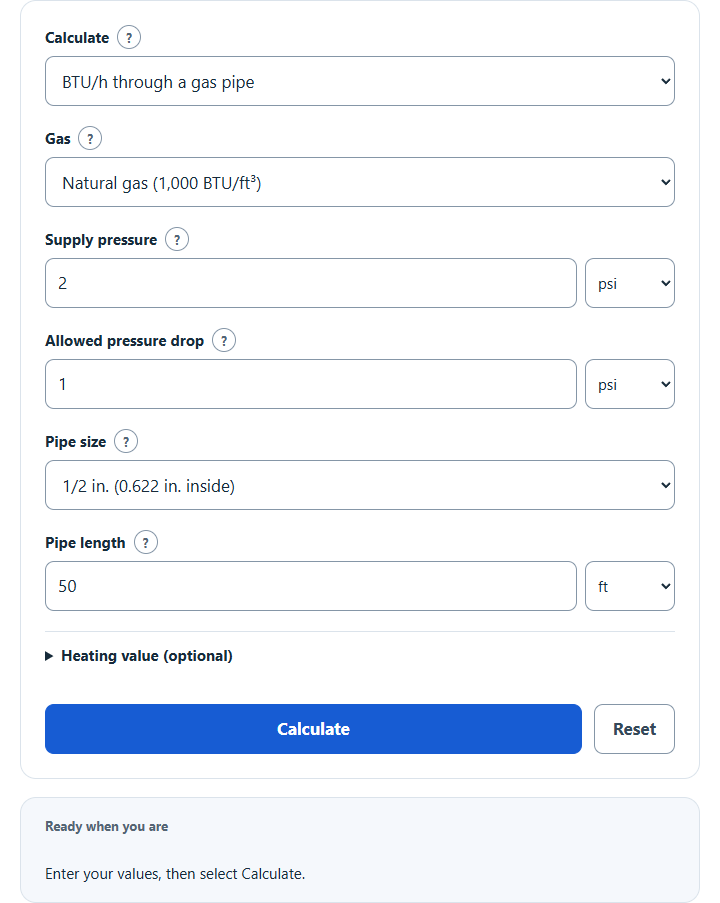
Convert a gas pressure in psi to BTU per hour for natural gas or propane, either through a gas pipe of a given size and length or through a burner orifice.
- All Construction Calculators
- Gas Piping Size Calculator
- Propane Orifice Size Calculator
- Gas Pressure To Btu Calculator
- CFH Calculator
- Pressure Volume Energy Calculator
- Btu Per Hour Calculator
Calculator Functions
A pressure in psi has no BTU value of its own. The BTU per hour depends on how much gas that pressure pushes through something, so each function asks what the gas flows through: a run of pipe or a burner orifice.
| Function | Use it when | You enter |
|---|---|---|
| BTU/h through a gas pipe | You know a gas line's supply pressure and want the BTU per hour the run can deliver | The gas, supply pressure, allowed pressure drop, pipe size and length |
| BTU/h through a burner orifice | You know the pressure behind a burner or appliance orifice and the size of its hole | The gas, pressure at the orifice, orifice diameter and orifice type |
Both functions work in psi, inches of water column or kPa, for natural gas or propane. To size a low-pressure line from a known BTU load, use the Gas Piping Size Calculator. To turn a metered gas flow into BTU per hour, use the Gas Pressure To Btu Calculator, and to pick a propane orifice for a target input, the Propane Orifice Size Calculator.
PSI to BTU Formulas
| Q | Gas flow in cubic feet per hour, measured at 60°F and atmospheric pressure |
| HV | Heating value of the gas, BTU per cubic foot |
| D | Inside diameter of the pipe, inches |
| P₁, P₂ | Absolute pressure at the inlet and at the outlet, psia (gauge pressure + 14.7) |
| Y | 0.9992 for natural gas, 0.9910 for propane |
| Cr | 0.6094 for natural gas, 1.2462 for propane |
| L | Equivalent length of the pipe, feet |
This is the fuel gas code's high-pressure equation for a supply of 1.5 psi or more [1]. The code writes it as the pipe diameter needed for a flow; solved for the flow, the exponent becomes 1 ÷ 0.381 = 2.625. Natural gas at 2 psi that may lose 1 psi along 50 ft of 1/2 in. Schedule 40 pipe has P₁ = 16.7 psia and P₂ = 15.7 psia, so X = 32.4 × 0.9992 ÷ (0.6094 × 50) = 1.0625 and Q = (18.93 × 0.622 × 1.0126)2.625 = 669 ft³/h. At 1,000 BTU per cubic foot that is 669,000 BTU/h.
The heating value turns cubic feet into BTU [2]. The calculator uses 1,000 BTU per cubic foot for natural gas, the figure in the code's worked examples [2], and 2,488 for propane [8]. Enter your supplier's figure if you have it.
Low-pressure lines (under 1.5 psi)
X = ΔH ÷ (Cr × L) [1]
Below 1.5 psi the code uses this equation, where ΔH is the pressure drop in inches of water column and 27.7 in. w.c. equal 1 psi [1]. The supply pressure doesn't appear in it: at low pressure the capacity depends on the drop the run is allowed, not on the pressure it starts from. A 7 in. w.c. supply that may lose 0.5 in. w.c. along 10 ft of 1/2 in. pipe carries 173 ft³/h of natural gas, or 173,000 BTU/h. The calculator switches equations at 1.5 psi, as the code does.
How the results compare with the code tables
The code also prints capacity tables for Schedule 40 pipe [1]. The natural gas tables are in cubic feet per hour and the propane tables in BTU per hour.
| Run | Code table | Calculator |
|---|---|---|
| Natural gas, 0.5 in. w.c. drop, 1/2 in., 10 ft | 172 ft³/h | 173 ft³/h |
| Natural gas, 2 psi, 1 psi drop, 1/2 in., 50 ft | 673 ft³/h | 669 ft³/h |
| Natural gas, 2 psi, 1 psi drop, 1 in., 10 ft | 5,560 ft³/h | 6,290 ft³/h |
| Natural gas, 3 psi, 2 psi drop, 3/4 in., 100 ft | 1,420 ft³/h | 1,420 ft³/h |
| Natural gas, 5 psi, 3.5 psi drop, 2 in., 50 ft | 31,200 ft³/h | 32,500 ft³/h |
| Propane, 11 in. w.c., 0.5 in. w.c. drop, 3/4 in., 50 ft | 255,000 BTU/h | 256,000 BTU/h |
| Propane, 2 psi, 1 psi drop, 1 in., 100 ft | 3,030,000 BTU/h | 3,050,000 BTU/h |
| Propane, 10 psi, 1 psi drop, 1/2 in., 10 ft | 3,320,000 BTU/h | 3,340,000 BTU/h |
Most runs agree within 1%. The code's 2 psi and 5 psi natural gas tables follow a slightly different curve and can sit several percent from the equation, about 12% lower for the 1 in. run above. Where a table covers your run and the two differ, the lower figure is the cautious one.
BTU/h through a burner orifice
√(H ÷ d) [3]
At appliance pressures the flow through an orifice follows this Bureau of Standards formula, where A is the orifice area in square inches, K the discharge coefficient, H the gas pressure in inches of water column and d the specific gravity of the gas, 0.60 for natural gas and 1.50 for propane [3]. It treats the gas as incompressible, which the Bureau found to be within 1% at city supply pressures [3]. K is the share of the ideal flow that a real orifice passes, and it depends on how the hole is made.
| Orifice in the Bureau of Standards tests | Discharge coefficient K |
|---|---|
| Sharp-edged, 90° approach | 0.605 |
| Sharp-edged, 8° approach | 0.875 |
| Drilled channel 0.10 to 0.125 in. long, 45° approach | 0.855 to 0.906 |
| Drilled channel 0.25 to 0.50 in. long | 0.865 to 0.879 |
| Drilled channel 1 in. long | 0.83 |
At pressures measured in psi the gas expands as it speeds up through the hole, so the calculator uses the compressible nozzle equations instead [4] [5]:
g ÷ √d
g = √γ × M ×
(1 + (γ − 1) × M² ÷ 2)−n
M² = 2 × (r−(γ − 1)/γ − 1) ÷
(γ − 1)
n = (γ + 1) ÷ (2 × (γ − 1))
r = 14.7 ÷ P₀
P₀ is the absolute pressure behind the orifice in psia, M the Mach number at the orifice and γ the ratio of specific heats: 1.30 for natural gas, taken as methane [6], and 1.13 for propane [7]. The constant 1609.8 carries the Bureau's velocity of 66.34 ft/s for 1 in. w.c. [3] up to atmospheric pressure, so at low pressure the two formulas agree. M can't pass 1: the flow goes sonic and chokes [4] once r falls to 0.546 for natural gas, at about 12.2 psi, or to 0.578 for propane, at about 10.7 psi. Above that point BTU/h rises in step with absolute pressure.
Propane at 10 psi behind a 0.035 in. orifice with K = 0.90 has P₀ = 24.7 psia and r = 0.595, which gives Mach 0.97, 17.8 ft³/h and 44,400 BTU/h. At 20 psi the same orifice is choked and passes 62,400 BTU/h. As a check at appliance pressure, a 0.010 in. orifice on propane at 11 in. w.c. comes to 786 BTU/h with K = 0.90, against 812 BTU/h in the National Fuel Gas Code's orifice table [8].
Why psi alone doesn't convert to BTU
Pressure is force on an area, and a BTU is an amount of energy. Pressure becomes energy only when it's multiplied by a volume: 1 psi acting through 1 cubic foot is 0.18505 BTU, so 1 BTU equals 5.404 psi·ft³, and 1 kPa acting through 1 cubic meter is 1 kJ, or 0.9478 BTU [9]. The Pressure Volume Energy Calculator does that conversion. It is a small number next to the heat in the fuel: a cubic foot of natural gas held at 2 psi stores 0.37 BTU as pressure and releases about 1,000 BTU when it burns. That is why a gas pressure turns into BTU per hour only through the flow it drives.
Limits of This Estimate
- The pipe equations assume smooth-walled pipe and the gas properties shown. Fittings, valves and regulators add resistance, so include an allowance for them in the length [2].
- The discharge coefficient is the largest unknown in the orifice result, since measured values run from 0.605 to about 0.91 [3]. The orifice method treats the gas as ideal at 60°F leaving into air at 14.7 psia, and it joins the Bureau of Standards constant to the nozzle equations, a combination no single reference tabulates. These estimates are based on the best available data and estimations.
- The heating values are nominal. Natural gas varies by supplier and propane by blend, and the result is fuel input, not the heat an appliance delivers.
- Gas piping and burner work fall under the local fuel gas code, which limits piping inside buildings to 5 psi unless listed conditions are met [1]. Use the result to check a design, not in place of sizing by a licensed installer.
Sources
- International Code Council, 2024 International Fuel Gas Code, Chapter 4: Gas Piping Installations: the low-pressure and high-pressure pipe equations and their factors, the pipe inside diameters, the capacity tables, and the 5 psi limit inside buildings
- International Code Council, 2024 International Fuel Gas Code, Appendix A: Sizing and Capacities of Gas Piping: converting between BTU per hour and cubic feet per hour with the heating value, the 1,000 BTU per cubic foot natural gas examples, and the allowance for fittings
- U.S. Bureau of Standards, Technologic Paper No. 193: Design of Atmospheric Gas Burners (1921): the low-pressure orifice formula, its velocity constant, and the measured discharge coefficients
- NASA Glenn Research Center, Mass Flow Choking: the compressible mass flow equation and choking at Mach 1
- NASA Glenn Research Center, Isentropic Flow Equations: the Mach number from the pressure ratio
- NIST Chemistry WebBook, Methane: Gas phase thermochemistry data: the heat capacity behind the specific heat ratio of 1.30
- NIST Chemistry WebBook, Propane: Gas phase thermochemistry data: the heat capacity behind the specific heat ratio of 1.13
- RegO Products, LP-Gas Serviceman's Manual (L-545): the propane heating value and specific gravity, and the National Fuel Gas Code orifice table
- NIST Special Publication 811, Appendix B.8: Factors for Units Listed Alphabetically: the psi, cubic foot and BTU factors behind the pressure-volume conversion