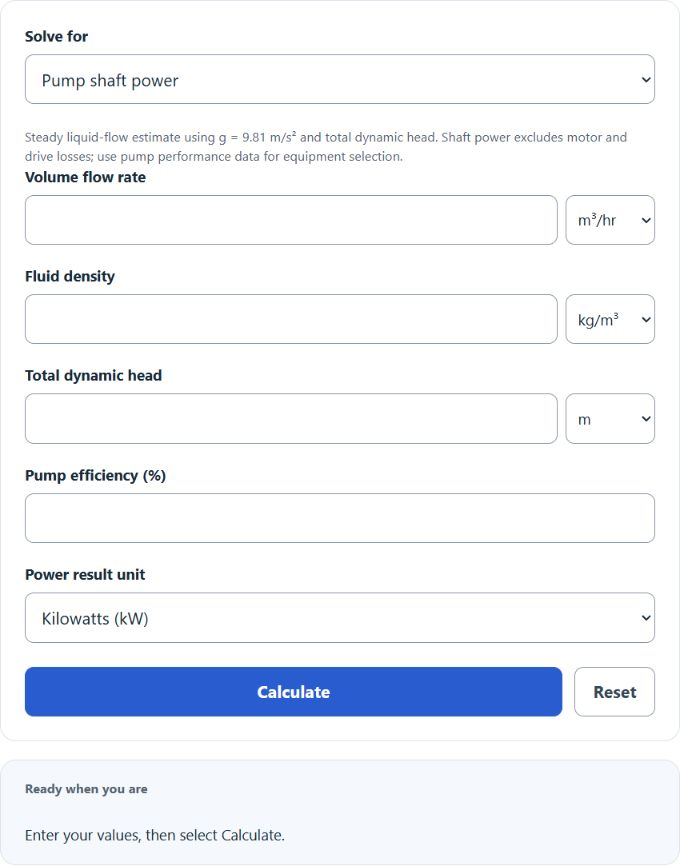
Calculate pump shaft power, flow, density, head or efficiency from the other four values using pump hydraulics and unit conversions.
Pump Shaft Power Formula
Pump shaft power is the mechanical power that must be supplied at the pump shaft so the pump can deliver a required flow rate against a given head. In practical terms, hydraulic power is the useful power transferred to the fluid, while shaft power is the larger input required after internal pump losses are considered.
The hydraulic power of the fluid is:
When flow is entered in cubic meters per hour, the calculator-friendly form is:
- Ps = pump shaft power in kW in the cubic-meters-per-hour formulas, or W in the SI formula
- Ph = hydraulic power, using the same power unit as shaft power
- q = flow rate in m3/hr
- Q = flow rate in m3/s
- ρ = fluid density in kg/m3
- g = gravitational acceleration, 9.81 m/s2 in this estimate
- h or H = total dynamic pump head in meters
- η = pump efficiency as a decimal
How this calculator is used
This calculator links five variables: flow, density, pump head, efficiency, and shaft power. Select the value to solve, then enter the other four. Zero divisors can prevent a unique inverse; pump efficiency must be greater than 0% and at most 100%. That makes it useful for pump sizing, motor selection, system checks, and troubleshooting when operating conditions change.
Rearranged forms
If you are solving manually, these equivalent forms are often useful:
How to calculate pump shaft power
- Determine the required flow rate.
- Use the correct fluid density for the liquid being pumped.
- Determine the total pump head, not just the vertical lift.
- Enter the pump efficiency. If calculating by hand, convert a percent to a decimal first.
- Compute hydraulic power, then divide by efficiency to obtain shaft power.
Example
Suppose a pump moves a fluid at 400 m3/hr with a density of 1,225 kg/m3, develops 3 m of head, and operates at 70% efficiency.
The required shaft power is approximately 5.72 kW.
What affects pump shaft power?
- Flow rate: Higher flow increases shaft power in direct proportion.
- Density: Heavier fluids require more power than lighter fluids at the same flow and head.
- Head: More developed head means more energy must be added to the fluid.
- Efficiency: Lower efficiency increases required shaft power because more input is lost internally.
Pump shaft power vs. hydraulic power
Hydraulic power is the useful energy delivered to the fluid. Shaft power is the mechanical input required at the pump shaft. Because no real pump is perfectly efficient, shaft power is greater than hydraulic power except in the idealized case of 100% efficiency.
Important application notes
- Use total dynamic head when possible, since friction losses and elevation changes both affect the required power.
- For water at ordinary conditions, density is often approximated near 1000 kg/m3, but the actual fluid value should be used for better accuracy.
- Shaft power is the demand at the pump shaft, not necessarily the electrical power drawn from the supply.
- If you are sizing a motor, also consider motor efficiency, drive losses, startup conditions, and a reasonable service margin.
- For highly viscous or non-standard fluids, real-world pump performance may deviate from simple theoretical estimates.
Common input and unit considerations
- Flow: m3/hr, L/s, or ft3/min
- Density: kg/m3 or lb/ft3
- Head: m or ft
- Power output: kW or horsepower
Frequent mistakes to avoid
- Using efficiency as 70 instead of 0.70 in hand calculations.
- Using static lift only and ignoring friction losses in the piping system.
- Mixing unit systems without converting flow, head, density, or power consistently.
- Confusing shaft power with motor input power or with hydraulic power.
- Using an estimated density that does not match the actual process fluid.
Why shaft power matters
Knowing shaft power helps verify whether a pump can meet process requirements, whether an installed motor is adequate, and how changes in fluid properties or head conditions will affect operation. It is one of the most important calculations for pump selection, energy planning, and equipment protection.