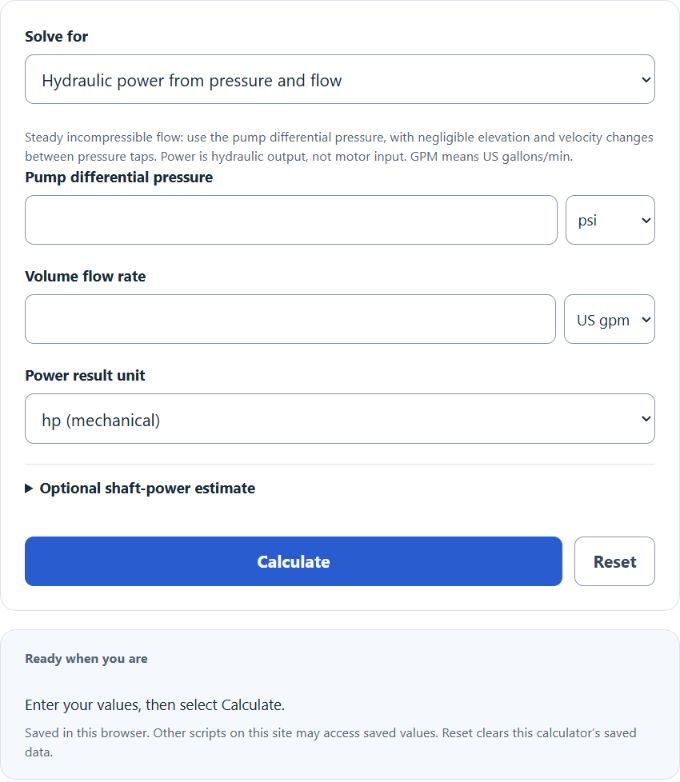
Select the unknown to calculate pump differential pressure, flow rate, or hydraulic output power from two inputs. GPM means US gallons per minute; hydraulic output differs from shaft and motor input power.
- All Electrical Calculators
- All Physics Calculators
- Pump Shaft Power Calculator
- Output Power Calculator
Pump Power Formula
The calculator uses the hydraulic horsepower relationship between pump pressure, flow rate, and pump power. In base units, pressure is in psi, flow rate is in GPM, and power is in horsepower.
- HP = hydraulic output power in mechanical horsepower
- P = pump differential pressure in psi
- Q = flow rate in US gallons per minute, GPM
- 1714.285714 = conversion constant for psi, GPM, and horsepower
To find pump pressure when power and flow rate are known, the formula is rearranged:
- P = pump differential pressure in psi
- HP = hydraulic output power in mechanical horsepower
- Q = flow rate in GPM
To find flow rate when power and pressure are known, the formula is rearranged:
- Q = flow rate in GPM
- HP = hydraulic output power in mechanical horsepower
- P = pump differential pressure in psi
Select the unknown and enter the two required values. If you choose bar, kPa, L/min, or kW, the values are converted to the base units first, the formula is applied, and the result is converted back to your selected unit.
Common Pump Unit Conversions
These are the conversion factors used to move between common pressure, flow, and power units.
| Quantity | Conversion | Base unit used by formula |
|---|---|---|
| Pressure | 1 bar = 14.5038 psi | psi |
| Pressure | 1 kPa = 0.145038 psi | psi |
| Flow rate | 1 L/min = 0.264172 GPM | GPM |
| Power | 1 kW = 1.34102 hp | horsepower |
Typical Pump Power Interpretation
The result is hydraulic power based on pressure and flow. Actual motor power is usually higher because pumps and motors are not 100% efficient.
| If the calculator gives | What it means | Practical note |
|---|---|---|
| Hydraulic horsepower | Power transferred to the fluid | Does not include efficiency losses |
| Higher pressure at same flow | Higher required power | Pressure and power are directly proportional |
| Higher flow at same pressure | Higher required power | Flow and power are directly proportional |
| Actual motor sizing | Requires efficiency adjustment | Shaft input = hydraulic power ÷ pump efficiency; motor electrical input also includes motor/drive losses |
Example Calculations
Example 1: Calculate pump power
You have a pump pressure of 1,000 psi and a flow rate of 20 GPM.
The pump power is about 11.67 hp.
Example 2: Calculate flow rate
You have a pump power of 5 hp and a pump pressure of 500 psi.
The flow rate is 17.14 GPM.
FAQ
Does this calculate hydraulic power or motor power?
It calculates hydraulic power using pressure and flow. This is the power delivered to the fluid. The actual motor power required is higher because of pump efficiency, motor efficiency, and other losses.
How do you include pump efficiency?
Divide the calculated hydraulic power by the pump efficiency as a decimal. For example, if the calculated power is 10 hp and the pump efficiency is 80%, use:
This estimates shaft input at the operating point. Motor selection also requires manufacturer performance data and application-specific limits; it is not a motor-sizing recommendation.
Why is 1714.285714 used in the pump power formula?
The number 1714.285714 is the displayed approximation to 12000/7, the unit conversion divisor that makes the formula work when pressure is entered in psi, flow is entered in GPM, and power is returned in horsepower.