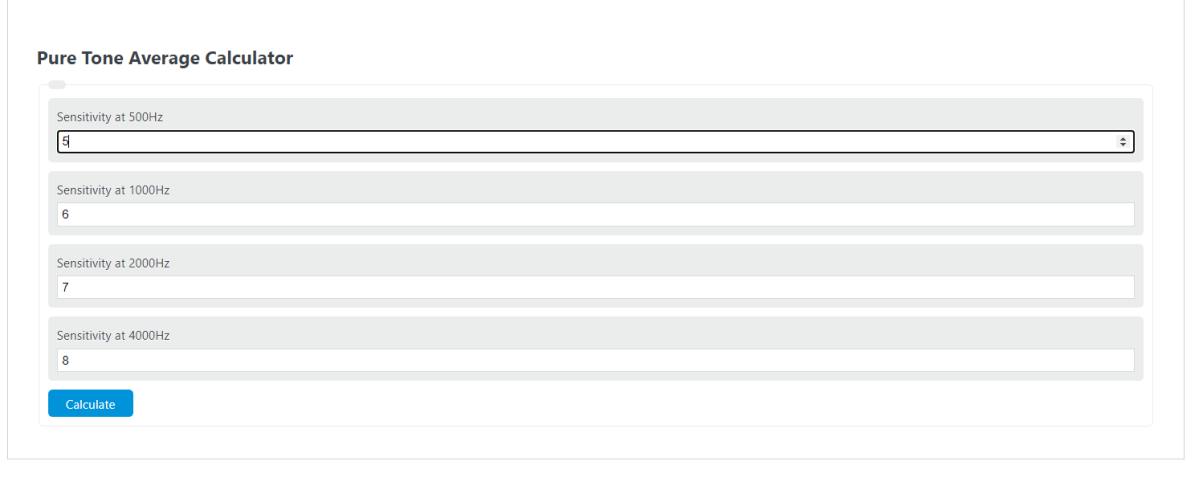
Enter the threshold levels for 500Hz, 1000Hz, 2000Hz, and 4000Hz, into the calculator to determine the pure tone average.
- All Health and Medical Calculators
- Sound Pressure Level Calculator
- Decibel Calculator
- TWA (Noise Exposure) Calculator
- Db to Percentage Calculator
Pure Tone Average Formula
The pure tone average (PTA) is a compact way to summarize hearing threshold results across the key frequencies used by this calculator: 500 Hz, 1000 Hz, 2000 Hz, and 4000 Hz. It is calculated by adding the four threshold values together and dividing by 4.
PTA = \frac{T_{500} + T_{1000} + T_{2000} + T_{4000}}{4}Where:
- PTA = pure tone average
- T500 = threshold at 500 Hz
- T1000 = threshold at 1000 Hz
- T2000 = threshold at 2000 Hz
- T4000 = threshold at 4000 Hz
In most hearing-related uses, these threshold values are recorded in dB HL. Lower threshold values generally indicate better hearing sensitivity, while higher values mean louder tones were required for detection.
How to Calculate Pure Tone Average
- Collect the threshold level at 500 Hz.
- Collect the threshold level at 1000 Hz.
- Collect the threshold level at 2000 Hz.
- Collect the threshold level at 4000 Hz.
- Add the four values together.
- Divide the total by 4.
This calculator automates those steps instantly and is useful when you want a quick summary value from an audiogram or hearing threshold dataset.
Example Calculation
If the thresholds are 10 dB HL, 15 dB HL, 25 dB HL, and 30 dB HL, the pure tone average is:
PTA = \frac{10 + 15 + 25 + 30}{4}PTA = \frac{80}{4} = 20The result is a PTA of 20 dB HL.
Solving for a Missing Threshold
Because this calculator allows you to enter 4 of the 5 fields, it can also solve for a missing threshold when the PTA is already known. Rearranging the formula gives:
T_{4000} = 4 \cdot PTA - T_{500} - T_{1000} - T_{2000}The same pattern applies if any other frequency is the missing value: multiply the PTA by 4, then subtract the other three known thresholds.
What the Pure Tone Average Tells You
The PTA reduces multiple threshold measurements into one average value, making it easier to:
- summarize hearing sensitivity for one ear at a glance,
- compare results across tests,
- support documentation and reporting, and
- identify overall changes more quickly than scanning individual frequencies alone.
PTA is useful as a summary metric, but it does not replace the full audiogram. Two people can have the same average while having very different threshold patterns across frequencies.
Inputs Used by This Calculator
| Input | Description |
|---|---|
| 500 Hz | Low-frequency threshold level |
| 1000 Hz | Mid-frequency threshold level |
| 2000 Hz | Important speech-range threshold level |
| 4000 Hz | Higher-frequency threshold level used by this calculator |
| PTA | Average of the four threshold values |
Practical Notes
- Use values from a single ear at a time. Do not mix right-ear and left-ear thresholds in the same calculation.
- Enter all thresholds in the same unit format, typically dB HL.
- If your thresholds include decimals, the PTA may also be a decimal value.
- Rounding can be done after the final calculation, not before, to preserve accuracy.
- A lower PTA usually reflects better average hearing sensitivity across the tested frequencies.
Why Average Multiple Frequencies?
Single-frequency results can be useful, but hearing ability is not represented well by one tone alone. Averaging several frequencies gives a more stable summary of overall sensitivity across a meaningful part of the hearing range. This is why PTA is commonly used as a quick reference value when interpreting threshold data.
Common Questions
Is pure tone average the same as an audiogram?
No. An audiogram is the full set of threshold measurements across frequencies. PTA is a simplified average derived from selected points on that audiogram.
Can the PTA be negative?
Yes, if one or more recorded thresholds are below 0 dB HL, the average can also be below 0. The calculator will still compute the arithmetic result correctly.
Does a higher PTA mean better hearing?
No. In threshold testing, a higher value generally means a louder sound was needed before it was heard, which usually indicates poorer average sensitivity across the tested frequencies.
Should I use this value alone to judge hearing status?
PTA is best used as a summary number. Interpretation is stronger when combined with the full audiogram, test conditions, speech testing, and clinical context.