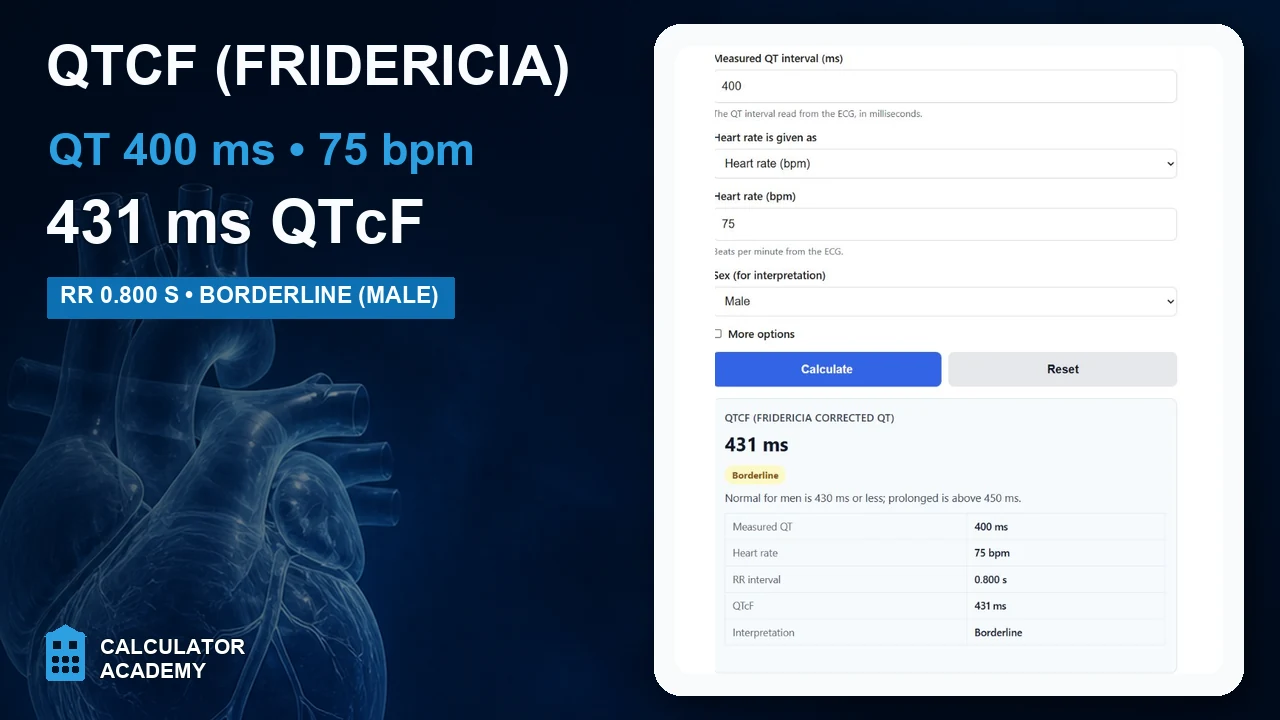
Calculate QTcF, measured QT, or RR interval by entering any two values with seconds or milliseconds using Fridericia’s correction formula.
- All Health and Medical Calculators
- R-R Interval Heart Rate Calculator
- Heart Rate Variability Calculator
- Vsepr Theory Calculator
QTcF Formula
The Fridericia formula corrects the QT interval for heart rate using the cube root of the RR interval:
Formula source: LITFL ECG Library – “QT Interval” (2024)
Variables:
- QTcF = Fridericia-corrected QT interval (ms)
- QT = measured QT interval (ms), from start of Q wave to end of T wave
- RR = RR interval (seconds) = 60 / heart rate in bpm
QTcF Reference Ranges
Sex-specific thresholds reflect an average 10 ms difference that emerges during puberty (ages 12-14) from testosterone-mediated QT shortening in males and persists throughout adulthood.
| Classification | Men | Women |
|---|---|---|
| Short QT syndrome | <340 ms | <340 ms |
| Normal | <430 ms | <450 ms |
| Borderline prolonged | 431-450 ms | 451-470 ms |
| Prolonged | >450 ms | >470 ms |
| Critical (high TdP risk) | >500 ms | >500 ms |
A QTcF above 500 ms carries substantially elevated risk of Torsades de Pointes (TdP) regardless of sex. In clinical drug trials, a single-dose increase of more than 10 ms above baseline triggers mandatory FDA reporting under ICH E14 guidelines.
Why Fridericia over Bazett?
Four correction formulas are in common use. The choice matters: Bazett and Fridericia both introduce systematic errors at heart rate extremes, while Framingham and Hodges show less bias in those conditions.
| Formula | Equation | Known Bias | Primary Use |
|---|---|---|---|
| Bazett (QTcB) | QT / √RR | Overcorrects at HR >100 bpm; undercorrects at HR <60 bpm | Historical clinical default |
| Fridericia (QTcF) | QT / RR⁹ | Overestimates drug effect at HR extremes | FDA TQT studies; oncology trials |
| Framingham (QTcFra) | QT + 0.154(1-RR) | Lowest bias across HR range | Drug-effect studies |
| Hodges (QTcH) | QT + 1.75(HR-60) | Linear; low overcorrection | Clinical research |
The FDA mandates QTcF under ICH E14 for Thorough QT/QTc (TQT) studies. The clinical significance threshold under Fridericia is a QTcF of 414 ms, compared to 460 ms under Bazett, reflecting the different scaling of the two formulas. This threshold difference is frequently overlooked when cross-referencing results between studies that used different correction methods.
Drug-Induced QT Prolongation
Acquired QT prolongation is most commonly drug-induced. The primary mechanism across drug classes is blockade of the hERG potassium channel (I₄₅ current), which delays ventricular repolarization.
| Drug Class | Examples | TdP Risk |
|---|---|---|
| Class Ia antiarrhythmics | Quinidine, disopyramide, procainamide | High (up to 10%) |
| Class III antiarrhythmics | Sotalol, dofetilide, ibutilide | High (up to 10%) |
| Fluoroquinolones | Moxifloxacin, levofloxacin | Moderate |
| Macrolides | Erythromycin, azithromycin | Moderate |
| Antipsychotics | Haloperidol, ziprasidone, thioridazine | Moderate |
| Antiemetics | Ondansetron, domperidone | Low-moderate |
| Opioids | Methadone | Moderate-high |
Risk of TdP increases with: hypokalemia, hypomagnesemia, bradycardia, female sex, age above 65, reduced ejection fraction, congenital long QT syndrome, and concomitant CYP3A4 inhibitors (such as fluoxetine or cimetidine), which elevate plasma concentrations of QT-prolonging drugs by reducing their hepatic clearance.