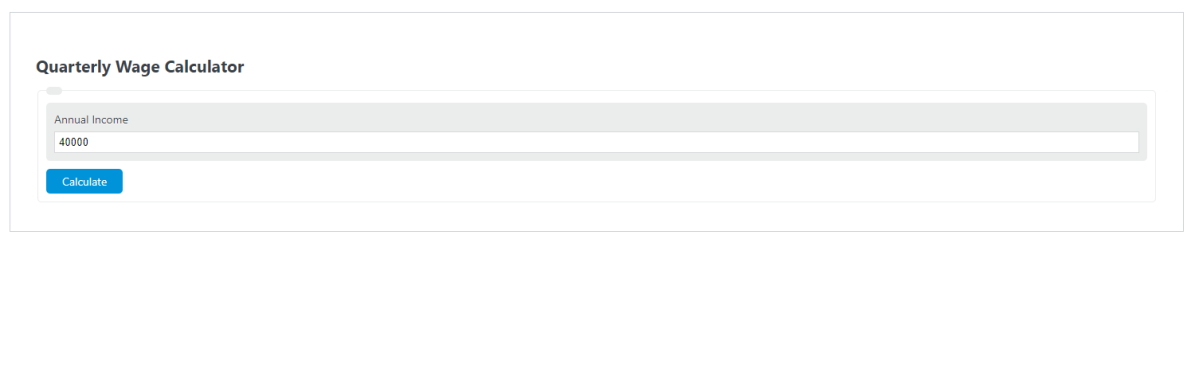
Calculate gross quarterly wages from annual salary or hourly, daily, weekly, biweekly, semimonthly, and monthly pay, or convert a quarterly amount back.
Quarterly Wage Formula
- QW = quarterly wage ($)
- AI = annual income ($)
For hourly workers: QW = Hourly Rate x Hours per Week x Weeks per Quarter. At standard full-time hours (40 hrs/week, 13 weeks/quarter), the multiplier is 520.
Fiscal Quarter Calendar
The standard calendar year divides into 4 quarters, each spanning 3 months and 13 weeks. Company fiscal years do not always align with the calendar year (Apple’s fiscal Q1 runs October through December; the U.S. federal fiscal year begins October 1), so confirm which reference point applies when comparing quarterly wages across employers or tax filings.
| Quarter | Calendar Dates | Months | Weeks |
|---|---|---|---|
| Q1 | Jan 1 – Mar 31 | January, February, March | 13 |
| Q2 | Apr 1 – Jun 30 | April, May, June | 13 |
| Q3 | Jul 1 – Sep 30 | July, August, September | 13 |
| Q4 | Oct 1 – Dec 31 | October, November, December | 13 |
US Quarterly Wage Benchmarks
The following figures are derived from U.S. Census Bureau and Bureau of Labor Statistics data. All values represent gross wages before taxes.
| Worker Category | Annual Wage | Quarterly Wage | Data Period |
|---|---|---|---|
| Median full-time year-round worker | $63,360 | $15,840 | 2024 (Census) |
| Median all workers | $51,370 | $12,843 | 2024 (Census) |
| Median weekly earnings x 13 (Q1 2025) | $62,088 | $15,522 | Q1 2025 (BLS) |
| Median household income | $83,730 | $20,933 | 2024 (Census) |
What is a Quarterly Wage?
A quarterly wage is the gross earnings for one fiscal quarter, a 3-month period representing one-fourth of the annual income. Unlike monthly pay (12 periods per year) or biweekly pay (26 periods per year), quarterly wages aggregate a full season of earnings into a single figure. The metric appears in several contexts: corporate payroll and financial reporting, the Bureau of Labor Statistics Quarterly Census of Employment and Wages (QCEW) which covers more than 95% of U.S. jobs, unemployment insurance wage records that states require employers to submit each quarter, and IRS estimated tax calculations for self-employed individuals and freelancers.
Quarterly Wages and Estimated Taxes
Self-employed individuals, freelancers, and independent contractors who expect to owe $1,000 or more in federal tax for the year are required to make quarterly estimated payments to the IRS using Form 1040-ES. The quarterly wage figure is the starting point for calculating the payment amount. The IRS safe harbor rule: pay the lesser of 90% of the current year’s expected tax or 100% of the prior year’s tax (110% if prior-year adjusted gross income exceeded $150,000) to avoid the underpayment penalty.
Note that IRS estimated tax periods do not align with standard calendar quarters. Q2 covers only 2 months (April through May), making the effective periods uneven.
| IRS Income Period | Months Covered | Payment Due Date (2025) |
|---|---|---|
| Q1 | January 1 – March 31 | April 15, 2025 |
| Q2 | April 1 – May 31 | June 16, 2025 |
| Q3 | June 1 – August 31 | September 15, 2025 |
| Q4 | September 1 – December 31 | January 15, 2026 |
How to Calculate Quarterly Wage
Example 1 – Salaried employee: Annual salary = $63,360 (2024 U.S. median for full-time, year-round workers). QW = $63,360 / 4 = $15,840 per quarter.
Example 2 – Hourly worker: $22.00/hour x 40 hours/week x 13 weeks/quarter = $11,440 per quarter ($45,760 annualized).
Example 3 – Freelancer estimated tax: Quarterly wage = $15,000 ($60,000/year). Self-employment (SE) tax applies to 92.35% of net earnings at a 15.3% rate. Quarterly SE tax = $60,000 x 0.9235 x 0.153 / 4 = approximately $2,116 per quarter, before accounting for income tax on top.