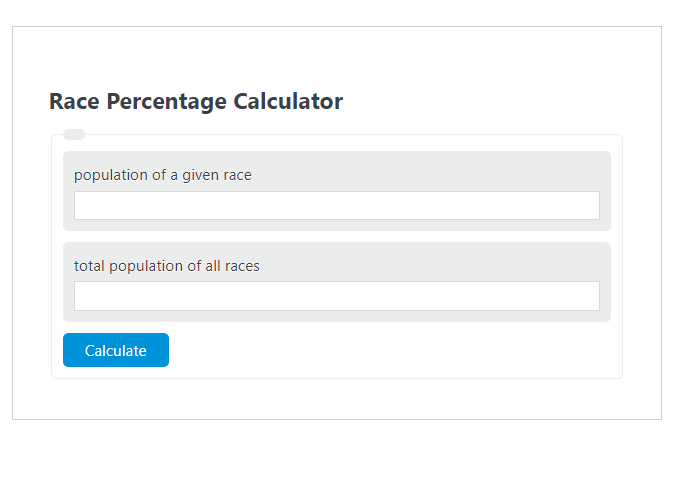
Calculate race percentage, population of a given race, or total population from any two values using population and percentage formulas.
Note: “Race” categories vary by country and dataset and are typically self-identified or defined by the data source (for example, a census). This calculator simply computes the percent share of a selected category within a total population.
- Population Proportion Calculator
- Population Density Calculator
- Population Growth Calculator
- All Sports and Fitness Calculators
Race Percentage Formula
Race percentage measures the share of a total population represented by one racial group. It is commonly used in demographic analysis, census-style summaries, community planning, school or workplace reporting, and population comparison across different locations or time periods.
Variable Definitions
- RP = race percentage
- P = population of the selected race
- TP = total population across all races in the dataset
If you already know the percentage and total population, you can also solve for the population of the selected race. If you know the percentage and the selected population, you can solve for total population.
How to Calculate Race Percentage
- Identify the population count for the race you want to measure.
- Identify the total population for the full group being analyzed.
- Divide the race population by the total population.
- Multiply the result by 100 to convert the decimal to a percentage.
The result tells you how much of the total population belongs to that specific race.
Example
Suppose a city has 12,500 people in one race category and 50,000 people total.
This means the selected race makes up 25% of the city’s total population.
How to Interpret the Result
| Result Range | Interpretation |
|---|---|
| 0% | No members of the selected race are included in the measured population. |
| Between 0% and 100% | The selected race represents that share of the total population. |
| 100% | The entire measured population falls into the selected race category. |
| Greater than 100% | The inputs are inconsistent, usually because the selected population is larger than the total population. |
Common Uses
- Summarizing demographic composition of a city, district, or region
- Comparing representation across schools, organizations, or neighborhoods
- Tracking changes in population share over time
- Preparing reports, dashboards, or community profiles
- Checking whether subgroup counts align with published percentages
Input Tips for Accurate Results
- Use population counts from the same place and the same time period.
- Make sure the total population includes every race category being counted.
- Use raw counts, not percentages, for the population fields.
- If people can be counted in more than one category, keep the same counting method for both the selected group and the total.
- The total population must be greater than zero, or the percentage is undefined.
Common Mistakes
- Dividing by the wrong total population
- Mixing data from different years or geographic areas
- Entering a percentage where the calculator expects a count
- Using a subgroup total instead of the full population total
- Rounding too early before the final percentage is calculated
Percentage vs. Percentage Points
These are not the same. If a racial share changes from 20% to 28%, the increase is 8 percentage points. Relative to the original 20%, that is a 40% increase in share. This distinction matters when comparing demographic change over time.
Frequently Asked Questions
Can the race percentage ever be negative?
No. Population counts cannot be negative, so a valid race percentage should never be negative.
What if the calculator gives a value above 100%?
That usually means the selected race population entered is larger than the total population, or the total population field does not match the same dataset.
Can this calculator solve for a missing population value?
Yes. If you know the percentage and one of the population values, the rearranged formulas above can be used to find the missing quantity.
Why is consistency in categories important?
Percentages are only meaningful when the selected race count and the total population are built from the same classification rules. Inconsistent category definitions can make the result misleading even if the arithmetic is correct.