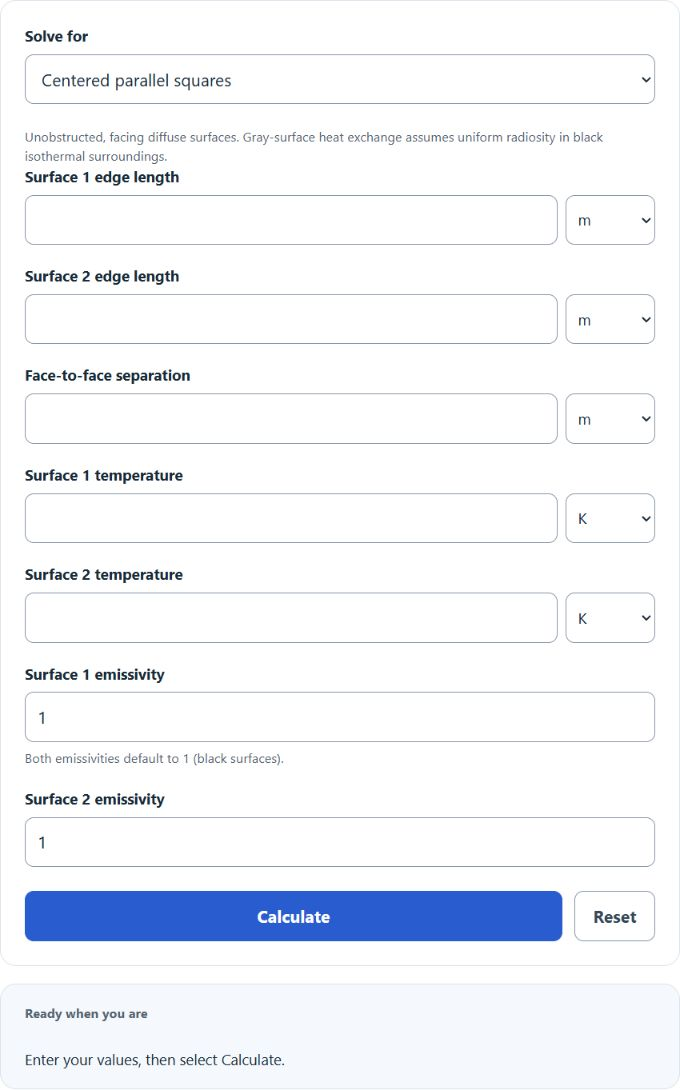
Calculate radiation view factors and net radiant heat exchange between square plates, parallel rectangles, perpendicular plates, or coaxial disks.
- All Physics Calculators
- Stefan's Law Calculator
- Emissivity Correction Calculator
- Thermal Resistance Calculator
- Heat Exchanger Effectiveness Calculator
- Heat Transfer Time Calculator
Radiation View Factor Formula
The calculator evaluates geometry-specific view factors for centered aligned parallel squares/rectangles, perpendicular rectangles sharing their full common edge, and parallel coaxial disks. It assumes unobstructed diffuse surfaces. The equation below is a separate far-field approximation for directly facing parallel surfaces when both are small compared with their separation; it is not a calculator mode.
Variables:
- F_{12} is the view factor from surface 1 to surface 2 (dimensionless, 0 to 1)
- A_2 is the area of surface 2 (m²)
- d is the line-of-sight separation between the surfaces (approximately the distance between centroids when the surfaces are small compared with d) (m)
To use this background approximation, divide the area of surface 2 by π times separation squared. Both surfaces must be small compared with separation; a value well below 1 alone does not verify those geometric assumptions. The calculator uses analytic finite-geometry relations instead. Its general definition is F₁₂ = (1/A₁)∫∫[cosθ₁ cosθ₂/(πR²)] dA₂ dA₁, with reciprocity A₁F₁₂ = A₂F₂₁.
For black surfaces, mutual pair heat exchange is q₁₂ = σA₁F₁₂(T₁⁴ − T₂⁴). Gray surfaces require the black surroundings temperature and use a uniform-radiosity approximation: J₁ = ε₁σT₁⁴ + (1−ε₁)[F₁₂J₂ + (1−F₁₂)σTₛ⁴], together with the reciprocal equation for J₂, then q₁₂ = A₁F₁₂(J₁−J₂). Surroundings fill the remaining views and do not obstruct the pair. This mutual exchange is not each surface’s total heat loss.
What is a Radiation View Factor?
The radiation view factor, also known as the configuration factor or shape factor, is a dimensionless quantity used in radiative heat transfer calculations. It represents the fraction of the radiation leaving one surface that directly reaches another surface. The view factor depends on the geometry of the surfaces and their relative orientation. It is a critical component in calculating radiative heat exchange between surfaces.
How to Calculate Radiation View Factor?
The following background example uses the far-field approximation above. For the calculator, select the actual geometry and enter positive dimensions, temperatures above absolute zero, and emissivities from greater than zero through one. Both emissivities default to one (black surfaces).
- Determine the area of surface 2 (A_2) in square meters.
- Determine the separation distance d (in meters).
- Use the approximation F_{12} ≈ A_2 / (π d^2).
- Confirm both surfaces are small compared with separation and directly face each other. Otherwise use the appropriate finite-geometry calculator mode.
- Calculate the Radiation View Factor (F_{12}).
Example Problem :
Use the following variables as an example problem to test your knowledge.
Area of surface 2 (A_2) = 0.10 m²
Distance between the surfaces (d) = 1.0 m
Using F_{12} ≈ A_2 / (π d^2): F_{12} ≈ 0.10 / (π · 1.0²) ≈ 0.0318.