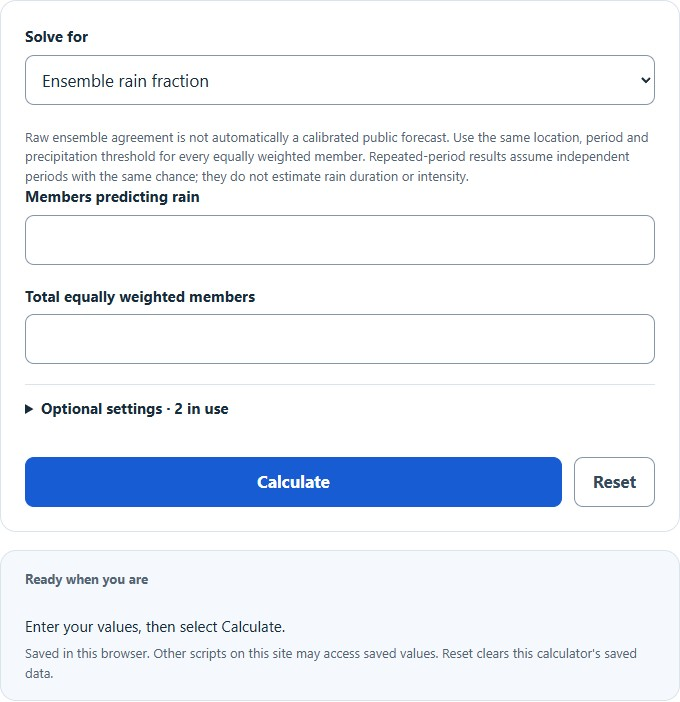
Calculate a raw equally weighted ensemble rain fraction, algebraically reverse-solve member counts, and model none, at-least-one or exact wet outcomes across independent equal-chance periods. This tool does not create a calibrated operational weather forecast.
Rain Probability Formula
The following formula is used to calculate an ensemble-member (model-vote) rain probability estimate when you have T equally weighted ensemble members and N of them predict rain for the same location, time period, and precipitation threshold. Variables:
Variables:
- RP is the ensemble-member rain probability estimate (%)
- N is the number of equally weighted ensemble members predicting the same precipitation event
- T is the total number of equally weighted ensemble members used for that same location, period and threshold
Divide the predicting members by the total and multiply by 100 to obtain the raw fraction of ensemble members indicating the same event. This is not automatically a calibrated public forecast. One NWS educational explanation uses PoP% = (C% × A%)/100, where C is confidence that precipitation occurs in the forecast area and A is the expected area coverage conditional on its occurrence. That explanation is not a separate feature of this calculator or a universal description of every operational forecast method.
What is a Rain Probability?
Rain probability, often called the Probability of Precipitation (PoP) or “chance of rain,” describes the likelihood that a given location will receive measurable precipitation during a specified forecast period. It is usually expressed as a percentage. For example, a 50% PoP means there is a 50% chance of measurable precipitation at your location during that period (not that it will rain for 50% of the time, and not that it will rain over 50% of the area). The Ensemble rain fraction mode reports the percentage of equally weighted members predicting the specified event. NWS measurable precipitation uses a threshold of at least 0.01 inch of liquid or water-equivalent precipitation; other ensembles must use their stated threshold consistently.
How to Calculate Rain Probability?
The following steps outline how to calculate the Rain Probability (RP) using the given formula:
- First, determine the number of equally weighted ensemble members predicting the specified precipitation event (N) for the same location, time period, and threshold.
- Next, determine the total number of ensemble members used (T).
- Next, use the formula RP = (N / T) * 100 to calculate the rain probability estimate.
- Finally, insert the values of N and T into the formula and compute RP.
- After calculating the result, check your answer with the calculator above.
Example Problem:
Use the following variables as an example problem to test your knowledge:
Number of ensemble members predicting rain (N) = 5
Total number of ensemble members used (T) = 10
Rain probability estimate (RP) = (5 / 10) × 100 = 50%
Inverse counts are algebraic: an exact percentage can imply a fractional member count, which is not a realizable whole-member ensemble. Rounded percentages may explain that mismatch. Repeated-period results additionally assume the same probability and independence: P(at least one) = 1 - (1 - p)^n and P(exactly k) = C(n,k) p^k (1 - p)^(n-k). Expected wet periods are n p, not rain duration; real forecast periods can be dependent.