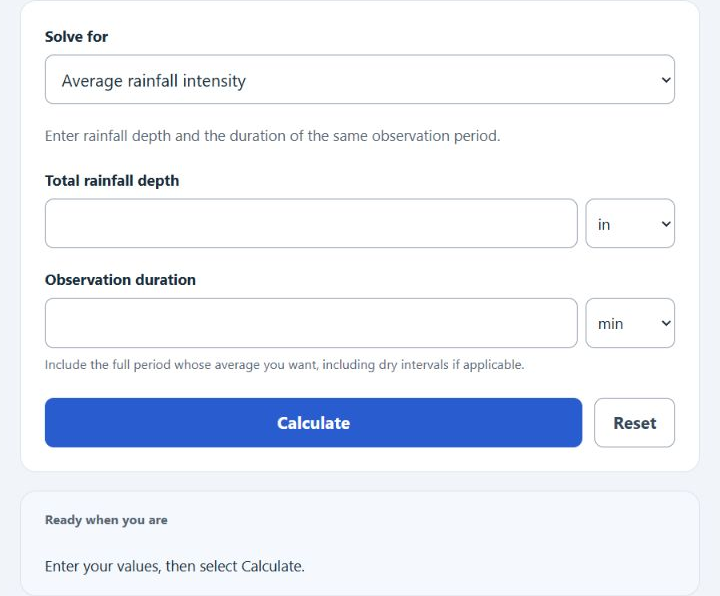
Calculate average rainfall intensity from rainfall depth and duration, or compare an entered rate with published hourly rain-intensity bands. The comparison uses NWS Boise’s 2006 light, moderate and heavy hourly bands, with the gap between 0.10 and 0.11 in/hr identified explicitly. A period average cannot determine peak intensity or flood risk.
Average Rainfall Intensity Formula
The following equation is used to calculate the Average Rainfall Intensity.
- Where ARI is the average rainfall intensity (in/hr)
- RD is the total rainfall that fell during the storm (in)
- T is the total duration of the storm (min)
To calculate average rainfall intensity, divide rainfall depth by duration in hours. With rainfall in inches and duration in minutes, use ARI = RD / (T/60). The calculator also displays mm/hr and cm/hr.
What is Average Rainfall Intensity?
Definition:
The average rainfall intensity is the amount of rainfall that a particular area receives in a given period. This can be measured in different ways and over different lengths of time.
For example, a monthly average rainfall rate divides the month’s total rainfall depth by the number of hours in that month; total monthly rainfall alone is an amount, not an intensity.
The intensity of rainfall is the rate at which it is falling. The average rainfall intensity is the total rainfall depth divided by the duration of the observation period.
Rainfall can vary significantly in intensity across a region and during a storm. A single depth-and-duration average does not describe that spatial or short-term variation.
Average rainfall intensities can be calculated from measured rainfall depths and their corresponding observation durations.
Rain gauges measure rainfall at a location, while radar estimates precipitation across an area. This calculator uses the measurements you enter and does not calibrate instruments or predict floods.