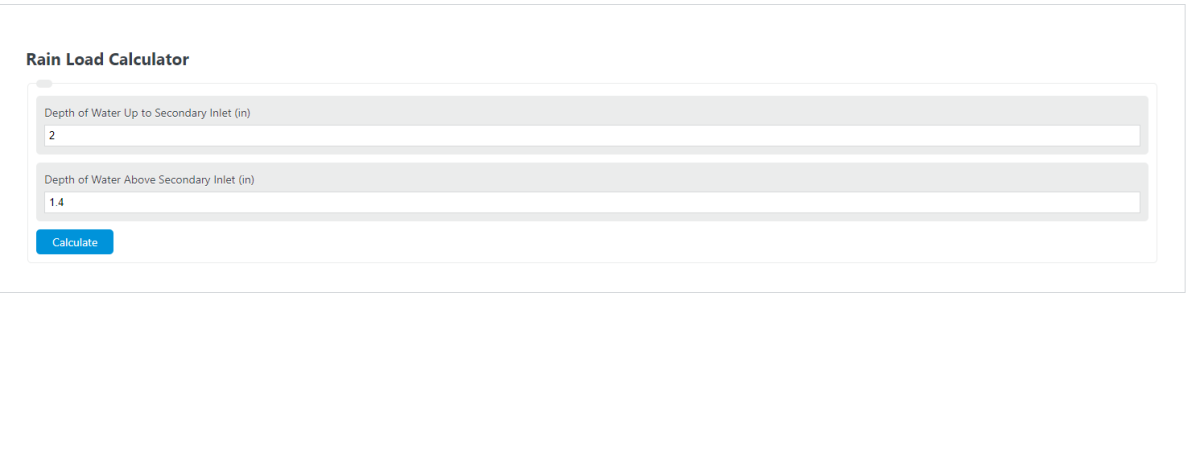
Calculate rain load from water depths up to and above a secondary inlet, or find either depth from rain load in psf, psi, or kPa units.
- All Construction Calculators
- Rain to Snow Calculator
- Inlet Capacity Calculator
- Average Rainfall Intensity Calculator
- Roof Drains Calculator
Rain Load Formula
The rain load calculator estimates the vertical pressure created by standing water on a roof. In this simplified method, the total water depth is the sum of the water depth up to the secondary inlet and the additional depth above that inlet. That total depth is then converted into a roof load.
| Variable | Meaning | Typical U.S. Units |
|---|---|---|
| RL | Rain load on the roof surface | psf |
| ds | Depth of water up to the secondary inlet | in |
| dh | Additional depth of water above the secondary inlet | in |
| ht | Total ponded water depth | in |
What the Inputs Represent
Depth of water up to the secondary inlet is the base water depth that exists before the roof reaches the level of the emergency or overflow drainage point. Depth of water above the secondary inlet is any additional accumulation once water has risen beyond that elevation. Adding both depths gives the full standing-water head acting on the roof.
How to Calculate Rain Load
- Measure the water depth from the roof surface to the level of the secondary inlet.
- Measure any extra water depth above the secondary inlet level.
- Add the two depths together to find the total water depth.
- Multiply the total depth by 5.2 when depth is expressed in inches to get rain load in psf.
This means rain load increases linearly with water depth. If the total ponded depth doubles, the calculated load also doubles.
Example
If the depth of water up to the secondary inlet is 2 in and the additional depth above the inlet is 1.4 in, the total water depth is 3.4 in.
So the roof is carrying a rain load of 17.68 psf from the standing water.
Equivalent Unit Forms
The common calculator form uses inches and psf, but the same physical relationship can be written in other consistent unit systems:
Use the first expression when depth is in feet and load is in psf. Use the second when depth is in meters and load is in kPa. If you use the calculator inputs directly, the unit conversion is handled for you.
Why Rain Load Matters
- Standing water adds uniform pressure over the roof area.
- Higher water depth increases stress on decking, joists, beams, and connections.
- Roof deflection can encourage more ponding, which may further increase load.
- Blocked drains, undersized drainage, or poor slope can make rain load more critical.
Common Input Mistakes
- Mixing units: keep both depth values in the same unit system before applying a manual formula.
- Ignoring the second depth term: the load depends on the full water depth, not just the depth to the secondary inlet.
- Using rainfall amount instead of ponded depth: the formula is based on standing water depth on the roof.
- Assuming drainage is perfect: real conditions may produce higher local water depths if drains or scuppers are obstructed.
Practical Interpretation
A calculated rain load is a pressure value, not a total force. To estimate the total water force on a roof area, multiply the load by the tributary area.
Where F is total force, RL is rain load, and A is roof area. This is useful when comparing ponded-water effects across different roof sections.
Rain Load FAQ
- Is rain load the same as snow load?
- No. Rain load is based on liquid water depth, while snow load depends on accumulated snow and its density.
- Why does the formula use 5.2?
- Each inch of standing water adds about 5.2 pounds per square foot of pressure to the roof surface.
- Can I use this calculator for flat and low-slope roofs?
- Yes, as a quick estimate of standing-water pressure. It is most relevant where drainage limitations or ponding are a concern.
- What happens if the secondary drainage is blocked?
- The actual water depth can rise beyond the assumed value, which increases the real roof load above the calculated estimate.
- Should this replace structural design checks?
- No. It is a convenient estimating tool. Final design and safety decisions should be verified against the project requirements, drainage details, and applicable structural criteria.