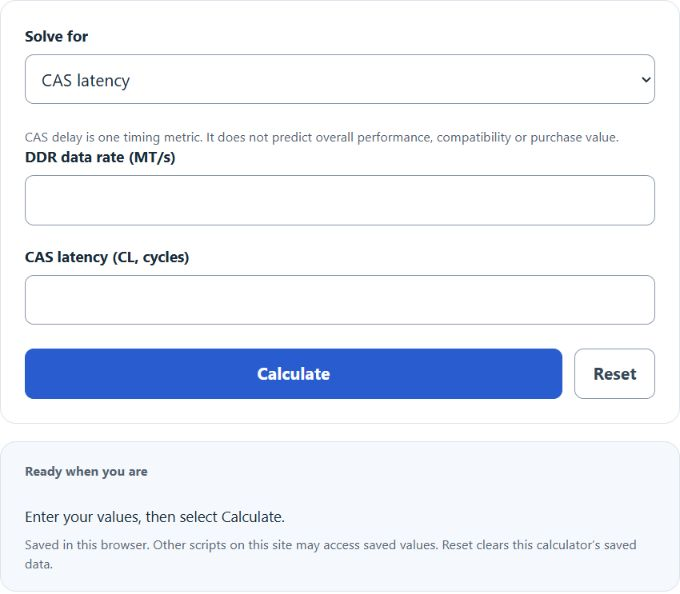
Calculate RAM true latency in nanoseconds from MT/s and CL, or compare two DDR4/DDR5 memory kits by CAS delay and an optional latency-based value index. This index does not predict overall performance or best purchase value.
RAM Value Formula
The following formula is used to calculate the RAM value (true CAS latency) in nanoseconds.
Variables:
- CL (CAS latency) is the number of memory clock cycles between a READ command and when the first data becomes available (cycles).
- Memory Clock is the actual clock rate in MHz (for DDR memory, Memory Clock = Data Rate ÷ 2).
- Data Rate is the effective DDR speed in MT/s (often marketed and mislabeled as “MHz,” e.g., “DDR4-3200”).
To calculate the RAM value, use the real memory clock in MHz, or use the DDR data rate in MT/s with the equivalent form of the formula above.
What is RAM Value?
RAM value, often referred to as true latency, is a measure of the CAS (first-word) access delay of RAM in nanoseconds. It helps you compare RAM beyond just frequency (data rate) or CAS latency alone. A lower RAM value means lower CAS delay, though overall performance also depends on bandwidth, other timings, and the workload.
How to Calculate RAM Value?
The following steps outline how to calculate the RAM Value.
- First, enter the RAM data rate in MT/s (the advertised DDR speed, such as 3200 MT/s). The calculator displays the corresponding base memory clock in MHz (half the MT/s value).
- Next, determine the CAS latency of the RAM (CL, in cycles).
- Use the formula: RAM Value (ns) = (CL / Memory Clock (MHz)) × 1000, or equivalently RAM Value (ns) = (CL × 2000) / Data Rate (MT/s).
- Finally, calculate the RAM Value (in nanoseconds).
- After inserting the variables and calculating the result, check your answer with the calculator above.
Example Problem :
Use the following variables as an example problem to test your knowledge.
Data Rate (MT/s) = 3200 (DDR4-3200), so Memory Clock = 1600 MHz
CAS Latency (CL, cycles) = 16, so RAM Value = (16 × 2000) / 3200 = 10 ns