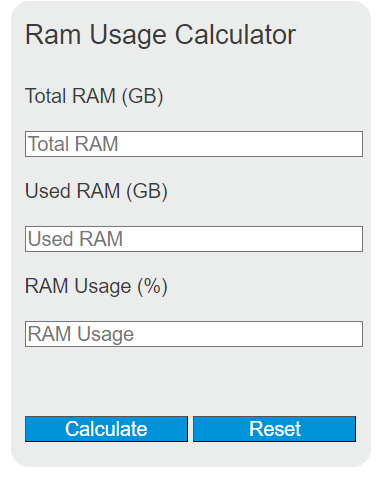
Calculate RAM usage percentage, used memory, or total RAM by entering any two values to find the missing value, with GB, MB, and TB units.
RAM Usage Formula
RAM usage measures how much of a system’s installed memory is currently occupied. This calculator is useful for checking current memory utilization, estimating remaining headroom, and solving for a missing value when you know any two of the three inputs: total RAM, used RAM, or RAM usage percentage.
| Variable | Meaning | Notes |
|---|---|---|
| RAM Usage | The percent of total memory currently in use | Reported as a percentage from 0% to 100% |
| Used RAM | The amount of memory occupied by the operating system, apps, background services, and active workloads | Use the same unit as total RAM |
| Total RAM | The total memory available to the system | Can be entered in GB, MB, or TB |
Rearranged Equations
If you know two values, you can solve for the third.
| Find | Formula |
|---|---|
| RAM Usage | RAMUsage = (RAMUsed) / (RAMTotal) × 100 |
| Used RAM | RAMUsed = RAMTotal × (RAMUsage) / (100) |
| Total RAM | RAMTotal = (100 × RAMUsed) / (RAMUsage) |
How to Calculate RAM Usage
- Identify the total RAM available to the device.
- Identify how much RAM is currently being used.
- Make sure both values use the same unit before calculating.
- Divide used RAM by total RAM.
- Multiply the result by 100 to convert it to a percentage.
This same calculator can also be used in reverse. For example, if you know total RAM and a target usage percentage, you can estimate the maximum amount of memory a workload should consume before crossing that threshold.
Example Calculations
Example 1: A system has 16 GB of RAM and 8 GB is in use.
Example 2: A workstation has 32 GB of RAM and you want to know how much memory corresponds to 75% usage.
Example 3: A process is using 12 GB of memory and that represents 60% of available RAM.
Useful Companion Calculations
RAM usage alone is helpful, but available memory and remaining headroom often make the result easier to interpret.
| Metric | Formula | Why It Matters |
|---|---|---|
| Available RAM | RAMAvailable = RAMTotal - RAMUsed |
Shows how much memory is still open for additional tasks. |
| Headroom | Headroom = 100 - RAMUsage |
Shows the percentage of memory capacity still remaining. |
How to Interpret the Result
There is no single “perfect” RAM usage percentage because the right level depends on workload, operating system behavior, and whether the machine is actively caching data. Still, these ranges are useful as a quick rule of thumb:
| RAM Usage | General Interpretation |
|---|---|
| 0%–40% | Light memory load with substantial room for more applications or browser tabs. |
| 40%–70% | Moderate usage that is common during everyday multitasking. |
| 70%–85% | Heavy usage; performance may still be fine, but available headroom is shrinking. |
| 85%–100% | Near memory limits; slowdowns become more likely if additional workloads are opened. |
Tips for Accurate Inputs
- Enter Total RAM and Used RAM in the same unit. Mixing MB and GB will produce incorrect results.
- Use the amount of RAM recognized by the operating system, not just the advertised module size.
- If your result is above 100%, the inputs are inconsistent or the units do not match.
- Short spikes in RAM usage are common. Persistent high usage combined with lag or freezing is usually more important than a brief peak.
- For planning purposes, compare current usage to a target limit such as 70% or 80% to estimate whether additional memory may be helpful.
Why RAM Usage Matters
Monitoring memory utilization helps you understand whether a system has enough capacity for current tasks. High RAM usage can reduce multitasking headroom, increase slowdowns during memory-heavy work, and make it harder to run additional applications smoothly. On the other hand, a moderate-to-high percentage is not automatically a problem if the system remains responsive and the workload is expected.
Use this calculator when you want a quick RAM usage percentage, need to estimate how much memory a program can consume before hitting a limit, or want to determine the total RAM required to support a known workload level.