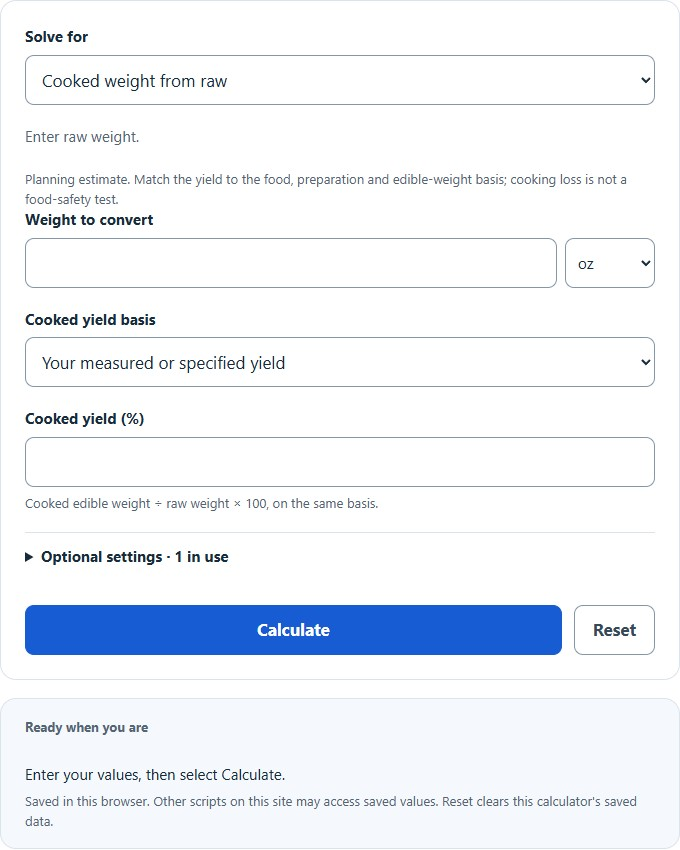
Calculate raw to cooked food weight by yield, convert dry grains or pasta, and estimate raw amounts to buy for cooked portions per person.
| Raw to Cooked | Cooked to Raw |
|---|---|
| 4 oz raw = 3 oz cooked | 3 oz cooked = 4 oz raw |
| 6 oz raw = 4.5 oz cooked | 4 oz cooked = 5.33 oz raw |
| 8 oz raw = 6 oz cooked | 5 oz cooked = 6.67 oz raw |
| 10 oz raw = 7.5 oz cooked | 6 oz cooked = 8 oz raw |
| 12 oz raw = 9 oz cooked | 8 oz cooked = 10.67 oz raw |
| 16 oz (1 lb) raw = 12 oz cooked | 10 oz cooked = 13.33 oz raw |
| 24 oz (1.5 lb) raw = 18 oz cooked | 12 oz cooked = 16 oz (1 lb) raw |
| 32 oz (2 lb) raw = 24 oz (1.5 lb) cooked | 16 oz (1 lb) cooked = 21.33 oz raw |
| 48 oz (3 lb) raw = 36 oz (2.25 lb) cooked | 24 oz (1.5 lb) cooked = 32 oz (2 lb) raw |
| 64 oz (4 lb) raw = 48 oz (3 lb) cooked | 32 oz (2 lb) cooked = 42.67 oz raw |
| Formulas: Cooked = Raw × 0.75 and Raw = Cooked ÷ 0.75. (Change the yield factor for different foods.) | |
| Dry to Cooked | Cooked to Dry |
|---|---|
| 2 oz dry rice = 6 oz cooked rice | 6 oz cooked rice = 2 oz dry rice |
| 4 oz dry rice = 12 oz cooked rice | 8 oz cooked rice = 2.67 oz dry rice |
| 6 oz dry rice = 18 oz cooked rice | 10 oz cooked rice = 3.33 oz dry rice |
| 8 oz dry rice = 24 oz cooked rice | 12 oz cooked rice = 4 oz dry rice |
| 12 oz dry rice = 36 oz cooked rice | 16 oz cooked rice = 5.33 oz dry rice |
| 16 oz (1 lb) dry rice = 48 oz (3 lb) cooked rice | 24 oz cooked rice = 8 oz dry rice |
| 24 oz (1.5 lb) dry rice = 72 oz cooked rice | 32 oz cooked rice = 10.67 oz dry rice |
| 32 oz (2 lb) dry rice = 96 oz cooked rice | 48 oz cooked rice = 16 oz (1 lb) dry rice |
| 48 oz (3 lb) dry rice = 144 oz cooked rice | 64 oz cooked rice = 21.33 oz dry rice |
| 64 oz (4 lb) dry rice = 192 oz cooked rice | 96 oz cooked rice = 32 oz (2 lb) dry rice |
| Formulas: Cooked = Dry × 3.0 and Dry = Cooked ÷ 3.0. (Illustrative assumption only; actual rice, grain and pasta weight factors depend on preparation.) | |
- All Food and Cooking Calculators
- Ham Cook Time Calculator
- Meat Shrinkage Calculator
- Meat Ratio Calculator
Cooked Weight from Raw Weight Formula
Variables:
- CW is the Cooked Weight from Raw Weight (ounces)
- RW is the total raw weight (ounces)
- Y is the cooked edible yield (%), using the same bone, skin and trimming basis
Multiply raw weight by your selected cooked yield divided by 100. At an assumed 75% yield, this is equivalent to subtracting 25%; the percentage is not universal.
How to Calculate Cooked Weight from Raw Weight?
The following steps outline how to calculate the Cooked Weight from Raw Weight.
- First, determine the total raw weight (ounces).
- Next, gather the formula from above = CW = RW * Y / 100.
- Finally, calculate the Cooked Weight from Raw Weight.
- After inserting the variables and calculating the result, check your answer with the calculator above.
Example Problem :
Use the following variables as an example problem to test your knowledge.
total raw weight (ounces) = 50; assumed cooked yield = 75%; cooked weight = 50 × 0.75 = 37.5 ounces
FAQs
What factors can affect the cooked weight of meat?
The cooked weight of meat can be affected by several factors including the type of meat, cooking temperature, cooking method (e.g., grilling, roasting, boiling), and the initial moisture content of the meat. Different meats have varying amounts of fat and connective tissue, which can influence how much weight is lost during cooking.
Why is it important to calculate the cooked weight from raw weight?
Calculating the cooked weight from raw weight is crucial for several reasons, including nutritional calculations, portion control, and cost analysis for food businesses. It helps in accurately determining the amount of food needed to serve a specific number of people and in managing food costs effectively.
Can the formula provided be used for all types of meat?
The yield must match the food and preparation. The USDA presets describe particular products and average weight yields; use a measured or specified yield for other foods. Bone, skin, trim and draining can change the edible amount.
How can I minimize meat shrinkage during cooking?
Yield varies with cut, temperature, time and cooking method. Weigh your prepared batch to establish a suitable factor and use appropriate food-safety guidance; a weight conversion does not verify safe doneness.