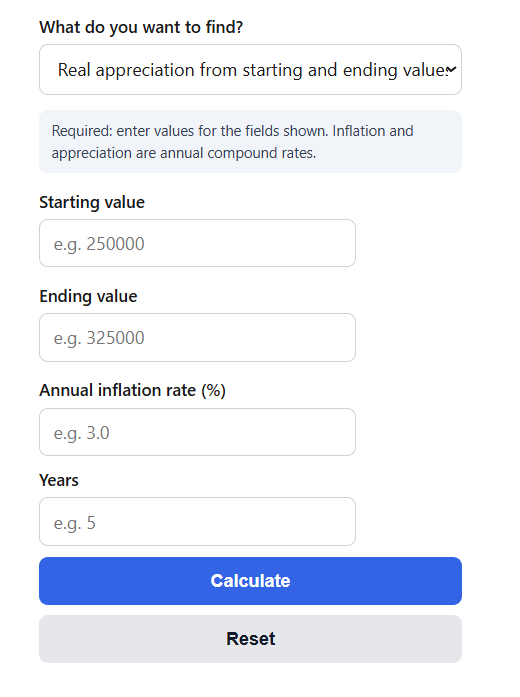
Use the Real Appreciation Calculator to remove inflation from an asset’s growth, find its real annual rate, and compare nominal and purchasing-power gains.
Real Appreciation Formula
Real appreciation measures growth after removing the loss of purchasing power caused by inflation. First calculate the nominal compound annual appreciation rate from the starting value, ending value, and time:
r_n = (V_f / V_i)^(1/n) - 1
Then use the exact Fisher relationship to remove inflation:
r_real = (1 + r_n) / (1 + i) - 1
The ending value expressed in starting-year purchasing power is:
V_f,real = V_f / (1 + i)^n
Variables:
- r_n is the nominal annual appreciation rate
- r_real is the real annual appreciation rate
- V_i is the starting value
- V_f is the ending value
- i is the annual inflation rate, written as a decimal
- n is the number of years
The calculator can also solve forward or backward. When you enter a target real appreciation rate, it first converts that target to the nominal rate required at the entered inflation rate, using 1 + r_n = (1 + r_real)(1 + i). It can then calculate either the required ending value or the implied starting value.
Nominal vs. Real Appreciation Rates
The approximation “nominal rate minus inflation” is close at low rates, but the exact formula accounts for compounding. The following examples use the exact relationship.
| Nominal annual appreciation | Annual inflation | Real annual appreciation |
|---|---|---|
| 3.00% | 2.00% | 0.98% |
| 5.00% | 3.00% | 1.94% |
| 8.00% | 3.00% | 4.85% |
| 10.00% | 4.00% | 5.77% |
| 2.00% | 4.00% | -1.92% |
Example Problems
Example 1: Find real appreciation from two values.
An asset rises from $100,000 to $150,000 over 10 years while inflation averages 3 percent annually. Its nominal annual appreciation rate is:
r_n = (150,000 / 100,000)^(1/10) – 1 = 4.14%.
Its real annual appreciation rate is (1.0414 / 1.03) – 1 = approximately 1.11 percent. The $150,000 ending value is worth about $111,614 in starting-year dollars.
Example 2: Find the ending value needed for a real target.
You start with $200,000 and want 2 percent real appreciation for 8 years while inflation averages 3 percent. The required nominal annual rate is (1.02 * 1.03) – 1 = 5.06 percent. The required ending value is approximately $200,000 * 1.0506^8 = $296,844.61.
Frequently Asked Questions
Can an asset appreciate nominally but lose value in real terms?
Yes. When the nominal appreciation rate is below inflation, the displayed dollar value rises more slowly than the general price level. The asset is worth more dollars but buys less than it did at the beginning, producing a negative real appreciation rate.
Why not simply subtract inflation from appreciation?
Subtracting is a useful approximation when both rates are small, but the exact calculation divides the growth factors. For example, 8 percent nominal appreciation with 3 percent inflation produces about 4.85 percent real appreciation, not exactly 5 percent.
Should I include income, rent, dividends, or maintenance costs?
This calculator measures change in the asset’s value only. For a complete investment return, include cash income and transaction, financing, tax, insurance, and maintenance costs in a separate total-return analysis. Real appreciation is most useful when the question is specifically how the underlying value changed after inflation.