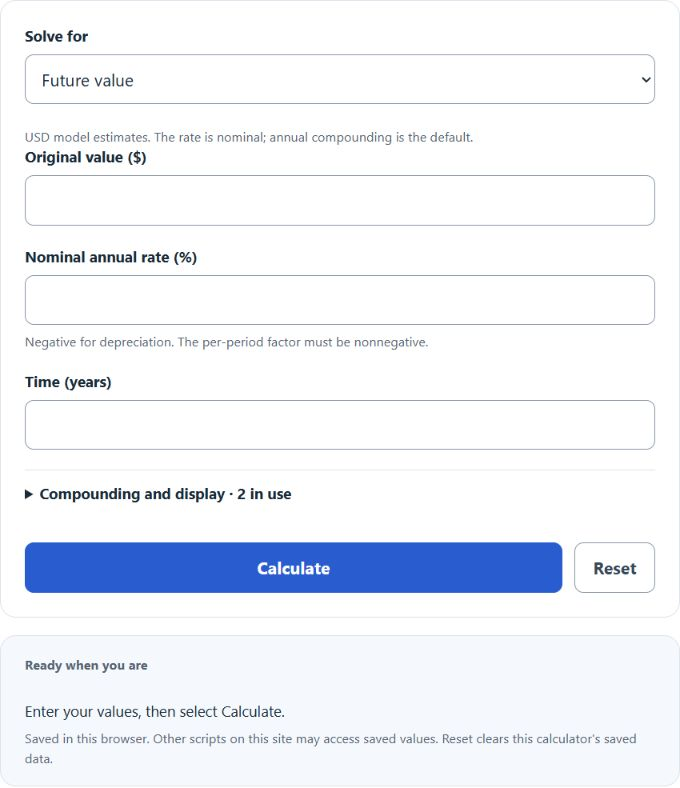
Calculate the future value, appreciation rate, original value, or time for any asset from its annual appreciation rate.
Appreciation Formula
The calculator uses the compound growth model. Each solve-for mode rearranges the same equation.
Future value:
F = P * (1 + r/m)^(m*n)
Appreciation rate:
r = m * [(F/P)^(1/(m*n)) - 1]
Original value:
P = F / (1 + r/m)^(m*n)
Time required:
n = ln(F/P) / [m * ln(1 + r/m)]
- F = future value of the asset
- P = original (or current) value of the asset
- r = annual appreciation rate, written as a decimal (5% = 0.05)
- n = time period in years
- m = number of compounding periods per year
When you solve for future value, you supply the starting value, the rate, and the number of years, and the calculator projects what the asset will be worth. The rate mode does the reverse: it takes a starting value and an ending value over a known number of years and returns the annual rate that connects them. The original value mode discounts a known future value back to today, and the time mode tells you how many years it takes to grow from one value to another at a given rate. A positive rate means the asset appreciates; a negative rate means it depreciates. The compounding setting (m) controls how often growth is applied. With annual compounding m is 1, which matches the simple appreciation formula F = P(1 + r)^n.
Illustrative Appreciation Scenarios
The following rates are hypothetical arithmetic scenarios, not observed asset-class averages, recommended defaults or forecasts. Supply a rate supported by your own scenario.
| Asset type | Hypothetical annual rate |
|---|---|
| Residential real estate | 3% to 5% |
| Broad stock market (long run) | 7% to 10% |
| Collectibles and fine art | 0% to 6% |
| New vehicles (depreciation) | -15% to -20% |
Reading the result: a total change near 0% means the asset roughly held its value, a large positive percent means strong appreciation, and a negative percent means the asset lost value over the period.
| Annual rate | Growth over 10 years |
|---|---|
| 3% | +34% |
| 5% | +63% |
| 7% | +97% |
| 10% | +159% |
Example Problems
Example 1: Future value of a home. You buy a house for $250,000 and expect it to appreciate 4% per year for 5 years, compounded annually. Using F = P(1 + r/m)^(m*n) with m = 1: F = 250000 * (1 + 0.04)^5 = 250000 * 1.21665 = $304,163. The total appreciation is $54,163, a 21.7% increase.
Example 2: Finding the appreciation rate. A collectible bought for $1,200 sells for $1,900 after 8 years. Using r = m*[(F/P)^(1/(m*n)) – 1] with m = 1: r = (1900/1200)^(1/8) – 1 = 1.58333^0.125 – 1 = 0.0591, or about 5.91% per year.
Frequently Asked Questions
What is the difference between appreciation and depreciation?
Appreciation is an increase in an asset’s value over time, shown as a positive rate. Depreciation is a decrease in value, shown as a negative rate. This calculator handles both: enter a negative rate to model an asset that loses value, such as a car.
Should I use simple or compound appreciation?
Compound growth assumes that each period builds on the previous value. Actual asset prices and investment returns vary and are not guaranteed to follow this model. Set the compounding frequency to Annually for the basic compound formula F = P(1 + r)^n. Increase the frequency only if the growth is genuinely applied more often than once a year.
Why does my result differ from a simple percentage estimate?
A simple estimate like “5% per year for 10 years equals 50%” ignores compounding. Because each year grows the already larger value, the true total at 5% over 10 years is about 63%, not 50%. The gap widens as the rate and the number of years increase.