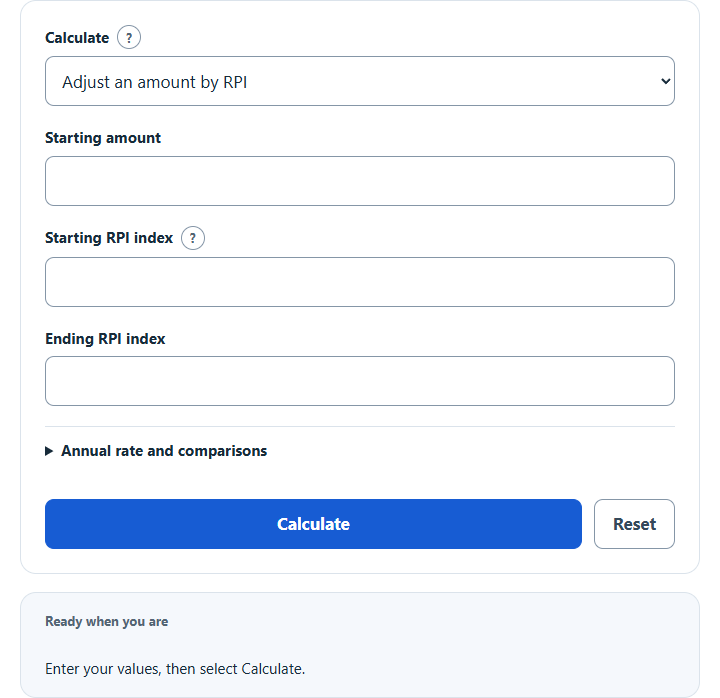
Calculate an RPI-adjusted amount from two Retail Price Index values, find the RPI percentage change, or increase rent or a price by an annual RPI rate.
RPI Formula
The RPI calculator uses the following formula to adjust an amount based on the change in the Retail Price Index:
RPI-Adjusted Amount = Starting Amount × Ending RPI ÷ Starting RPI
Where:
- Starting Amount is the original price, rent, bill, salary, or other value you want to adjust.
- Starting RPI is the Retail Price Index value at the beginning of the period.
- Ending RPI is the Retail Price Index value at the end of the period.
What Is RPI?
RPI stands for Retail Price Index. It is commonly used as a measure of inflation and tracks how the price of goods and services changes over time. Many people use RPI to adjust rents, wages, pensions, contracts, and long-term costs for inflation.
How to Use the RPI Calculator
Enter the starting amount, the starting RPI index value, and the ending RPI index value. The calculator will estimate what the original amount would be worth after adjusting for the change in RPI. You can also enter a time period to calculate the annualized rate of RPI inflation.
Example Calculation
If an amount was £1,000 when the RPI was 300, and the RPI later increased to 345, the adjusted amount would be:
£1,000 × 345 ÷ 300 = £1,150
This means the original £1,000 amount would need to increase to £1,150 to keep pace with the change in RPI.
When to Use an RPI Calculator
An RPI calculator is useful when comparing prices across different years, adjusting rent or contract amounts, estimating inflation-linked increases, or understanding how purchasing power has changed over time.