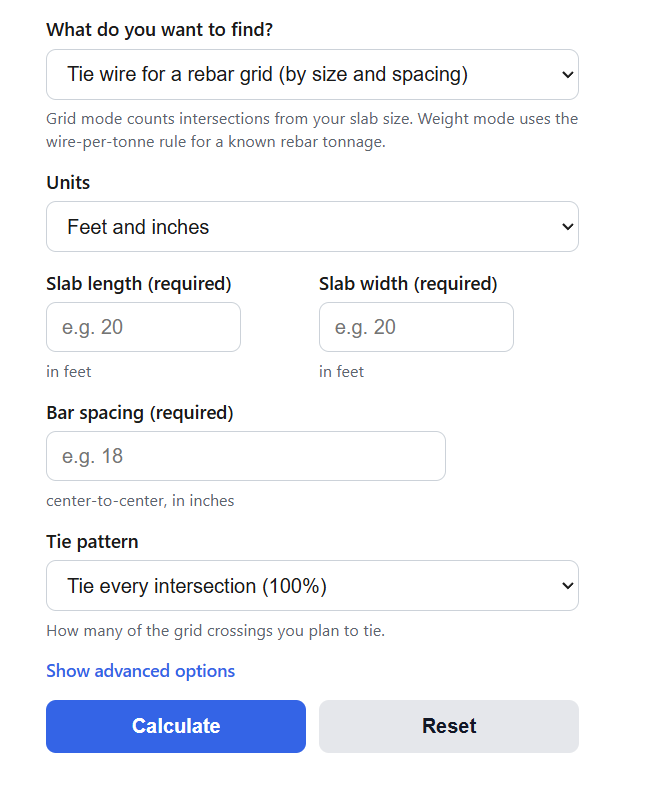
Calculate how much rebar tie wire you need from slab size and bar spacing, or from total rebar weight, including tie count, wire length, weight, and rolls.
Rebar Tie Wire Formula
The calculator works two ways. The grid method counts the crossings in your rebar mat, then turns those crossings into ties, wire length, wire weight, and rolls:
Na = ceil((L - 2*C) / S) + 1
 Nb = ceil((W - 2*C) / S) + 1
 Intersections = Na * Nb
 Ties = Intersections * P
 Wire = Ties * w * (1 + waste)
Variables:
- Na and Nb are the number of bars in each direction
- L and W are the slab length and width
- C is the edge cover, the clear distance from the slab edge to the first bar
- S is the center-to-center bar spacing
- P is the share of intersections you tie, from 0 to 1 (1 means every crossing)
- w is the length of wire used per tie
- waste is a spare allowance for miscut and twist-off, entered as a decimal
Wire weight comes from the length and the wire gauge, since heavier gauge weighs more per foot. Rolls to buy is the total weight divided by the roll weight, rounded up. The weight method skips the grid and uses the industry thumb rule for a known tonnage of steel:
Wire (kg) = (Rebar_kg / 1000) * rate * (1 + waste)
Here rate is kilograms of tie wire per tonne of rebar. It runs about 12 for small bars and drops to about 7 for the largest bars, because a tonne of thin bar has far more crossings than a tonne of thick bar. Pick your solve method at the top of the calculator. Grid mode is best when you know the slab size and spacing. Weight mode is quicker when a supplier has already given you a rebar tonnage.
Tie Wire Per Tie and How Often to Tie
Two choices drive the result more than anything else: how much wire each tie eats, and what share of crossings you actually tie. The first table gives typical wire used per tie by tie style, so you can set the wire-per-tie field with a real number instead of a guess.
| Tie type | Wire per tie | When it is used |
|---|---|---|
| Snap tie (simple twist) | 4 to 6 in (10 to 15 cm) | Fastest tie, flat mats, most slab crossings |
| Wrap and twist | 6 to 9 in (15 to 23 cm) | General purpose, holds better than a snap tie |
| Saddle tie | 8 to 10 in (20 to 25 cm) | Corners and where a straight bar meets a bent bar |
| Figure eight or double wire | 10 to 14 in (25 to 36 cm) | Heavy bars, walls, and high load areas |
The second table sets a sensible tie share for slabs and walls. Always tie every crossing around the perimeter and at lap splices, then thin out the interior based on spacing. Tighter grids can skip more crossings and still hold their shape.
| Bar spacing | Interior crossings to tie | Percent to enter |
|---|---|---|
| 4 in (100 mm) | Every 4th crossing | About 25% |
| 6 in (150 mm) | Every 3rd crossing | About 35% |
| 8 in (200 mm) | Every other crossing | About 50% |
| 12 in (300 mm) or wider | Every crossing | 100% |
These shares suit slabs on grade and other crack control mats. Structural decks, columns, and any work in a seismic zone are usually tied at every intersection, so use 100% unless your drawings say otherwise.
Example Problems
Example 1: tie wire for a slab by the grid method.
You have a 20 ft by 20 ft slab with bars at 18 in on center, 3 in cover, and you plan to tie every crossing. The bar count each way is ceil((240 – 6) / 18) + 1 = 14, so the mat has 14 by 14 = 196 crossings and 196 ties. At 8 in of wire per tie with a 10% waste allowance that is about 144 ft of wire. With 16.5 gauge wire, that length weighs about 1.3 lb, so one 3.5 lb roll covers the job.
Example 2: tie wire from a rebar tonnage.
A supplier tells you the job has 1,500 kg of #5 and #6 rebar. Medium bars use a rate near 10 kg of wire per tonne. The estimate is (1500 / 1000) times 10 times 1.10 for waste, which is about 16.5 kg, or roughly 36 lb of tie wire. That is about 11 rolls at 3.5 lb each.
Frequently Asked Questions
How much tie wire do I need per intersection?
Plan on about 4 to 6 in of wire for a fast snap tie and 8 to 14 in for a saddle or double wire tie on heavier bars. As a weight check, one pound of 16 gauge black annealed wire makes roughly 100 to 150 average ties, so a common 3.5 lb roll ties somewhere around 350 to 500 crossings depending on how much wire each tie uses.
Do I have to tie every rebar intersection?
Not always. Tie wire holds the bars in place during the pour; it does not add strength to the finished slab, so a crack control mat on grade is often tied at every crossing on the perimeter and roughly half of the interior crossings in a staggered pattern. Structural slabs, walls, columns, and seismic work are normally tied at every intersection. When in doubt, follow the project drawings or tie more rather than less.
What gauge of tie wire is standard?
Black annealed wire in 16 or 16.5 gauge is the usual choice for hand tying and for most tie tools, because it is soft enough to twist fast and strong enough to hold. Step up to 15 or 14 gauge for large bars or where ties must resist more movement, and use galvanized or stainless wire when the tie could be exposed to moisture, such as near a slab edge or with stainless rebar.