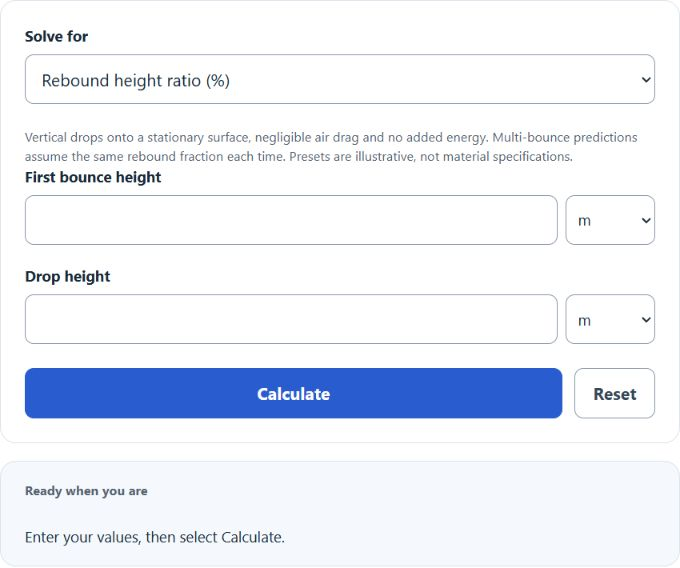
Calculate rebound ratio, bounce height, drop height, coefficient of restitution, and multi-bounce heights from drop and rebound measurements.
- All Ratio Calculators
- Digit Ratio Calculator
- All Sports and Fitness Calculators
- Trigonometric Ratio Calculator
- Inelastic Collision Velocity Calculator
Rebound Ratio Formula
The following formula is used to calculate the Rebound Ratio.
- Where REBR is the Rebound Ratio (%)
- HB is the height of the first bounce
- HD is the height of the drop
To calculate the rebound ratio, divide the first-bounce height by the drop height and multiply by 100. For a vertical passive drop, e = √(HB/HD); the height ratio is e². Multi-bounce distance ends at the last apex and assumes a constant ratio below 100%. Material presets are illustrative, not specifications.
How to Calculate Rebound Ratio?
The following example problems outline how to calculate Rebound Ratio.
Example Problem #1:
- First, determine the height of the first bounce.
- The height of the first bounce is given as 150.
- Next, determine the height of the drop.
- The height of the drop is provided as 200.
- Finally, calculate the Rebound Ratio using the equation above:
REBR = HB / HD * 100
The values given above are inserted into the equation below and the solution is calculated:
REBR = 150 / 200 * 100 = 75.00 (%)
Example Problem #2:
For this problem, the variables required are provided below:
height of the first bounce = 150
height of the drop = 300
Test your knowledge using the equation and check your answer with the calculator above.
REBR = HB / HD * 100 = ?