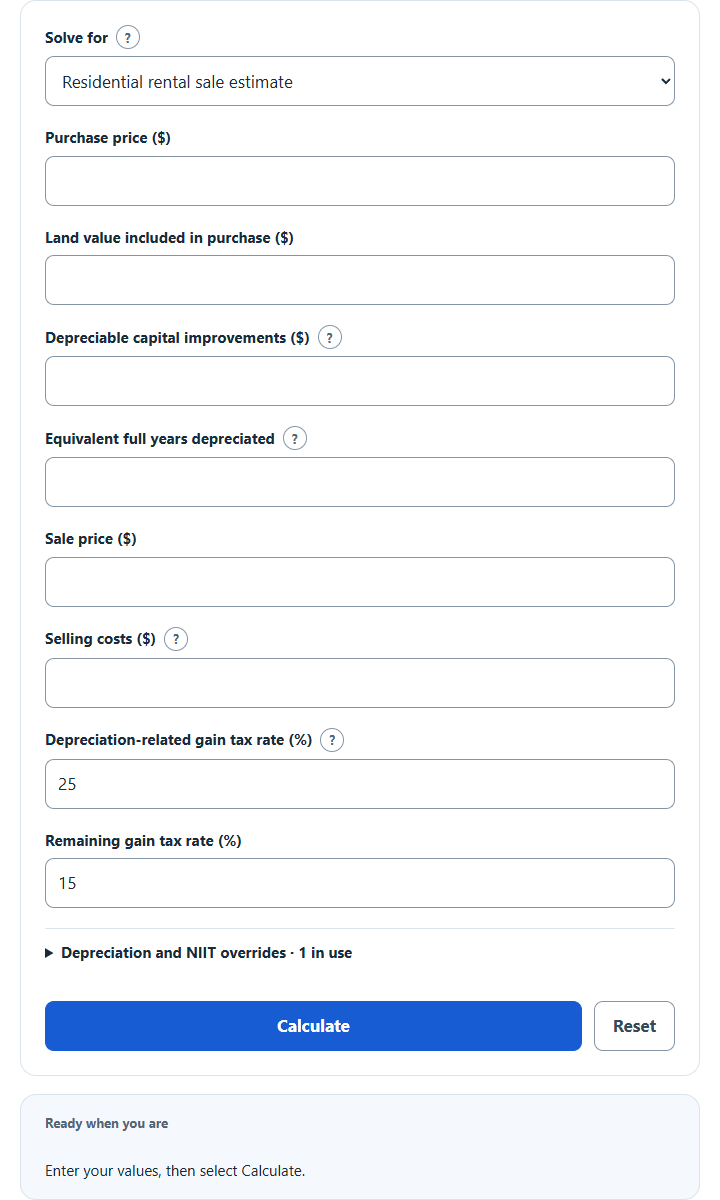
Calculate depreciation recapture tax on a rental property sale from the purchase price, land value, years rented and sale price, or your adjusted basis.
Depreciation Recapture Formula
The following formulas are commonly used to estimate the depreciation-related portion of gain (often called “depreciation recapture”) and the tax on that portion. In practice, the applicable tax treatment depends on the type of property (e.g., Section 1245 vs. real property and unrecaptured Section 1250 gain).
Variables:
- G is the realized gain ($)
- SA is the sale amount / amount realized ($) (sale price net of selling costs, if known)
- BA is the adjusted basis at the time of sale ($) (sometimes called “book value”)
- AD is the accumulated depreciation ($) (allowed or allowable)
- RA is the depreciation-related gain (recapture/unrecaptured 1250) ($)
- RT is the estimated tax on the depreciation-related gain ($)
- TR is the applicable tax rate (decimal) (if you have a percent, divide by 100)
To estimate the depreciation-related portion of gain, compute the realized gain and take the lesser of (1) accumulated depreciation and (2) the realized gain, but not less than zero. To estimate tax on that portion, multiply by the applicable rate.
What is Depreciation Recapture?
Depreciation recapture is a tax concept that can reclassify part of the gain from selling depreciable property as ordinary income (commonly for Section 1245 property) or as “unrecaptured Section 1250 gain” for most depreciated real property, generally up to the amount of depreciation previously claimed (or allowed/allowable). Any remaining gain may receive different treatment (such as Section 1231/long-term capital gain), depending on the facts.
How to Calculate Depreciation Recapture?
The following steps outline how to calculate depreciation recapture (in its most common simplified form).
- First, determine the amount realized on the sale (sale price minus selling costs, if any).
- Next, determine the adjusted basis of the asset at the time of sale.
- Next, determine the accumulated depreciation (allowed or allowable) taken on the asset.
- Compute the realized gain and the depreciation-related gain: Recapture/Unrecaptured 1250 = min(accumulated depreciation, max(0, amount realized − adjusted basis)).
- If estimating the tax on that portion, multiply the depreciation-related gain by the applicable rate and check your answer with the calculator above.
Example Problem :
Use the following variables as an example problem to test your knowledge.
sale amount / amount realized ($) = 5000
adjusted basis at the time of sale ($) = 3000
accumulated depreciation ($) = 3000
recapture tax rate (decimal) = 0.25
Then, realized gain = 5000 − 3000 = 2000. Depreciation-related gain (recapture/unrecaptured 1250) = min(3000, 2000) = 2000. Estimated tax on that portion = 2000 × 0.25 = 500.