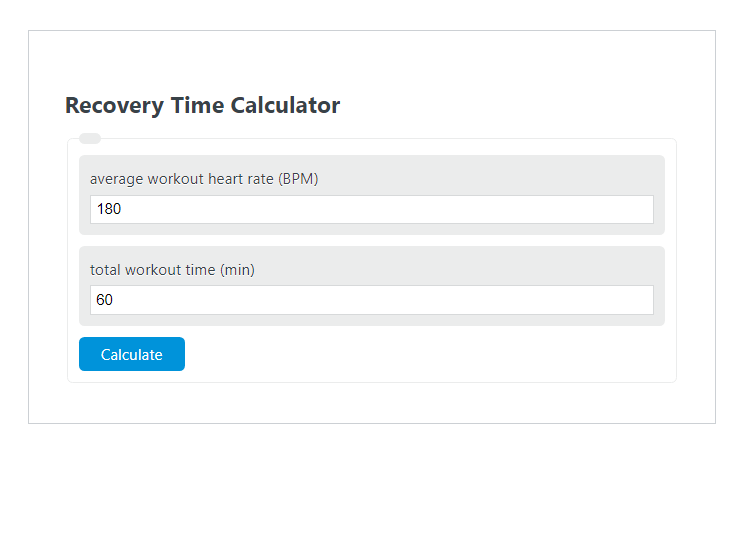
Estimate recovery time between workouts or recommended rest between sets based on workout type, duration, and training guidelines.
Related Calculators
- Pulse Rate Calculator
- Stress Test Heart Rate Calculator
- Blood Pressure By Height And Weight Calculator
- Gait Velocity Calculator
- All Health and Medical Calculators
Rest Suggestion Heuristic Formula
The recovery time calculator estimates a rest suggestion from two simple workout inputs: your average heart rate and your total workout time. It is a fast heuristic for approximating training load, not a medical recovery prescription. In practical terms, the calculator assumes that a session with more total heartbeats places a larger recovery demand on the body.
You can also think of the calculation as a two-step process. First, estimate the total beats accumulated during the workout. Then convert that workload into a rest suggestion measured in hours.
| Symbol | Description | Typical Units |
|---|---|---|
| R | Estimated rest suggestion | hours |
| HR | Average workout heart rate across the full session | beats per minute (BPM) |
| WT | Total workout time | minutes |
| B | Approximate total beats during the workout | beats |
| 200 | Scaling constant used by this calculator to convert workload into a rest estimate | beats per suggested rest hour |
How to Calculate the Rest Suggestion
- Find your average heart rate for the entire workout.
- Determine your total workout duration in minutes.
- Multiply heart rate by workout time to estimate total beats.
- Divide that value by 200 to get the rest suggestion in hours.
This model is linear, which makes it easy to interpret. If your workout time doubles while your average heart rate stays the same, the estimated rest also doubles. If your average heart rate increases while duration stays fixed, the estimate rises in the same proportion.
Example
Suppose your average workout heart rate is 160 BPM and the session lasts 30 minutes.
Under this heuristic, the workout maps to a rest suggestion of 24 hours. That does not mean every person should wait exactly one day before all activity. It means the session scores as relatively demanding according to this calculator’s workload rule.
How to Interpret the Result
- Higher values generally indicate a harder or longer session.
- Lower values usually reflect shorter duration, lower average heart rate, or both.
- The output is most useful for comparing sessions in your training log rather than predicting exact physiological recovery.
- If two workouts have similar results, they created a similar workload according to this formula, even if the exercises themselves were different.
Tips for Better Inputs
- Use your average session heart rate, not your peak heart rate.
- Include the full duration of the session unless you specifically want to measure only the active portion.
- If your device reports time in hours or seconds, convert it carefully when checking the math by hand.
- For interval sessions, remember that a single average heart rate can hide major changes in effort from one segment to the next.
What This Calculator Does Not Include
Recovery depends on much more than heart rate and duration alone. This heuristic does not account for:
- exercise type and muscular damage
- sleep quality and overall fatigue
- hydration, heat, and altitude
- training age and fitness level
- nutrition, stress, and illness
- medications or unusual heart-rate responses
Because of those missing factors, two people can complete workouts with the same average heart rate and duration yet need very different recovery times.
When This Calculator Is Most Useful
- tracking relative workout stress over time
- comparing easy, moderate, and hard training days
- planning rest days after longer or more intense sessions
- adding a simple recovery metric to a fitness journal or spreadsheet
Common Questions
- Why can the result become large so quickly?
- Total beats accumulate fast during sustained exercise, and the formula converts that workload directly into hours using a fixed divisor.
- Should I use this for all sports?
- It can be used as a general comparison tool, but it is most reliable as a simple workload estimate rather than a sport-specific recovery model.
- Is this a medical or performance-readiness test?
- No. It is a simplified planning tool designed to estimate recovery demand from session heart rate and duration.