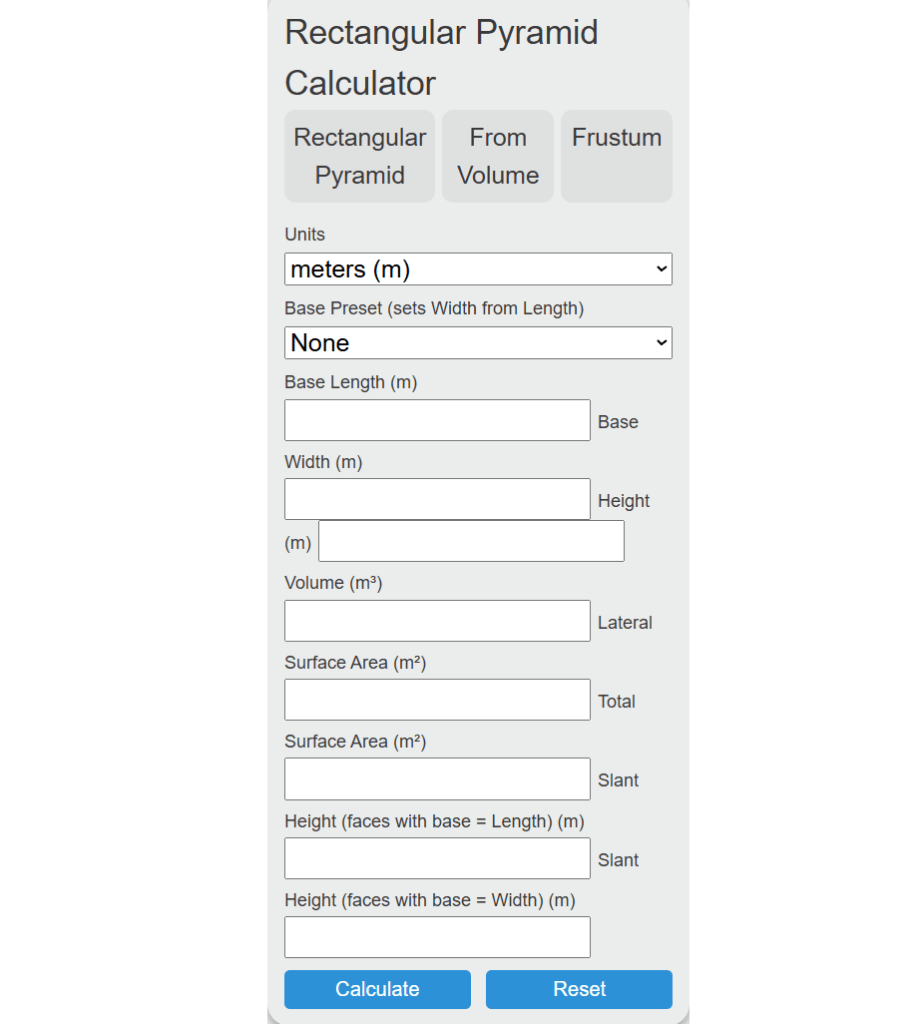
Calculate rectangular pyramid volume, surface area, slant heights, and fill level from base length, width, and height, or solve for height from volume.
Related Calculators
- Base Area Calculator
- Slant Height Calculator
- Surface Area to Volume Calculator
- Lateral Area of a Prism Calculator
- All Math and Numbers Calculators
Rectangular Pyramid Formula
The following equations are used to calculate the volume and lateral surface area of a rectangular pyramid.
Volume Formula:
- Where V is the volume of the pyramid
- l is the base length
- w is the base width
- h is the height
Multiply the base dimensions and height, then divide the product by 3 to calculate the volume.
Lateral Surface Area Formula:
- Where LSA is the lateral surface area of the pyramid
- l is the base length
- w is the base width
- h is the height
- sqrt denotes the square root function
Calculate the lateral surface area by finding the slant heights for the pyramid’s faces and summing the areas of the corresponding triangles.
What is a Rectangular Pyramid?
Definition:
A rectangular pyramid is a three-dimensional geometric shape with a rectangular base and triangular faces that converge to an apex above the center of the base. It is commonly found in architecture and used in various mathematical applications.
How to Calculate the Dimensions of a Rectangular Pyramid?
Example Problem:
The following example outlines the steps needed to calculate the volume and lateral surface area of a rectangular pyramid.
First, consider a pyramid with a base length of 10 units, a base width of 8 units, and a height of 6 units.
Next, calculate the volume using the formula above:
V = (10 * 8 * 6) / 3
V = 480 / 3
V = 160 units³
Then, calculate the lateral surface area using the formula:
LSA = 10 * sqrt((8/2)^2 + 6^2) + 8 * sqrt((10/2)^2 + 6^2)
LSA ≈ 10 * sqrt(52) + 8 * sqrt(61)
LSA ≈ 72.1111 + 62.4816
LSA ≈ 134.5927 units²
FAQ
What are the practical applications of a rectangular pyramid?
Rectangular pyramids are often used in architectural designs, art installations, and engineering projects, as well as in educational geometry problems.
Why is the volume of a pyramid one-third that of a prism with the same base and height?
This one‑third factor results from the pyramid’s tapering shape, which causes it to occupy only one‑third of the space of a prism with an identical base area and height.
Can I use this calculator for pyramids with non‑rectangular bases?
This calculator is specifically designed for rectangular pyramids; different formulas are needed for pyramids with other base shapes.