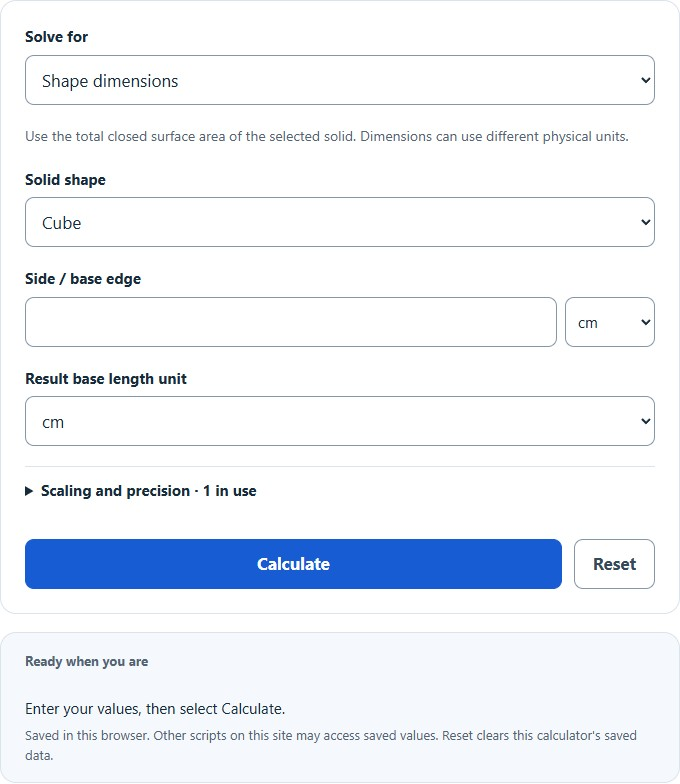
Calculate the surface area to volume ratio from shape dimensions or a known surface area and volume, or solve for the size that hits a target SA:V ratio.
- All Math and Numbers Calculators
- All Volume Calculators
- Weight to Volume Calculator
- Surface Area of a Pipe Calculator
- Gas Volume Calculator
- Volume Ratio Calculator
Surface Area to Volume Ratio
The calculator divides total exterior surface area by volume: R = SA / V. Area uses squared length units and volume uses cubed length units, so the ratio has inverse-length units. For example, 150 cm² / 125 cm³ = 1.2 per cm = 120 per m. Keep the base length unit consistent; total exterior surface area alone does not determine a unique volume without additional shape information.
The closed-solid geometry formulas include the flat disk on a solid hemisphere, both end disks of a cylinder, and the base of a cone or square pyramid. Capsule height means the straight cylindrical middle only, excluding its hemispherical ends; the capsule combines a cylinder and two hemispheres. Ellipsoid inputs are semi-axis lengths, and its surface area uses the Knud Thomsen approximation with exponent 1.6075; its derived ratio and sphericity are approximate.
Scaling every linear dimension by k multiplies surface area by k² and volume by k³, so SA:V is divided by k. Doubling every dimension halves the ratio. A cube has R = 6/a, and a sphere has R = 3/r. Target mode reverses the selected shape formula; a cylinder also requires a fixed height-to-radius ratio. The result is the size for that selected shape and aspect ratio, not a minimum across different shapes.
The equivalent-sphere diameter comes from a sphere with the same volume. Sphericity compares that sphere’s surface area with the object’s total exterior area. The isoperimetric bound gives the sphere the smallest enclosing area at a fixed volume. This check assumes the area is the complete boundary of a closed solid; partial or open surface measurements need a different interpretation.
The cross-sectional examples below describe the separate identity V = A × L for a constant cross-section. Here A is base area, not the total exterior surface area used in SA:V. Their arithmetic and units remain useful for prisms and cylinders.
Volume From Area (Cross-Section) Formula
The following formula is used to calculate volume when a shape has a constant cross-section (for example, a prism or cylinder). Here, A is the cross-sectional/base area perpendicular to the length—this is not total exterior surface area.
- Where V is the volume (ft^3)
- A is the cross-sectional (base) area (ft^2)
- L is the length (ft)
To calculate the volume from cross-sectional area, multiply the area by the length.
| Area (sq ft) | Length (ft) | Volume (cu ft) |
|---|---|---|
| 10 | 0.5 | 5 |
| 10 | 1 | 10 |
| 10 | 2 | 20 |
| 50 | 0.5 | 25 |
| 50 | 1 | 50 |
| 50 | 2 | 100 |
| 100 | 0.5 | 50 |
| 100 | 1 | 100 |
| 100 | 2 | 200 |
| 150 | 0.5 | 75 |
| 150 | 1 | 150 |
| 150 | 2 | 300 |
| 200 | 0.5 | 100 |
| 200 | 1 | 200 |
| 200 | 1.5 | 300 |
| 250 | 1 | 250 |
| 250 | 2 | 500 |
| 300 | 0.5 | 150 |
| 300 | 1 | 300 |
| 400 | 1 | 400 |
| Assumes consistent units: area in square feet and length in feet. Volume is computed as V = A × L and expressed in cubic feet. | ||
How to Calculate Volume From Cross-Sectional Area?
The following example problems outline how to calculate volume from cross-sectional (base) area and length.
Example Problem #1:
- First, determine the cross-sectional (base) area (ft^2).
- The area (ft^2) is given as 500.
- Next, determine the length (ft).
- The length (ft) is provided as 30.
- Finally, calculate the volume using the equation above:
V = A * L
The values given above are inserted into the equation below:
V = 500 * 30 = 15,000 (ft^3)
Example Problem #2:
The variables needed for this problem are provided below:
cross-sectional (base) area (ft^2) = 700
length (ft) = 2
Entering these values and solving gives:
V = A * L = 700 * 2 = 1,400 (ft^3)