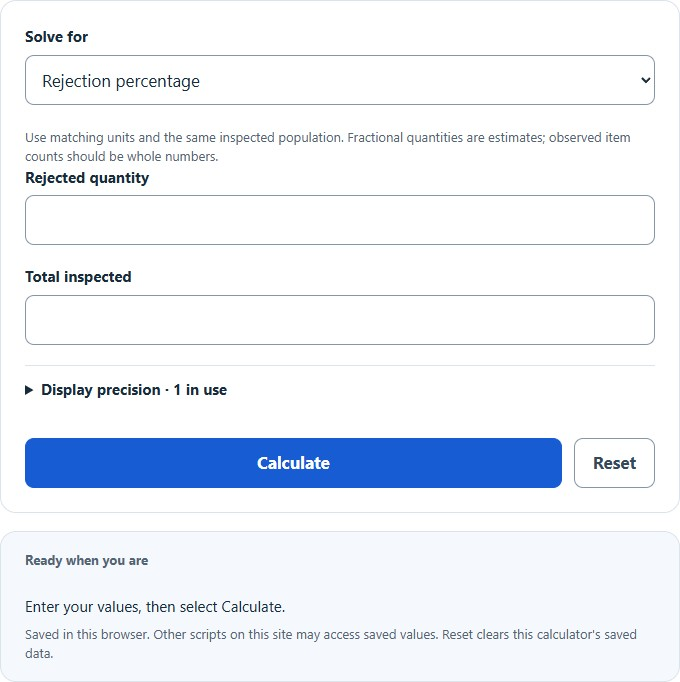
Calculate rejection percentage, total inspected or rejected quantity from the other two values. Solving total inspected requires a positive rejection percentage and rejected quantity; this is not a statistical sample-size planner.
- All Math and Numbers Calculators
- Failure Rate Calculator
- Defect Rate Calculator
- Rate Per 1000 Calculator
- System Reliability Calculator
- Defect Density Calculator
Rejection Percentage Formula
The following formula is used to calculate a rejection percentage.
- Where R is the rejection percentage (%)
- TR is the total number of rejected units
- TU is the total number of unique units inspected in the same cohort as TR
Divide the unique rejected units by the unique units inspected in the same cohort, then multiply by 100. Each unit is counted once and rejects cannot exceed that total. This tool assumes a binary accepted/rejected classification: its accepted quantity is the complement of rejected, not an independent release decision. A sample rejection proportion is descriptive; it does not establish the whole lot or population proportion with certainty.
Rejection Percentage vs. Defect Rate vs. Scrap Rate
Rejection percentage counts rejected units in a defined inspected population, counting each unit once even if it has multiple defects. Defects per unit counts individual defects and is a different measure. A rejected unit may be reworked or scrapped; define the disposition and inspection stage before comparing rates. The NIST proportion-nonconforming guidance distinguishes unit outcomes from defect counts.
Rework rate can be defined as unique reworked units divided by the same eligible total, multiplied by 100. Rejection and rework categories may overlap, so their rates must not generally be added. A sum is valid only when the categories form a mutually exclusive partition of the same population. Investigate causes rather than inferring them from a single rate.
Illustrative PPM Conversions
Acceptable limits depend on product risk, specifications, customer agreements and the inspection method. No universal industry target or global average is established here. The following hypothetical values illustrate conversion only; they are not sector standards or evidence of acceptable quality.
| Illustrative scenario | Assumed rejection rate (PPM) | Equivalent Percentage |
|---|---|---|
| Example A | 0 to 10 PPM | 0.000% to 0.001% |
| Example B | 0 to 50 PPM | 0.000% to 0.005% |
| Example C | 10 to 50 PPM | 0.001% to 0.005% |
| Example D | 100 to 500 PPM | 0.010% to 0.050% |
| Example E | 200 PPM or less | 0.020% or less |
| Example F | Below 10,000 to 20,000 PPM | Below 1% to 2% |
| Example G | 75 PPM | 0.0075% |
| Example H | Below 25 PPM | Below 0.0025% |
To convert between rejected-unit PPM and rejection percentage: PPM = Rejection Percentage × 10,000. A 0.5% rejection rate equals 5,000 rejected units per million inspected. A numerical conversion alone does not establish compliance with a product or customer requirement.
Rejection Percentage and Six Sigma Levels
The following conventional Six Sigma table uses an assumed 1.5-sigma long-term shift. DPMO means defects per million opportunities, with the opportunity count explicitly defined. It is not automatically a rejected-unit rate or a measured process capability. Only a single binary opportunity per unit makes the corresponding proportions directly comparable.
| Sigma Level | DPMO | DPMO ÷ 10,000 (%) | Opportunity yield |
|---|---|---|---|
| 1 | 691,462 | 69.15% | 30.85% |
| 2 | 308,538 | 30.85% | 69.15% |
| 3 | 66,807 | 6.68% | 93.32% |
| 4 | 6,210 | 0.62% | 99.38% |
| 5 | 233 | 0.023% | 99.977% |
| 6 | 3.4 | 0.00034% | 99.99966% |
Under this shifted convention, six sigma corresponds to about 3.4 defects per million opportunities. It does not mean 3.4 rejected units per million unless one binary opportunity per unit is defined. A rejection percentage alone cannot identify sigma capability or the cause of nonconformance.
Cost of Rejection
Every rejected unit carries both direct and hidden costs. Direct costs include material and labor already invested. Hidden costs include inspection labor, disposal, production downtime for root cause investigation, replacement runs, and late-delivery penalties. A useful estimation formula:
Where R is the rejection percentage, TU is total units produced, and C_unit is the fully loaded cost per unit (materials + labor + overhead). A facility producing 50,000 units per month at $12 per unit with a 2.5% rejection rate loses $15,000 monthly in rejected product alone. Total failure costs require separate accounting for rework, scrap, replacement, inspection and consequential costs; no fixed percentage of revenue follows from the rejection rate.
Common Causes of High Rejection Rates
High rejection percentages in manufacturing typically trace back to a handful of root causes. Raw material variability is one possible cause, where incoming material properties fall outside specification due to supplier inconsistency. Machine wear and calibration drift cause dimensional deviations that worsen gradually over a production run. Environmental factors such as temperature and humidity fluctuations affect processes like injection molding, coating, and adhesive bonding. Operator error from inadequate training or fatigue accounts for a significant share of rejections in manual operations. Finally, inadequate process design, where tolerances are tighter than the process is capable of holding, creates a built-in rejection floor that no amount of operator vigilance can overcome.
Reducing Rejection Percentage
One structured framework for reducing rejection percentage is Lean Six Sigma’s DMAIC methodology (Define, Measure, Analyze, Improve, Control). In the Define phase, specific defect types are identified and prioritized using a Pareto chart, which helps identify the categories contributing most to the measured rejection count. The Measure phase establishes process capability (Cp and Cpk indices) and baseline rejection data. During Analysis, fishbone diagrams and 5-Why analysis trace rejections to root causes. The Improve phase implements countermeasures such as adjusted machine parameters, improved incoming inspection, or mistake-proofing (poka-yoke) fixtures. Control sustains gains through statistical process control (SPC) charts that trigger alerts before the process drifts out of specification. Improvement should be demonstrated with comparable before-and-after data; no particular percentage reduction is guaranteed.
Lot Rejection vs. Unit Rejection
Rejection percentage can be calculated at either the unit level or the lot level. Unit rejection percentage uses the formula above: rejected units divided by total units. Lot rejection percentage measures how many entire lots (batches) are rejected out of total lots inspected. Under the AQL (Acceptable Quality Limit) system defined in ISO 2859-1, an entire lot is accepted or rejected based on defective units found in a random sample. A lot can be rejected even if the vast majority of units conform, because the sample defect count exceeds the accept number for that AQL level. Lot rejection and unit rejection use different denominators and cannot be ordered or converted without the sampling plan and process information. When reporting rejection percentage, always specify whether it refers to units or lots.