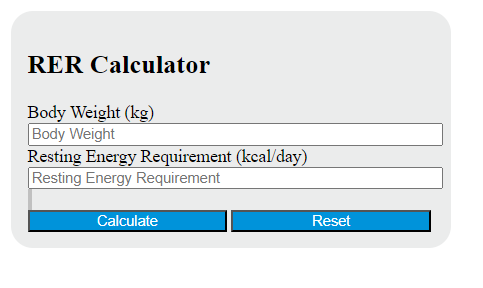
Calculate your dog or cat's daily calorie needs from weight, life stage, and activity level, with RER and MER in kcal/day for feeding.
Note: This calculator provides an educational RER estimate (a baseline used in veterinary nutrition) for dogs and cats. RER is not the same as daily calories to feed (MER/DER), which depends on life stage and health status. For individualized feeding plans—especially for puppies/kittens, pregnancy/lactation, illness/recovery, diabetes, kidney/GI disease, or weight loss—consult your veterinarian. Not for human nutrition or other species.
- All Health and Medical Calculators
- REE/RDEE (Resting-Energy-Expenditure) Calculator
- EER Calculator (Estimated Energy Requirement Calculator)
RER (Resting Energy Requirement) Formula
The Resting Energy Requirement (RER) estimates how many kilocalories per day a dog or cat needs for basic metabolic function while at rest. It is a baseline energy value, not a complete feeding recommendation. In practice, RER is often the starting point for estimating maintenance, growth, recovery, or weight-management calories.
- RER
- Resting Energy Requirement, measured in kcal/day.
- BW
- Body weight in kilograms.
If you want to reverse the equation and estimate the body weight that corresponds to a known RER value from the same formula, use:
If your pet’s weight is in pounds, convert it to kilograms first:
On pet food labels, a capitalized Calorie is the same as a kilocalorie (kcal).
How to Calculate RER
- Measure the pet’s body weight.
- Convert the weight to kilograms if needed.
- Raise body weight to the power of 0.75.
- Multiply that value by 70.
- Interpret the result as a resting daily calorie estimate.
How to Use the Calculator
- Enter the pet’s body weight.
- Select the correct unit: kilograms or pounds.
- Read the calculated RER in kcal/day.
- Use the value as a starting point for a broader feeding plan, not as the final daily feeding amount in every case.
What the Result Means
RER reflects the energy needed to support essential functions such as breathing, circulation, cellular activity, and temperature regulation while the animal is resting. Most pets need more than RER to cover normal daily life, because activity level, age, reproductive status, body condition, and medical status all change calorie needs.
That adjustment factor can vary widely. A sedentary adult, a growing puppy or kitten, a pregnant animal, a highly active dog, and a recovering patient may all have very different total calorie needs even if their RER is identical.
Examples
Example 1: 10 kg pet
Example 2: 4 kg pet
Example 3: Back-calculating weight from a known RER of 200 kcal/day
Quick Reference Table
| Body Weight | Approx. Weight | RER |
|---|---|---|
| 2 kg | 4.4 lb | 117.7 kcal/day |
| 4 kg | 8.8 lb | 198.0 kcal/day |
| 5 kg | 11.0 lb | 234.1 kcal/day |
| 10 kg | 22.0 lb | 393.6 kcal/day |
| 20 kg | 44.1 lb | 662.0 kcal/day |
| 30 kg | 66.1 lb | 897.3 kcal/day |
| 40 kg | 88.2 lb | 1113.4 kcal/day |
Why RER Matters
- Feeding plans: RER is a practical starting point for estimating how much energy a pet may need per day.
- Weight management: It helps frame calorie targets when a pet needs to gain, lose, or maintain weight.
- Clinical nutrition: It is often used as a baseline in recovery and supportive care planning.
- Diet comparison: It makes it easier to compare a pet’s energy needs with the kcal content listed on food packaging.
Important Notes
- RER is not the same as daily feeding amount. Most pets eat above resting needs.
- Use the correct body weight. For some nutrition plans, target or ideal body weight may be more appropriate than current weight.
- Small differences are normal. Actual calorie needs vary by breed, age, environment, activity, body condition, and health status.
- Monitor outcomes. Body weight, body condition score, stool quality, appetite, and energy level matter more than a calculator alone.
- This formula is primarily used for dogs and cats. It should not be treated as a universal nutrition rule for all species.
Common Questions
Why is the exponent 0.75 used?
Metabolic rate does not increase in a perfectly straight line with body weight. The 0.75 power reflects how energy use tends to scale with body size, which is why larger pets need more calories overall but fewer calories per kilogram than smaller pets.
Why does my pet’s actual food intake differ from the calculator?
Because the calculator estimates resting energy, while real-world feeding depends on movement, lean body mass, age, neuter status, growth, recovery, and body condition goals.
When should I be cautious with a calculator result?
Use extra care for puppies, kittens, pregnancy, lactation, obesity treatment, chronic disease, recovery from illness or surgery, and any pet with a veterinarian-directed diet plan.